


REAL INTELLIGENCE
& PARASOCIAL BONDS
Why do people get attached to chatbots they know feel nothing? A survey of 159 people, 112 of them users of companion AI such as Character.AI or Replika, analysed as a research study, turned into personas and journey maps, and published as an editorial series for the student media Psyder.
Solo project within Psyder, the psychology outreach media created by the M1 EPSID and PCFA students.
Companion AI is built to be talked to every day, and some people end up attached to it. I surveyed 159 people (112 users) about their use, their attachment and their ethical views. An 8-item attachment index proved reliable (α = 0.82). Attachment rises with intensity of use: 25% of occasional users report a bond against 80% of daily users, and in a logistic model only daily use (OR 3.8) and sessions over an hour (OR 3.4) remain predictive. Seeking emotional support, rather than loneliness itself, goes with the strongest bonds. Knowing that the AI feels nothing does not protect: half of those who deny it any feelings got attached. A classification of motives reveals five profiles, from the detached creator to the all-purpose user, translated into personas, an empathy map and an experience map of the path into and out of dependency. The findings point to design responsibilities: visible time, real age checks, handover to humans, and success metrics other than engagement.
The media
Psyder makes cognitive and social psychology research accessible on Instagram. It was created by the M1 EPSID and PCFA students as their project-management course, with themed teams, a design team and an admin team.
The series
A three-part series on anthropomorphism and companion AI: the mechanisms, the survey and its results, then the findings and ethics. I carried the whole series alone, from the research question to publication.
What I did
Literature review (13 sources), questionnaire design, sharing it on Reddit and through a bilingual poster, data collection, quantitative and qualitative analysis, personas and maps, writing the three carousels.
Horton & Wohl (1956)
Parasocial interaction: a one-sided relationship with a media figure who cannot answer back. Companion AI breaks the rule: the figure now answers, which makes the illusion of reciprocity far stronger.
Reeves & Nass (1996)
The media equation: people apply social rules to computers without noticing, even when they know they are machines. Politeness, trust and attachment follow.
Epley, Waytz & Cacioppo (2007)
Three factors make us anthropomorphise: available knowledge about humans, the need to understand and predict (effectance), and the need for social connection (sociality). Tested here.
Tisseron (2017)
Studying human-robot relationships as the new challenge for psychology: how will we react to their bugs, their obsolescence, their disappearance?
Devillers (2020)
Empathic machines are pseudo-affective objects: empathy is simulated by design, which moves the ethical question towards the designer.
Curiale, Tisseron et al.
Anthropomorphism as a chatbot performance lever: the projective mechanisms that cyberpsychology describes are the ones persuasive technology uses.
ELIZA
MIT / Joseph Weizenbaum
A program imitating a Rogerian therapist through simple pattern matching. Weizenbaum was disturbed to see users confide in it while knowing it was a script.
Replika
The companion AI era
The first product explicitly designed to cultivate attachment. Grief reactions were documented when the app changed its behaviour.
Character.AI
Role-play and personas
Users create the character they then talk to: they co-author the persona they project onto. 89% of the users in this survey used it.
After ChatGPT
Mass adoption
Conversational AI enters everyday life for hundreds of millions of people, and the question moves from curiosity to public health.
What leads people to form emotional bonds with an entity they know is not sentient, and what does it mean for the people who design it?
Attachment rises with intensity of use (dose effect).
ConfirmedProjecting oneself and imagining the chatbot as a person feed the bond.
Partly: true alone, weaker once intensity is controlledKnowing that the AI feels nothing does not protect from attachment.
SupportedNon-users judge these relationships more harshly than users.
ConfirmedFollowing Epley, the need for social connection drives anthropomorphism.
Nuanced: support seeking yes, loneliness noMinors use companion AI more intensely than adults.
Partly: longer sessions, daily use not significant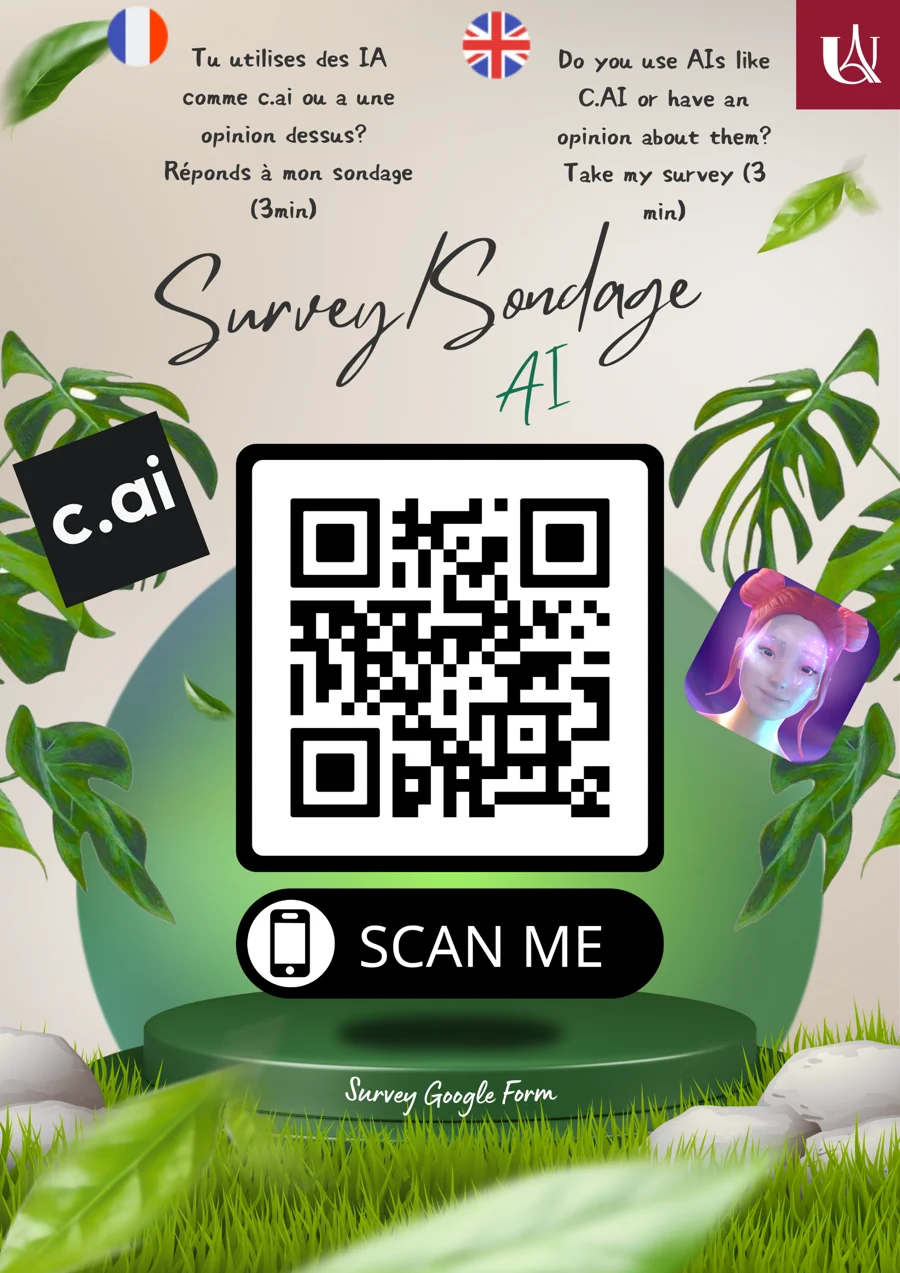
159 respondents recruited online in May 2025, mostly through posts on Reddit, with a bilingual poster and QR code as a complement. 112 had used a companion AI, 47 never had. Anonymous questionnaire, no identifying data collected.
Google Forms, 26 questions in 5 blocks: profile (3), usage (5), attachment and projection (8), ethics (7), open questions (2). A filter question sent non-users to the opinion block.
Frequencies on the right base (users or all) with 95% Wilson confidence intervals.
Attachment index built from 8 items, reliability checked with Cronbach's alpha and item-rest correlations, rescaled 0 to 100.
Chi-square tests with Cramér's V, Cochran-Armitage trend test and Spearman correlation for dose effects, multivariate logistic regression for predictors of the bond.
Agglomerative hierarchical clustering (Ward) on the six usage motives, number of groups chosen with the silhouette score.
Thematic coding of the 62 meaningful open answers, word frequencies, and coding of the accounts of quitting.
Data-driven personas and a 2x2 matrix from the clusters; affinity diagram, jobs to be done, empathy map, experience map and storyboard built only from respondents' answers; then an opportunity tree, design principles and an interview guide for the next step.
Age (all respondents, N=159)
Gender (N=159)
A young sample: 28% are minors and 77% are at school or university. Use is widespread in every age group, from 62% among 18-24 year olds to 90% among 11-14 year olds.
Why they use them (several answers)
What they expect from a chatbot (several answers)
Platforms used (several answers)
Eight questions measure the same thing: a reliable attachment index (α = 0.82).
Perceived personality, emotional bond, imagining it as a person, projection, intense emotions, preferring it to people, loss if it disappeared, feeling better understood. Each item correlates with the others (item-rest 0.38 to 0.70), so they can be combined into one score from 0 to 100. Average: 44.
Distribution of the attachment index (users)
Projected part of themselves
Identity, experiences, traumas
Formed an emotional bond
17% definitely
Once preferred the AI to people
If the AI disappeared
The more often and the longer people talk to it, the more they get attached, step by step.
Emotional bond by frequency
Emotional bond by session length
Emotional bond by time since adoption
All three gradients are significant (Cochran-Armitage), but frequency weighs most: its correlation with the attachment index (ρ = 0.61) is close to twice that of time since adoption (ρ = 0.37). It is not how long ago you started that counts, it is how much room the AI takes in your days.
All else being equal, only intensity remains.
A logistic regression estimates the effect of each factor while holding the others constant. Daily use multiplies the odds of a bond by 3.8 and sessions over an hour by 3.4. Imagining the AI as a person is borderline (2.6, p = 0.05). Projection, age, gender and the loneliness motive no longer add anything once intensity is known. The model explains a meaningful share of the variance for survey data (McFadden R² = 0.26) and classifies 71% of users correctly.
Not loneliness, but the search for support and emotional realism.
Epley's sociality factor predicts that the need for connection drives anthropomorphism. The data split it in two: chatting "to fight loneliness or boredom" is not linked to attachment, while seeking emotional support doubles it. Expecting emotional realism or empathy from the chatbot goes the same way. The bond grows where people come for something the AI pretends to give.
Formed an emotional bond
Formed an emotional bond
Feel better understood by it
Formed an emotional bond
Formed an emotional bond
Formed an emotional bond
The more motives a user has, the higher the index (ρ = 0.53): those who bring several parts of their life to the same AI are the most attached.
A hierarchical classification of the six motives groups users into five profiles (silhouette 0.24, a moderate structure: profiles overlap, as people do). They become the personas below, each with its real figures and the words of a respondent from that group.
“AIs let me talk to someone sometimes when I happen to have no friends. And it won't betray me, not like humans do.”User, 18-24, translated from French
Need: Someone available who does not judge.
Risk: The AI replaces the people it was meant to bridge to.
“I feel comfortable talking to it than to a real person”User, 15-17
Need: A safe space to rehearse conversations.
Risk: The rehearsal becomes the place itself: the most likely to prefer the AI to people.
“Your messages are never truly deleted from places like Character AI and Chai and, yet, one can't help themselves.”User, 25-34
Need: A private space to explore desire and identity without judgement.
Risk: Conversations are never truly deleted, and minors reach these spaces.
“Getting addicted to it is very easy and it's very hard to stop and it's taking my interactions from real people away almost completely”User, 18-24
Need: Everything at once: company, support, love, stories.
Risk: The highest attachment and the most dependency accounts.
“Chat bots are good for people like me. A roleplayer who's sick of dealing with real people in the space.”User, 25-34
Need: A writing partner that keeps up with the story.
Risk: Low: the fiction stays a fiction. The control group of the study.
Same intensity, not the same dependency.
A 2x2 matrix places each profile by its mean frequency of use and the share who would feel a loss if the AI disappeared; the dotted lines are the averages of all users, the bubble size is the number of people. Only the all-in user is in the risk quadrant.
Two profiles break the simple rule "more use, more attachment". The intimate fiction writer uses it almost as much as the all-in user, yet only 10% would feel a loss: the fiction stays a fiction. The companion seeker uses it less than average, yet 29% would feel a loss. Time limits alone would miss this second group: what protects it is a handover to people.
| Daily | Session > 1 h | > 1 year | Projection | Imagined real | Bond | Prefers AI | Loss | Understood | AI feels | Wants rules | Minor | |
|---|---|---|---|---|---|---|---|---|---|---|---|---|
| Daily | 0.44 | 0.31 | 0.32 | 0.23 | 0.43 | 0.42 | 0.5 | 0.4 | 0.13 | 0.07 | 0.13 | |
| Session > 1 h | 0.44 | 0.31 | 0.24 | 0.08 | 0.36 | 0.34 | 0.23 | 0.14 | 0.11 | 0.06 | 0.13 | |
| > 1 year | 0.31 | 0.31 | 0.3 | 0.02 | 0.19 | 0.19 | 0.31 | 0.05 | -0.07 | 0.11 | 0.22 | |
| Projection | 0.32 | 0.24 | 0.3 | 0.29 | 0.29 | 0.26 | 0.33 | 0.19 | 0.03 | 0.16 | 0.09 | |
| Imagined real | 0.23 | 0.08 | 0.02 | 0.29 | 0.32 | 0.29 | 0.34 | 0.44 | 0.21 | -0.18 | 0.04 | |
| Bond | 0.43 | 0.36 | 0.19 | 0.29 | 0.32 | 0.28 | 0.37 | 0.39 | 0.18 | 0.09 | 0 | |
| Prefers AI | 0.42 | 0.34 | 0.19 | 0.26 | 0.29 | 0.28 | 0.38 | 0.35 | 0.13 | -0.01 | 0.07 | |
| Loss | 0.5 | 0.23 | 0.31 | 0.33 | 0.34 | 0.37 | 0.38 | 0.34 | 0.03 | 0.05 | 0.16 | |
| Understood | 0.4 | 0.14 | 0.05 | 0.19 | 0.44 | 0.39 | 0.35 | 0.34 | 0.23 | -0.04 | 0.11 | |
| AI feels | 0.13 | 0.11 | -0.07 | 0.03 | 0.21 | 0.18 | 0.13 | 0.03 | 0.23 | -0.08 | 0.09 | |
| Wants rules | 0.07 | 0.06 | 0.11 | 0.16 | -0.18 | 0.09 | -0.01 | 0.05 | -0.04 | -0.08 | 0.17 | |
| Minor | 0.13 | 0.13 | 0.22 | 0.09 | 0.04 | 0 | 0.07 | 0.16 | 0.11 | 0.09 | 0.17 |
Daily use sits at the centre of the map.
Phi coefficients between 12 indicators, among users. The strongest link of the whole survey is between daily use and feeling a loss if the AI disappeared (0.50). Imagining the AI as a person goes with feeling better understood by it (0.44).
Two things stand apart. Wanting regulation is independent of attachment: attached users are not against rules, which matters for anyone afraid of a backlash. And it is the only indicator negatively linked to imagining the AI as a person (-0.18): those who humanise it most want it framed least.
90% of users say an AI cannot feel emotions. Half of them got attached anyway.
Among the 101 users who deny the AI any feelings, 52.5% formed an emotional bond and 51.5% once preferred it to people. This is the media equation in practice: the social reflexes run whatever the user believes. Telling people "this is an AI" is not enough to protect them.
"I find it worrying or problematic"
"I think it's normal and interesting"
Users once disturbed by an interaction
Users who want more regulation
70% among those once disturbed, 43% among the others (p = 0.005)
Users who accept romantic AI
Heavy use changes behaviour (N=159)
44 respondents were minors, and 82% of them used companion AI.
The survey did not target minors, yet they make up 28% of the sample. Their sessions over two hours are twice as frequent as adults'. In the open answers, 10 of the 16 people who spontaneously describe an addiction or a struggle to quit are under 18.
Sessions over two hours (users)
Use it every day (users)
62 open answers coded by theme. The questionnaire did not ask about addiction: these accounts came on their own.
Most frequent words in users' answers
Answers are in English. "Real" and "human" come back as often as "character": users keep measuring the AI against people. "Addicted" and "quit" appear 15 times, only in users' answers.
“somehow it's the most boring yet addicting thing ever”
“I used it so much I had a hard time recalling if certain memories actually happened or if they were something said by a bot.”
“When big tech companies measure their success on engagement and time, it's taking away from in-person social connection opportunities.”
Without being asked, a dozen respondents tell how they stopped or are trying to.
Why they stop
Seeing the harm or the ethics: environmental impact, artists, a voice actor recast for refusing to be fed into AI. Taking back their time: hours lost every night, real responsibilities. Their mental health and social life: anxiety, isolation, sleep.
What helps
Deleting every account and app, a time limit set by someone else (a mother, 15 minutes a day), and filling the time with friends and projects. None of these levers comes from the product.
What holds them back
Urges a week after stopping, relapses "for 15 minutes", and in one case the bots they created themselves: deleting the account would leave other users without them.
The 62 open answers grouped by affinity. Each note is an exact excerpt from a respondent; the header gives the number of answers in the theme. The two largest groups describe a harm, and they are written mostly by users themselves.
The job that binds most is support: 84% of those who hire the AI for it got attached.
Each motive rewritten as a job the user hires the AI to do, with the share of users concerned and the share of them who formed a bond. The statements are my synthesis of the motives and the open answers.
When I have a story in my head, I want a partner who writes back instantly, so I can explore my characters without waiting for anyone.
When I feel alone or bored, I want someone to talk to right away, so the time passes and I feel less alone.
When I want to feel loved or desired, I want a relationship that responds to me, so I can live it without the risk of rejection.
When I want to explore my desires, I want a private space without judgement, so I can express them without hurting anyone.
When I am struggling, I want to be heard at any hour, so I can feel better.
When I am anxious about talking to people, I want to practise first, so I feel more confident in real conversations.
Built only from the answers of the most attached profile and of the respondents who describe dependency. Every line comes from what they wrote.
· "Getting addicted to it is very easy and it's very hard to stop."
· "It's a helpful way to express my feelings completely freely without hurting anybody."
· "I'm a week clean at the moment and still get urges."
· I feel more at peace with it than without it.
· If I delete my account, the people who depend on my bots lose them.
· I should stop, yet I keep coming back.
· Talks to it every day, sometimes over 6 hours.
· Swipes and edits answers until they fit.
· Tries to quit several times, deletes, comes back.
· An escape from reality at first, then guilt about the hours lost.
· Irritable when real people do not answer the way they want.
· Anxious, cut off from friends and family.
· Loss of sleep, productivity and social skills.
· Blurred line between fiction and memory.
· Saying what they are too shy to tell their friends.
· Answers they can swipe or edit until they fit.
Reconstructed from the quitting accounts and the open answers. The curve shows the emotional tone respondents describe at each stage; the last row is where design could act.
Tries it out of curiosity, for a story or out of boredom.
Comes back every evening, builds characters, confides.
Sessions of several hours, prefers the AI to friends.
Notices lost hours, sleep, grades.
Deletes the app, asks a parent for a limit, relapses.
Spends the time with friends and projects.
Amused, curious.
Comforted, understood.
Absorbed, irritated by real people.
Guilt, shame.
Urges, lack.
Relief, regained time.
"I started using the platform as a way to test new ideas of my story."
"I've found a safe space in AI to express myself."
"It ruined my social skills."
"I really hated myself for still using it."
"I tried and failed to quit several times."
"Since then, I've spent that time with friends."
Honest onboarding: what the AI is and is not.
Show time spent, let the user set a daily limit.
No emotional re-engagement; suggest real-world contact.
A weekly usage summary without judgement.
A real pause mode and easy account deletion.
Measure success by healthy exits too.
The path of one respondent aged 15-17, panel by panel, in her own words. It condenses on one real person what the experience map generalises.
She discovers role-play with an AI. For a daydreamer, the stories become vivid.
“As a maladaptive daydreamer it made fake scenarios feel more real and immersive”
Sessions stretch over the whole day.
“I used to use it for over 6 hours per day”
She swipes and edits until the AI says exactly what she wants.
“you can swipe or edit responses until you get the ones you want”
Real people stop measuring up.
“I got very irritable when they didn't respond the way I wanted”
Friends, family, sleep and school slip away.
“It ruined my social skills, productivity, caused sleep issues”
She gets out of it.
“I managed to break the addiction”
The results update Horton and Wohl's parasocial interaction for an age where the figure answers back. The bond does not come from believing the AI is alive: 90% of users say it feels nothing. It comes from repetition. Daily use and long sessions are the only factors that survive the multivariate model, and the dose effect is visible step by step. This is the media equation of Reeves and Nass at the scale of a relationship: social reflexes run on their own, and the more they are fed, the more they bind.
Epley's sociality factor needs a nuance. Loneliness, as declared, does not predict attachment; seeking emotional support does, as does expecting emotional realism. People get attached where they come for what the AI simulates, which echoes Devillers on pseudo-affective objects and Curiale and colleagues on anthropomorphism as a performance lever. The responsibility therefore shifts to design: when engagement is the success metric, the product rewards exactly the intensity that goes with dependency, and the minors in this sample show where that leads.
Intensity is what binds
From 25% (rarely) to 80% (daily) of users with a bond. In the full model, daily use multiplies the odds by 3.8 and long sessions by 3.4.
Support, not loneliness
84% of support seekers formed a bond, against 41%. Chatting against loneliness or boredom makes no difference.
Knowing is not protecting
90% of users deny the AI any feelings; half of them got attached anyway. Disclaimers alone do not prevent dependency.
Five profiles, one at high risk
The all-in user (14%) brings every part of their life to the AI: index 62, 88% attached, 69% daily. The detached creator (13%) is the opposite.
Two worlds that judge each other
70% of non-users find these relationships worrying, against 39% of users, while attached users are not against regulation.
Minors are already there
28% of an untargeted sample, 82% of them users, twice as many long sessions, and 10 of the 16 addiction accounts.
Each opportunity comes from a result, each How Might We question opens ideas, and each idea comes with a way to measure it. These are hypotheses to test, not validated solutions.
Users keep what companion AI gives them (stories, comfort, practice) without sliding into dependency.
Intensity goes unnoticed, yet daily use is the strongest predictor of attachment.
help users see how much room the AI takes in their days?
Support seekers are the most attached (84%).
offer comfort without becoming the only source of it?
Leaving depends on outside help: a mother, deleting everything.
make stepping back as easy as starting?
Minors are 28% of an untargeted sample, with longer sessions.
give minors a journey designed for their age?
Intensity is the strongest predictor, and one respondent had to ask her mother for a 15-minute limit. The limit should exist in the product.
Half of those who know it is an AI got attached anyway: act on the mechanisms (emotional re-engagement, endless sessions), not on a label.
Support seekers are the most attached, and respondents say the advice given when venting can make things worse.
28% minors in an untargeted sample, with the longest sessions.
Every lever that helped people quit came from outside the product: a pause mode and a simple deletion would bring them inside.
The current metrics reward exactly the intensity that goes with attachment.
A charter a product team could adopt, each principle tied to the finding it answers.
Say it is an AI, without counting on it to protect: 90% know, and half get attached anyway.
Time spent is visible, and limits are set by the user, not imposed by a parent from outside.
The AI never uses feelings to bring someone back to the app.
When distress shows, the AI points to people and real help.
Pause, export and deletion are as easy as signing up.
Minors get a protected journey without having to ask for it.
Healthy use and healthy exits count as much as retention.
Self-selected online sample, not representative: people interested in the topic answered, and 89% of users came through Character.AI.
Self-reported answers, collected in English; some respondents said the closed answers did not fit them ("relieved" was missing).
Associations, not causes: attached people may also use it more. With 112 users and 8 predictors, the confidence intervals of the model are wide.
The typology is moderately structured (silhouette 0.24) and the personas simplify it. The empathy and experience maps rest on a minority of respondents who chose to tell their story.
Next step: 8 to 10 interviews with all-in users and people who quit, then a usability test of a time-limit and pause feature.
A longitudinal follow-up would show whether intensity comes before attachment or the other way round.
The survey says what; interviews would say how and why.
Objective
Understand the path into and out of dependency, and get first reactions to the ideas of the opportunity tree.
Participants
10 adults recruited from the survey profiles: 4 all-in users, 3 people who quit, 2 companion seekers, 1 detached creator as a contrast. Minors only in a later phase, with parental consent.
Format
60-minute semi-structured interviews, remote, recorded with consent, then thematic coding compared with the five profiles.
Purpose, anonymity, the right to skip a question or stop at any time.
"Tell me about the first time you used a companion AI. What were you looking for?"
"Walk me through the last time you talked to it, from opening the app to closing it."
"What does this character give you that others don't?" "Has there been a moment when you felt it was taking too much room?"
"Have you tried to use it less? What helped, what made it hard?"
Show two or three concepts (weekly time summary, pause mode) and ask what they would change.
Anything to add, thanks, and support resources handed to every participant.
Ethics: no judgement of the practice; sexuality and distress are discussed only if the participant brings them up; if distress appears, pause, offer to stop and give support resources.
The three carousels published on @psyderrr: the mechanisms of anthropomorphism, the survey and its results, then the findings and ethics.
Curiale, T., Acquatella, F., Gros, L., Cosquer, M. & Tisseron, S. L'anthropomorphisme, enjeu de performance pour les chatbots.
Devillers, L. (2020). Des interfaces traditionnelles hommes-machines aux machines empathiques : vers une coadaptation humain-machine. Enjeux numériques, 12.
Epley, N., Waytz, A. & Cacioppo, J. T. (2007). On seeing human: a three-factor theory of anthropomorphism. Psychological Review, 114(4), 864-886.
Gamba, F. (2022). AI, mourning and digital immortality: some ethical questions on digital remain and post-mortem privacy. Études sur la mort, 157.
Gilormini, P. & Hachana, R. (2024). Penser les « boundary conditions » entre l'homme et la machine d'intelligence artificielle à partir de la philosophie de Paul Virilio. RIMHE, 13(57).
Horton, D. & Wohl, R. R. (1956). Mass communication and para-social interaction. Psychiatry, 19(3), 215-229.
Kerekes, M. Comprendre les interactions entre les consommateurs et les robots sociaux : une approche interprétativiste et ethnographique. Vie & Sciences de l'Entreprise.
Mignon, A. & Beloucif, S. Intelligence et intimité : artificielles ?
Reeves, B. & Nass, C. (1996). The Media Equation. Cambridge University Press.
Tisseron, S. (2017). L'étude de la relation homme-robot : l'avenir de la psychologie. Le Journal des psychologues, 350.
Weizenbaum, J. (1966). ELIZA, a computer program for the study of natural language communication between man and machine. Communications of the ACM, 9(1), 36-45.