QUALITATIVE STUDYINTERVIEWSBA SOCIAL SCIENCES2023 · 2024
사랑의 언어
K-ROMANCE
What do Korean dramas do to the way their fans imagine love?
Two semesters of qualitative research on the "language of love" in South Korean TV series. I built an interview guide, conducted and transcribed two in-depth interviews with fans, and analysed what these series change, or don't, in their idea of love and of men.
Methods in ethnography and interviews · BA in social sciences · Université Paris Cité · 2023-2024
E2 · 23INTERVIEW 2 · APRIL 2024
« if a man cries, I fall in love right away »
ILLUSTRATION · PEXELS
PREVIOUSLY · READ IT IN TWO MINUTES
2semesters: a first survey, then a second one refocused on love
2in-depth interviews I conducted, transcribed and analysed
1 h 31for the first recorded interview
58questions in the guide I built, in 11 themes
THE QUESTIONHow do K-dramas influence their viewers' perception of love and relationships, and what role do they play in their expectations?
MY ROLESemester 1, within a group of six: my own interview guide, recruitment, a 1 h 31 interview, its transcription and my observations. Semester 2, in pairs: a second interview with the course's common guide, its transcription and my analysis. Each of us conducted and analysed our own interview.
WHAT IT SHOWSThe fans I met do not take K-dramas at face value: they like the modesty and the gentle men, while finding the scenarios repetitive and unrealistic. The strongest effect is not on how they talk about love, but on their image of men.
WHY IT MATTERS FOR RESEARCHThe same method as a user interview: a guide that moves from the general to the intimate, follow-up questions, an honest look at what went wrong, and a change of guide between two waves of interviews.
EP. 01THE PREMISE
A love that takes its time, written for a worldwide audience.
K-dramas have conquered a worldwide audience, largely through their romance: slow-building love stories, declarations, gestures, very little sex on screen. Since a presentation on Korean soft power in my second year, I had wanted to understand what these series leave in the minds of those who watch them. The course gave the framework: a qualitative survey on love in South Korean TV series.
STARTING HYPOTHESISThe language of love in K-dramas has a positive effect on viewers: it gives them a more romantic vision of love, and may lead them to adopt a more romantic language in their own lives.
WHY INTERVIEWSA questionnaire would say how many people watch. To understand what a series changes in someone's idea of love, you need them to tell their story, their favourite scenes, and their doubts.
KEY WORDSK-romance: the romantic codes of Korean dramas. Koreaboo: a pejorative term for an excessive fascination with Korea, which I defined in a glossary at the end of my guide so as not to impose it on the interviewees.
EP. 02THE SCRIPT
A 58-question guide, from the habit of watching to the image of men.
I built the guide like a progression, from the easiest to the most intimate: first the habits (since when, how often, which genres), then a favourite series, then love on screen, and only at the end what it changed in the person's own expectations. Each block opens with a broad question, followed by follow-ups.
01Introduction and habits
02Watching K-dramas: choice, actors, social media
03Understanding Korean culture
04K-dramas as soft power
05Criticism and controversies
06Romantic dynamics
07Influence on expectations in love
08Female and male characters
09Passion and the "koreaboo" label
10The image of Korean men
11Conclusion and glossary
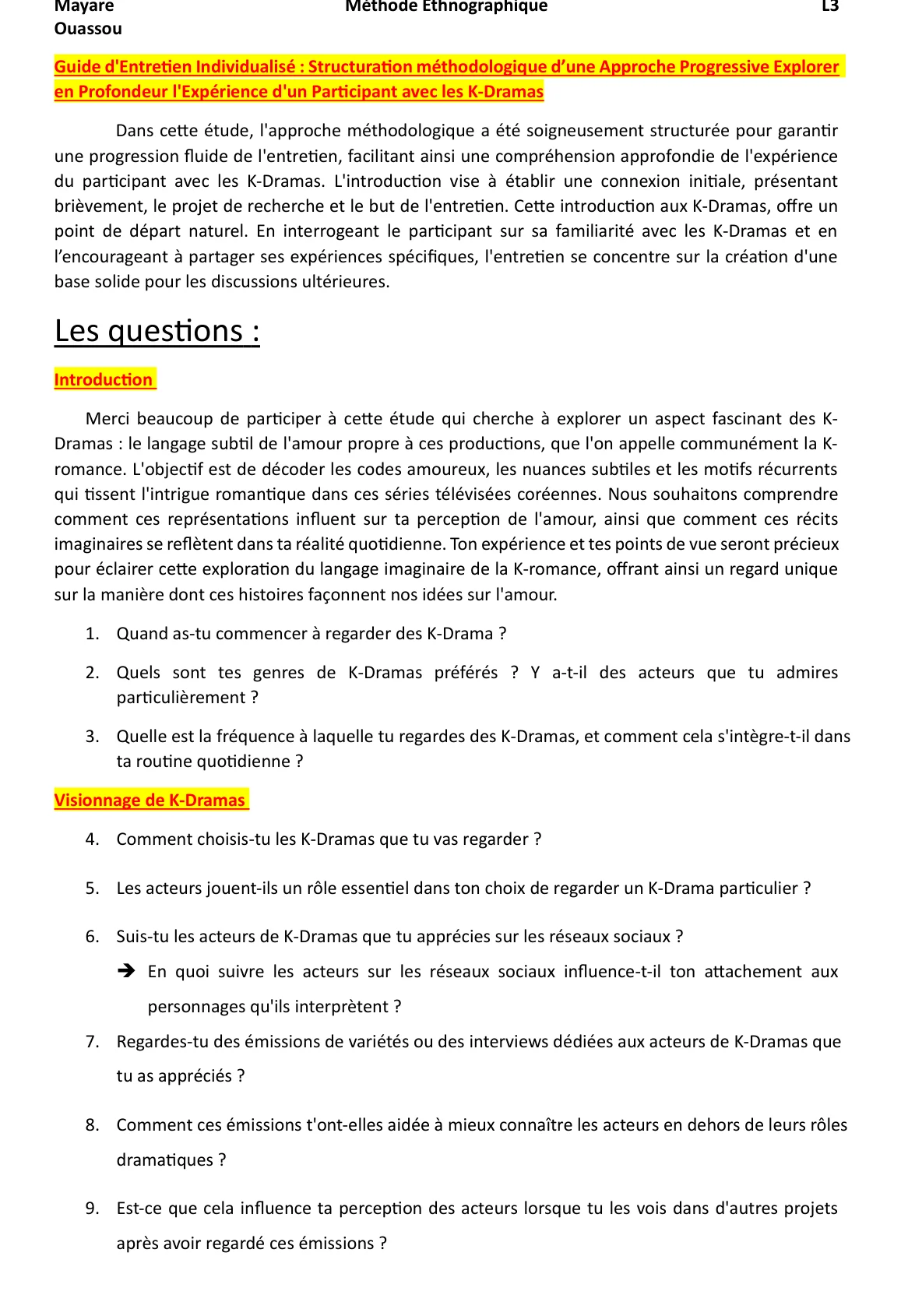
MY GUIDE · SEMESTER 1The opening text read to the participant, then the first blocks. Each question is numbered and follow-ups are indented.
WHY A FUNNELAsking straight away "have K-dramas changed your idea of love?" gets a yes or a no. Starting with habits and a favourite series lets the person tell concrete stories first; the intimate questions then rely on those stories.
OPEN, NOT LEADING“How do you perceive...”, “what aspects...”, “can you share...”: the questions open the answer instead of suggesting it. When I test a cliché, such as the purity of love in dramas, I present it as what “some people argue” and ask for her view.
A GLOSSARY FOR ME, NOT FOR HER“Koreaboo” and “sasaeng” are defined at the end of the guide so that I use them precisely, and only if the interviewee brings them up or agrees to discuss them.
EP. 03THE SHOOT
Two interviews, two very different conversations.
Fieldwork rarely goes as planned. My first interviewee dropped out; I recruited another fan through Instagram, a former classmate studying Korean. The university library was closed on the day: we moved to a soundproofed room in a media library. In the second semester, the interviewee was a nurse who watches dramas from all over East Asia.
E1 · THE INSIDER20 · student in Korean studies · December 2023 · 1 h 31At ease, quick and concise answers, a lot of distance: she studies Korean society and compares what dramas show with what she learns in class.
E2 · THE ENTHUSIAST23 · nurse · April 2024 · more than fifty dramasVery emotional, hesitant, many nervous laughs and silences; she mixes up plots but describes intensely what she felt.
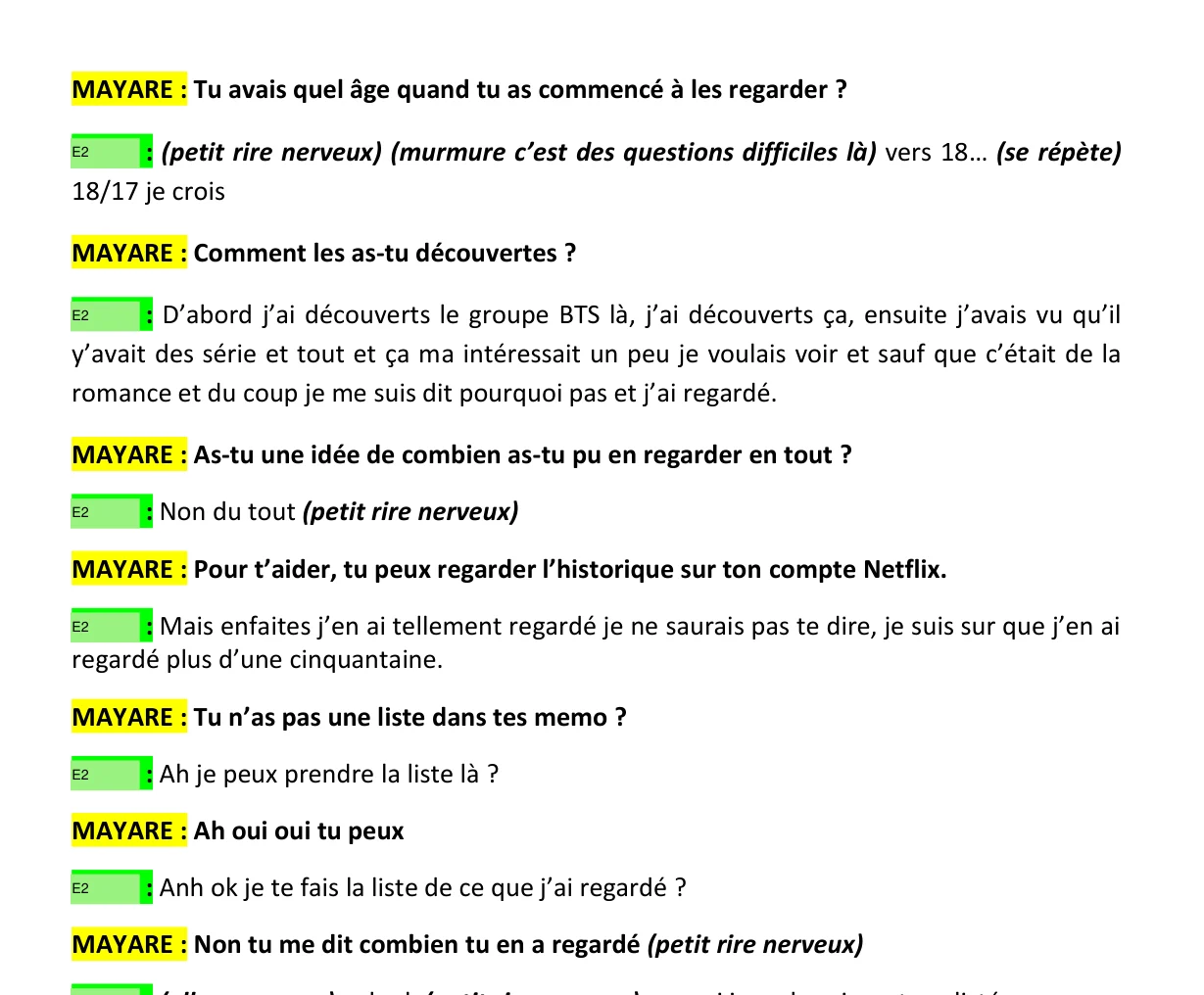
MY TRANSCRIPTION · SEMESTER 2Every turn is transcribed word for word, with silences, nervous laughs and murmurs in italics. Here, the interviewee is renamed E2.
ADAPTING TO THE PERSONWith E2, broad questions were too hard. I reformulated, suggested she check her Netflix history as the guide planned, then asked whether she kept a list in her phone notes, and let her look up titles. The aim: lower the pressure so she could tell rather than "answer correctly".
ANONYMISINGFirst names were changed in the dossiers, and the descriptive sheet (age, studies, family situation) stayed in the academic file. Here, the interviewees are only E1 and E2.
EP. 04BONUS · THE INTERVIEWS IN NUMBERS
They talk nine words out of ten: what the transcripts say about the interviews themselves.
A transcript is also data about the interview. I went back over my two full transcripts and counted who speaks, how much, how often I asked a question, and the annotations I had noted in brackets: laughs, silences, murmurs. These counts do not replace the analysis; they check it.
SHARE OF WORDS SPOKEN BY THE INTERVIEWEE
E189,3 %
E287,8 %
E1: 13,247 words against 1,597 for me. E2: 9,915 against 1,376.
MY QUESTIONS AND FOLLOW-UPS
E185
E284
Turns of mine ending in a question, out of 115 and 108 turns.
AVERAGE LENGTH OF AN ANSWER
E1118 words
E294 words
Words per turn of the interviewee.
E1 · WHAT I NOTED IN BRACKETS
(amused tone)51
(laughs)23
(coughs)6
(thinks)5
(sighs)4
(silence)6
E2 · WHAT I NOTED IN BRACKETS
(silence)9
(nervous laugh)9
(thinks)6
(giggle)6
(murmurs)16
(checks her phone)2
TIMES THE WORDS "CRY" APPEAR
E14
E28
Counted in the interviewees' words only.
TIMES THE WORD "SAD" APPEARS
E11
E26
WHAT THEY SAYIn both interviews, the interviewee speaks almost nine words out of ten, with one question or follow-up from me at almost every turn. E1's answers are longer and punctuated with amusement; E2's are shorter, with silences, nervous laughs and murmurs, and far more words of sadness and tears.
WHAT I READ IN ITTwo confirmations. On method: I let them talk, which is the first rule of an interview. On content: the numbers match the portraits drawn in EP.03, the insider who comments with distance, the enthusiast who relives her emotions. What I had felt during the interview is visible in the transcript.
THEIR WATCHLIST
E1 · Discovered with Boys Over Flowers, through a friend, in 2017.
1Extraordinary You
2Alchemy of Souls
3It's Okay to Not Be Okay
Also cited: Oh My Venus, Twenty-Five Twenty-One
E2 · Discovered through K-pop: first BTS, then the series.
1Goblin
2Moon Lovers: Scarlet Heart Ryeo
3Made for Each Other
Their three most memorable series, in the order they gave them. None of the six is a pure contemporary romance: fantasy, historical or psychological dramas with a love story at their heart. The romance they like comes wrapped in another genre.
EP. 05WHAT THEY SAY
Same series, two readings: six themes side by side.
Each interview was analysed by theme in its own semester. I then took the themes of my two analyses and put them side by side. Where the two interviewees agree, the finding is stronger; where they differ, it shows how much the reading of a drama depends on who watches it. Here is the path from a sentence to a finding, on a real example.
01 · VERBATIM"if a man cries, I fall in love right away" (E2)
02 · CODEMen who show their emotions; vulnerability valued.
03 · THEMEGentle masculinity, also present in E1: sensitivity, attention, patience.
04 · FINDINGThe strongest effect of dramas is on the image of men, more than on the language of love.
THEMEE1 · THE INSIDERE2 · THE ENTHUSIASTREADING
ModestyE1 · Allusions, but "nothing actually happens on screen". Appreciated: the whole family can watch.E2 · Intimate scenes "a bit taboo", "not developed at all".BOTH
SlownessE1 · Not in my observations.E2 · "In American series it goes very fast, and with them it goes slowly."E2 ONLY
Gentle masculinityE1 · Values sensitivity, attention and respect for elders; likes a soft face with muscles.E2 · Men who cry and show their emotions: "if a man cries, I fall in love right away".BOTH
RealismE1 · Repetitive scenarios that end up looking like "the norm" for romance in Korea.E2 · Flirting scenes "impossible", "unrealistic", like the convenient "accidents".BOTH
BeautyE1 · Not in my observations.E2 · Beauty is "THE most important thing" for the characters; some heroines change their look to please.E2 ONLY
Gender rolesE1 · Gallantry as a must: "as if the drama couldn't work if the man wasn't gallant".E2 · The man protects and dominates, the ideal woman is gentle and "naive"; she sees a risk of legitimising unequal roles.NUANCED
E1 · 20INTERVIEW 1 · DEC. 2023
« it starts to make it look like a norm »
ILLUSTRATION · PEXELS
E2 · 23INTERVIEW 2 · APRIL 2024
« in American series it goes very fast, and with them it goes slowly »
ILLUSTRATION · PEXELS
E2 · 23INTERVIEW 2 · APRIL 2024
« if they're not in love, it's not a life »
ILLUSTRATION · PEXELS
WHAT THEY SAYBoth appreciate the modesty of the romance and the gentle male characters, and both find the scenarios repetitive or unrealistic. E2 adds what is absent from my notes on E1: the slowness of the romance, the weight of beauty and very traditional gender roles. E1 sees gallantry as a rule of the genre.
WHAT I READ IN ITTheir attachment is real, but not naive. They consume an ideal while keeping it at a distance: E1 through what she learns about Korean society, E2 through her own experience. The diversity of profiles matters more than the number of interviews: one fan cannot speak for all fans.
EP. 06THE TWIST
What changes is not how they talk about love, but how they see men.
My starting hypothesis expected K-dramas to make viewers more romantic in their own language. Neither interview really confirms it. What comes up again and again, in both, is another effect: the image of the "ideal man". Men who cry, who take care of their appearance, who are attentive and patient, shift their idea of what masculinity can be.
E2 · 23INTERVIEW 2 · APRIL 2024
« they're not robots programmed to protect us »
ILLUSTRATION · PEXELS
HYPOTHESIS · VERDICTPartly confirmed, and displaced. Yes, the series feed a desire for an attentive, gentle romance. No, they do not make the viewers adopt their romantic language. And the effect also has a downside: E2 notes that the protective, dominant man can legitimise unequal relationships.
AN UNEXPECTED EFFECTE2 explains that dramas showing anger or mental distress helped her better understand some of her patients. Fiction also works as a lesson in empathy.
EP. 07SEASON 2
Between the two waves, I changed guides.
SEMESTER 1 · MY SELF-CRITICISMIn my observations, I noted that my guide spent too long on favourite series and not enough on K-romance itself: too few questions on how love is shown and on the male characters. The interview was rich, but partly beside the question.
SEMESTER 2 · WHAT CHANGEDFor the second wave, I used the course's common guide, centred on love: differences with Western series, seduction, beauty, gender roles, masculinity. Result: the second interview gives much more material on what dramas do to the image of men, exactly what the first one was missing.
This is the logic of iterative research: a first wave of interviews, an honest review of the guide, then a second wave that targets what the first one missed.
EP. 08THE SOCIOLOGICAL READING
Neither dupes nor detractors: a negotiated reading.
This is a social sciences survey before being a user study. The methods come from sociology, and so do the tools used to interpret what the interviewees say.
SEMI-STRUCTURED INTERVIEWA guide of themes and questions, but the order follows the conversation: follow-ups, reformulations, and room for what the person brings herself.
SOCIOLOGICAL PORTRAITFor each interviewee, a portrait: educational and professional path, family background, how she discovered Korean culture. It situates what she says: a view of love always comes from somewhere. The details stay in the academic file.
FULL TRANSCRIPTIONWord for word, with paraverbal annotations in brackets: laughs, silences, murmurs, tone. They carry part of the meaning, as EP.04 shows.
THEMATIC ANALYSISEach interview is cut into themes (modesty, beauty, gender roles, masculinity...), then the themes are compared from one interview to the other.
REFLEXIVITYSaying where I stand: E1 was a former classmate, E2 found some questions difficult. The way the interview went is part of the data, not a detail to hide.
ETHICSChanged first names, personal data kept out of public view, interviewees designated only by a letter and their age.
STUART HALL · ENCODING / DECODINGA media message can be read in three ways: by adopting it (dominant reading), by rejecting it (oppositional reading), or by adopting part of it while contesting the rest (negotiated reading). Both interviewees make a negotiated reading: they embrace the attentive, gentle love, and reject the repetition, the unrealism and, for E2, the unequal roles.
DOMINIQUE PASQUIER · SERIES AS A SCHOOL OF FEELINGSHer study of a French teen series showed that young viewers use series to learn about feelings. The same mechanism appears here: E2 says dramas helped her understand emotions she meets at work.
RESOURCES TO READ A DRAMAThe two readings differ according to what each one brings: E1 reads with academic knowledge of Korean society, E2 with her own emotions and experience. Distance is not a personality trait: it depends on the resources available.
EP. 09BONUS · FROM SURVEY TO PRODUCT
Two viewers, two ways of using a streaming platform.
Two interviews are not a market study, but they already draw two very different profiles of viewers. If I had to design a streaming service for K-dramas, here is how I would turn the survey into usable research material: proto-personas, jobs to be done, a journey with its friction points, then design leads. Everything comes from the two interviews and remains to be validated with more people.
PROTO-PERSONAS · FROM TWO INTERVIEWS, TO BE VALIDATED
E1 · THE INSIDER« it starts to make it look like a norm »
GOALS· Original stories, women characters who break the mould· Understand Korean society through fiction
BEHAVIOURS· Compares dramas with her Korean studies· Watches to escape when daily life is hard
FRUSTRATIONS· Repetitive scenarios presented as the norm· Romance that turns sugary, "bisounours"
E2 · THE ENTHUSIAST« if a man cries, I fall in love right away »
GOALS· Feel strong emotions: laugh, cry, get angry· Share her passion with those close to her
BEHAVIOURS· More than fifty dramas, from all over East Asia· Keeps a list in her phone notes
FRUSTRATIONS· Forgets titles and plots· Friends and family don't follow her recommendations
JOBS TO BE DONE
When daily life is heavy, I want to plunge into another world, so I can think about something else.FROM E1
When I want to feel something strong, I want a series that takes me through every emotion, so I come out moved.FROM E2
When I watch with my family, I want a series with no awkward scene, so everyone can stay in front of the screen.FROM E1
When I've loved a series, I want my friends to watch it too, so I can share it with them.FROM E2
A FAN'S JOURNEY · WHERE IT HURTS
01 · DISCOVERThrough a friend (E1) or through K-pop (E2).
02 · CHOOSEBy genre, actors, mood.▲ Scenarios that all look alike
03 · WATCHAlone or with family, episode after episode.▲ Awkward scenes in front of family
04 · FEELLaugh, cry, get angry, identify.
05 · KEEP TRACKA list in the phone notes.▲ Forgotten titles and plots
06 · SHARERecommend to friends and family.▲ Friends don't follow
HOW MIGHT WE · AND WHAT I WOULD DESIGN
01 · FIND BY MOOD AND TROPEBoth choose a drama for a feeling: to escape (E1), to go through strong emotions (E2). Filters by mood or by trope (slow burn, contract marriage) speak more than genres.
02 · KEEP TRACKE2 counts her dramas in her phone notes and could not remember titles. A real watch diary, with what you felt about each series, meets a need she already improvises.
03 · WATCH TOGETHERModesty is valued because the whole family can watch. Showing how "family-friendly" a series is helps choose what to watch together.
04 · CULTURAL NOTESE1 reads dramas through what she knows of Korean society. Optional notes on customs and words, without interrupting the episode, would enrich the experience for curious viewers.
05 · RECOMMEND TO SOMEONEE2 recommends series to her friends and family, often without success. Sharing a series with a personal word is part of the practice.
06 · DON'T REDUCE THE FANNeither fits the "koreaboo" cliché. Designing for critical, informed viewers, rather than for an imagined obsessive fan, is more respectful and more accurate.
THE NEXT STUDY · RESEARCH PLAN
OBJECTIVEValidate the two proto-personas and find the ones missing.
SAMPLE8 to 12 viewers, including men, over-40s and newcomers to dramas, until no new theme appears.
METHODSShort interviews (about 20 questions), plus a two-week viewing diary to capture choices and emotions as they happen.
ANALYSISCoding in pairs, affinity mapping of the themes, then a workshop with the product team on the friction points of the journey.
EP. 10THE END CREDITS
Limits, and what this survey taught me.
TWO VOICESTwo interviews, two young women from the Paris region: no man, no older viewer, and far from saturation, the point where new interviews stop bringing new themes. The findings describe these two fans, not "the K-drama audience".
PROXIMITYE1 was a former classmate. It helped trust, but may have encouraged her to give answers she thought I expected.
A LONG GUIDE58 questions is a lot for one interview, even 1 h 31 long: the more questions, the less room for follow-ups. Fewer questions, better targeted, would have gone deeper.
WHAT I LEARNEDTo build a guide that moves from the general to the intimate, to adapt to someone who struggles to answer, to transcribe everything, including silences, to anonymise, and above all to judge my own guide honestly and change it when it misses the question. Exactly what a user interview requires.
WHAT I WOULD DO DIFFERENTLYTest the guide in a pilot interview before the real ones; cut it down to the questions that serve the research question; recruit men and viewers over 40 to compare; and code the interviews in pairs to check that two readers find the same themes.
REFERENCESHall, S. (1973). Encoding and Decoding in the Television Discourse. CCCS, University of Birmingham. · Pasquier, D. (1999). La culture des sentiments. L'expérience télévisuelle des adolescents. Éditions de la MSH. · Nye, J. S. (1990). Soft Power. Foreign Policy, 80, 153-171.
FRAMEWORKL3 course in ethnographic methods and interviews, Université Paris Cité, 2023-2024. Semester 1 in a group of six, semester 2 in pairs. Interviews recorded, then transcribed.
NEXT_CASE_STUDY
UX RESEARCH · UI DESIGN
VINTED
Solving the trust deficits behind 65% cart abandonment: user research, mobile mockups and an interactive prototype.