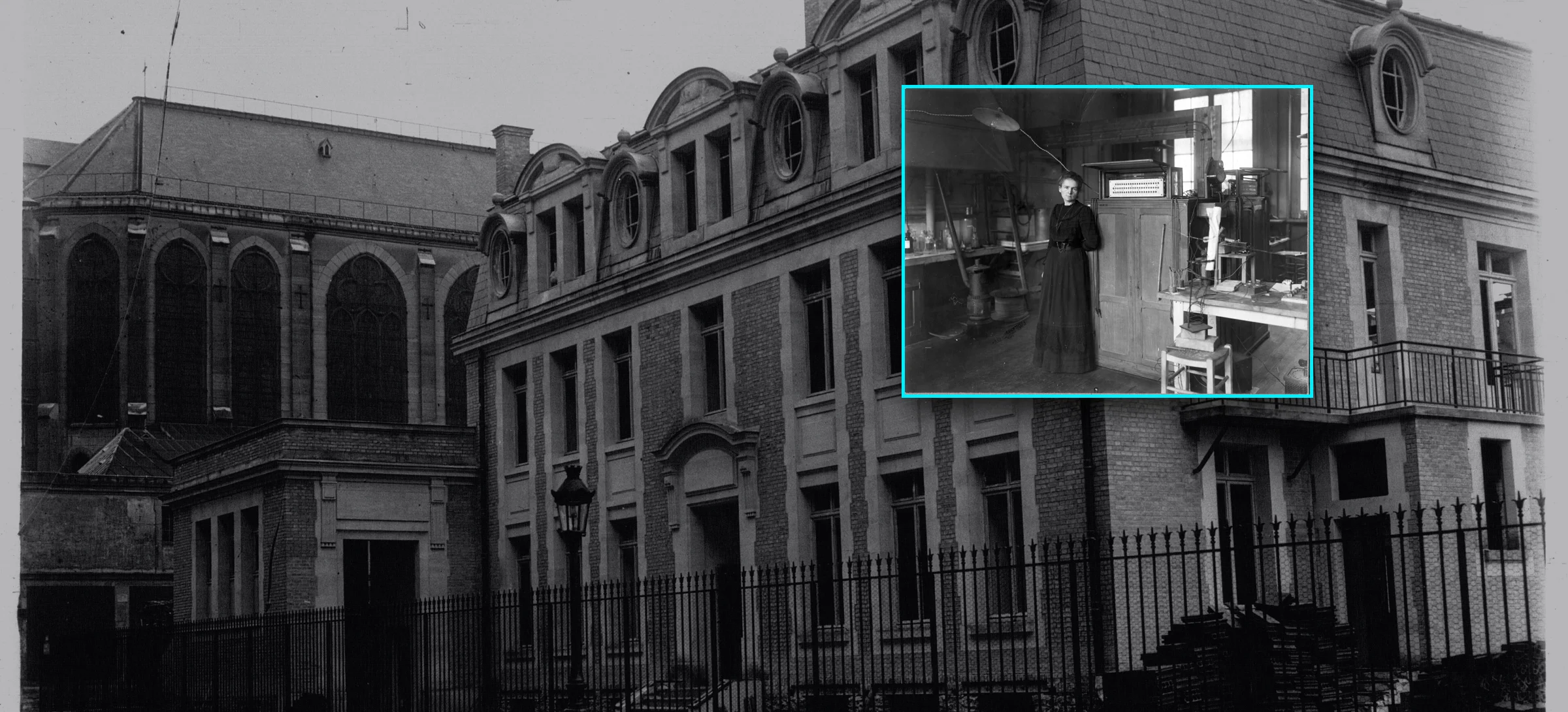
The mission
Design the ergonomic approach for a virtual environment of the Curie Museum: immersive, interactive and educational visits for middle and high school pupils, and for researchers.
What already exists
The museum already has a free 360° visit: 42 views, 111 audio tracks and 11,751 words of text. A rich content, designed for one person exploring alone.
What is missing
Everything a class needs: a guide who leads, shared moments, short paths by level, activities. And basic accessibility: no subtitles, French audio in the English version, low-contrast markers.
My role
An individual master's assignment (May 2025) on the design method, which I completed alone with an audit of the museum's real online visit. Independent work, not commissioned by the museum.
What the audit measured
The English version plays the same French audio files; none of the 111 tracks is subtitled; the plan's markers reach a contrast of 2.86 and 2.6 where 4.5 is expected; zoom is blocked on phones.
Three recommendations
1. Quick wins first: readable markers and zoom allowed. 2. Subtitles and English audio for the 111 tracks. 3. A class mode led by a guide, with short paths by level. The full priorities are in section 6.1.
Contents
A museum full until July 2027: for classes, the virtual visit is the way in.
"Enrich the visits of the Curie Museum with a virtual environment."
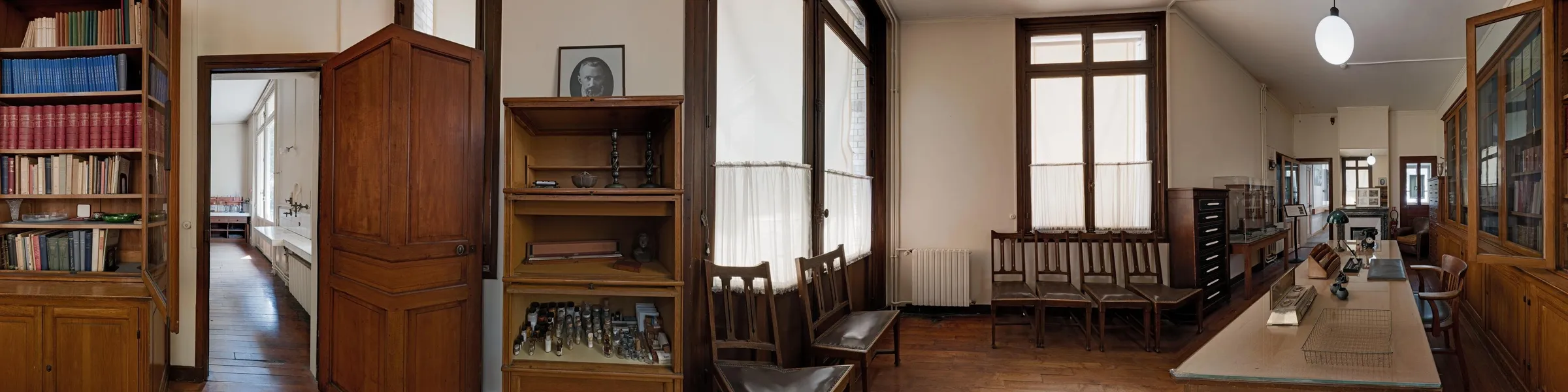
The Curie Museum sits in the last laboratory where Marie Curie worked, in the former Radium Institute in Paris. The assignment asked me, as an ergonomist, to analyse the needs, propose a user-centred methodology and formulate recommendations, around three questions: how to build personas, how to evaluate similar systems, and how to analyse the collective activity of a guided visit.
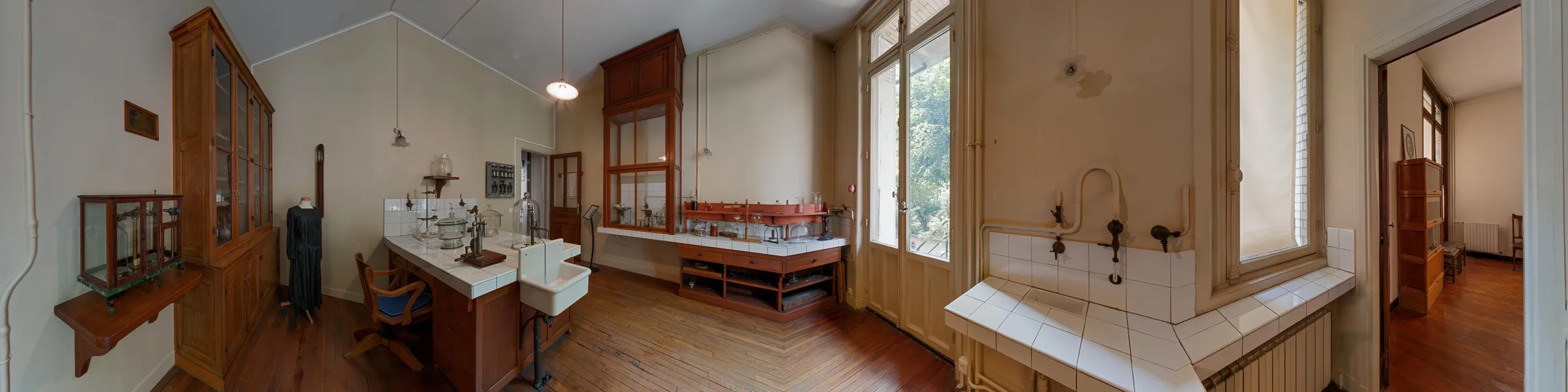
A small museum that has almost tripled its audience.
Before designing anything, I looked at who actually comes. The museum's 2023 activity report gives the figures: free entry, open four days a week, a team of nine people, and a record year.
Group visitors in 2023 (3,236 people)
Fill rate of the 2023 activities
A record, +34% in one year
36,407 visitors in 2023, against 13,210 in 2016. The report itself says the museum must think about how to face this growing demand.
Schools: 5.6% of visitors
2,051 pupils came in groups: they are 63% of groups, but only 5.6% of all visitors. The brief's main audience is the smallest one on site.
Activities are full
Thematic visits filled at 122% and the storytelling show at 104%. Physical space and staff are the limit, which is a strong reason for a virtual offer.
From October to December 2023, the website received 82,000 visits, about 27,000 a month. On site, 36,407 visitors a year make about 3,000 a month. The online audience is already about nine times larger than the one that walks in: the virtual visit speaks to the museum's biggest public.
Today, a class that wants a guided visit has to wait until July 2027.
The museum's pages for schools and teachers announce it: "due to very high demand", the calendar of guided group visits is full until July 2027. They also describe how a class visit works, which gives the real constraints the virtual environment has to respect.
| Level | Format | What the virtual visit must keep |
|---|---|---|
| Primary to 8th grade | Guided visit with investigation booklets, small autonomous groups that rotate between sections | Group investigation and rotation |
| 9th grade and high school | Class split in two, each half led by a museum guide | A guide who leads and answers |
| All levels | Office and chemistry lab of Marie Curie visited; time for questions | The historic rooms and the questions |
| Supervision | 1 adult for 15 secondary pupils; booking months in advance | A format that needs no travel |
Demand exceeds the building
The 2023 report already said the museum had to face growing demand. Three years later, the group calendar is full for nine months ahead.
A tiny share of pupils
France counted 3,386,832 middle school pupils in 2024 (DEPP). The 2,051 school visitors of 2023 are about 0.06% of them, before counting high schools.
The emotion comes from the real place. What they miss is doing something.
I collected the 76 public reviews of the museum relayed by Petit Futé (75 come from Google) and coded them by hand: they are in nine languages, which rules out keyword coding. Average rating: 4.5 out of 5.
What reviews mention (number of reviews, mean rating)
Language of the 76 reviews
“A lot to read, rather little to look at, nothing to try yourself.”
“Very instructive. It's free, but I still find it lacks pep.”
“A storm of emotions at the sight of the laboratory and her office!”
The lowest-rated theme: reading without doing
The 10 reviews that mention a lot to read, a lack of depth or of liveliness average 3.8, against 4.5 overall. It is exactly what the online visit reproduces.
59% of reviews are not in French
45 of the 76 reviews are written in another language, 23 of them in English. An English version that plays French audio misses a majority of the museum's online public.
The virtual environment is not a gadget here: it is a way to reach the classes that cannot come, in a place that is already full.
A virtual class visit is not a second-best here: it is the only way for most classes to see Marie Curie's laboratory in the coming year.
The content exists and is solid; it is not staged for each audience.
The museum already has an online visit. So I audited it.
1. The museum's figures
The 2023 activity report: attendance since 2016, groups, fill rates, website traffic, team.
2. Inventory of the online visit
The public files of the 360° visit list every view, audio track and text, in French and English. I counted them.
3. Accessibility checks
Contrast, target size, zoom, subtitles, mobile display, measured in a browser against WCAG 2.2.
4. Visitors and schools
76 public reviews coded by hand, the museum's pages for schools and teachers, its investigation booklet and its radioactivity game.
5. Expert evaluation
Readability of the texts of the visit, automated accessibility test (axe-core) of four pages, heuristic evaluation of the 360° visit.
6. Literature
Research on learning in virtual reality, cybersickness and reading speed, to judge what a class can absorb.
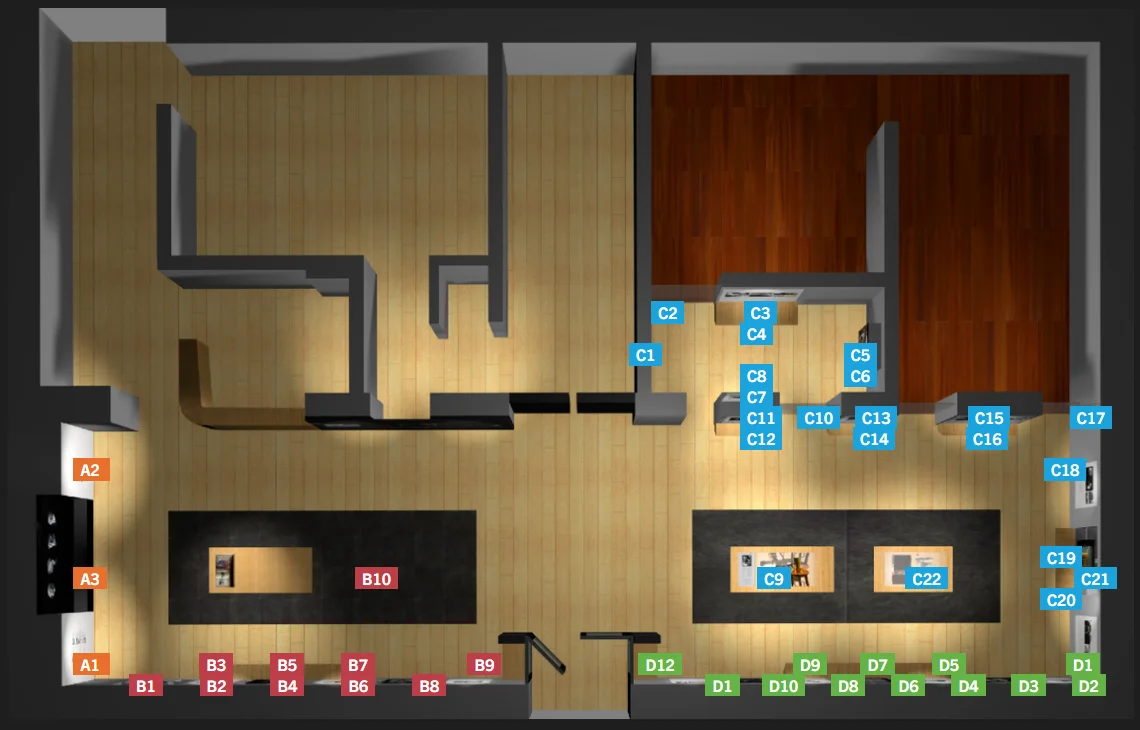
Two doors: an immersive 360° visit and a 2D plan.
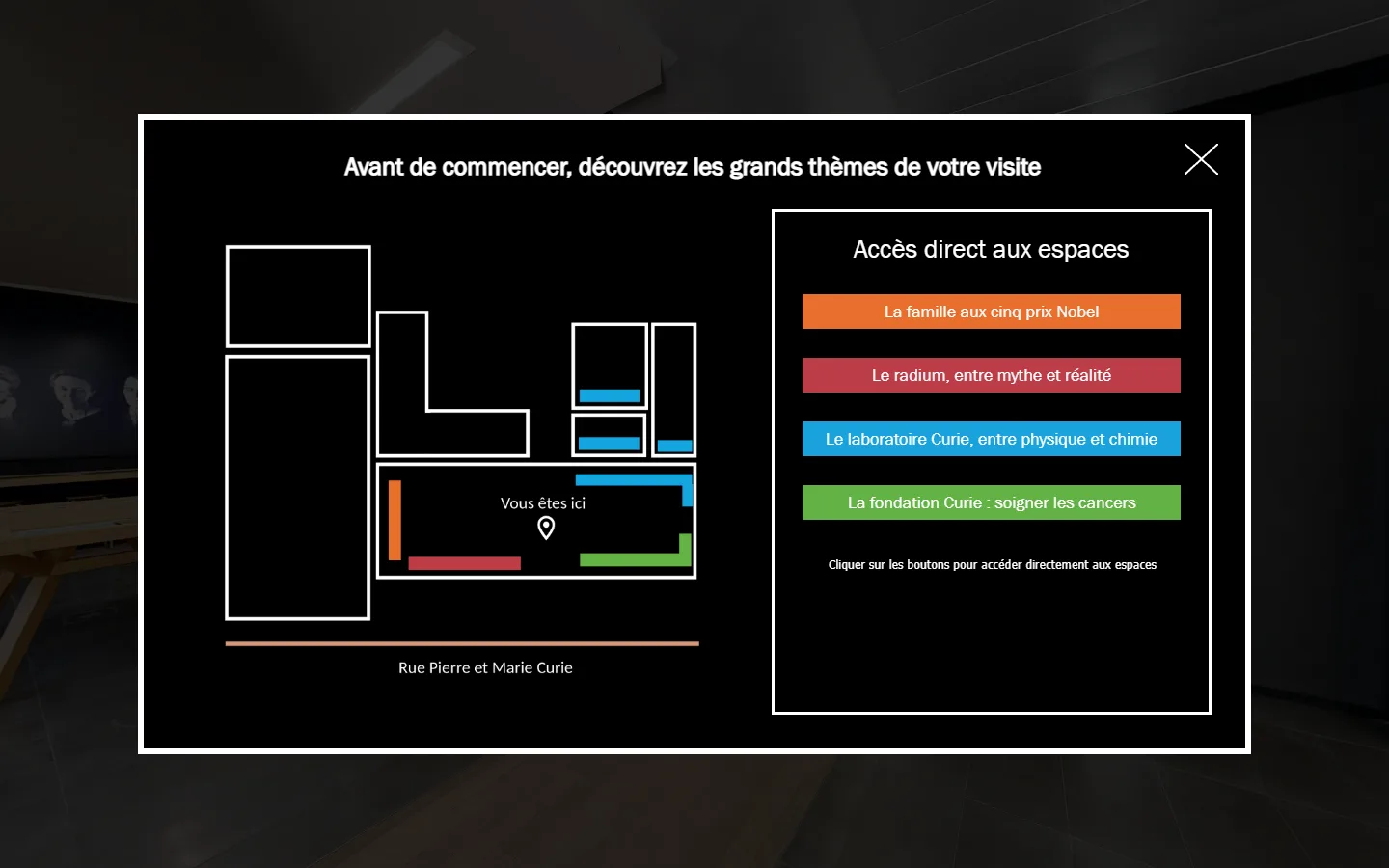
On the museum's website, the "virtual visit" page offers an immersive 360° tour, in French or English, and a 2D plan of the exhibition where each point opens a page. The 2D plan follows the four spaces of the museum.
Points of the 2D plan, by space (47 in all)
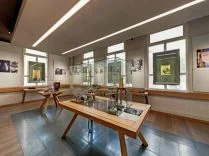
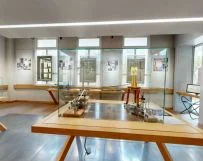
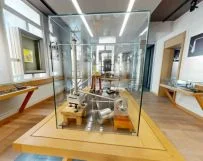
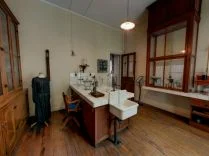
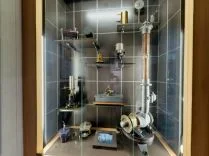
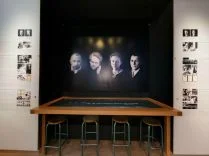
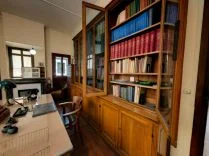
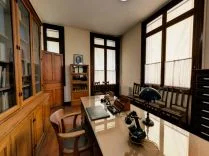
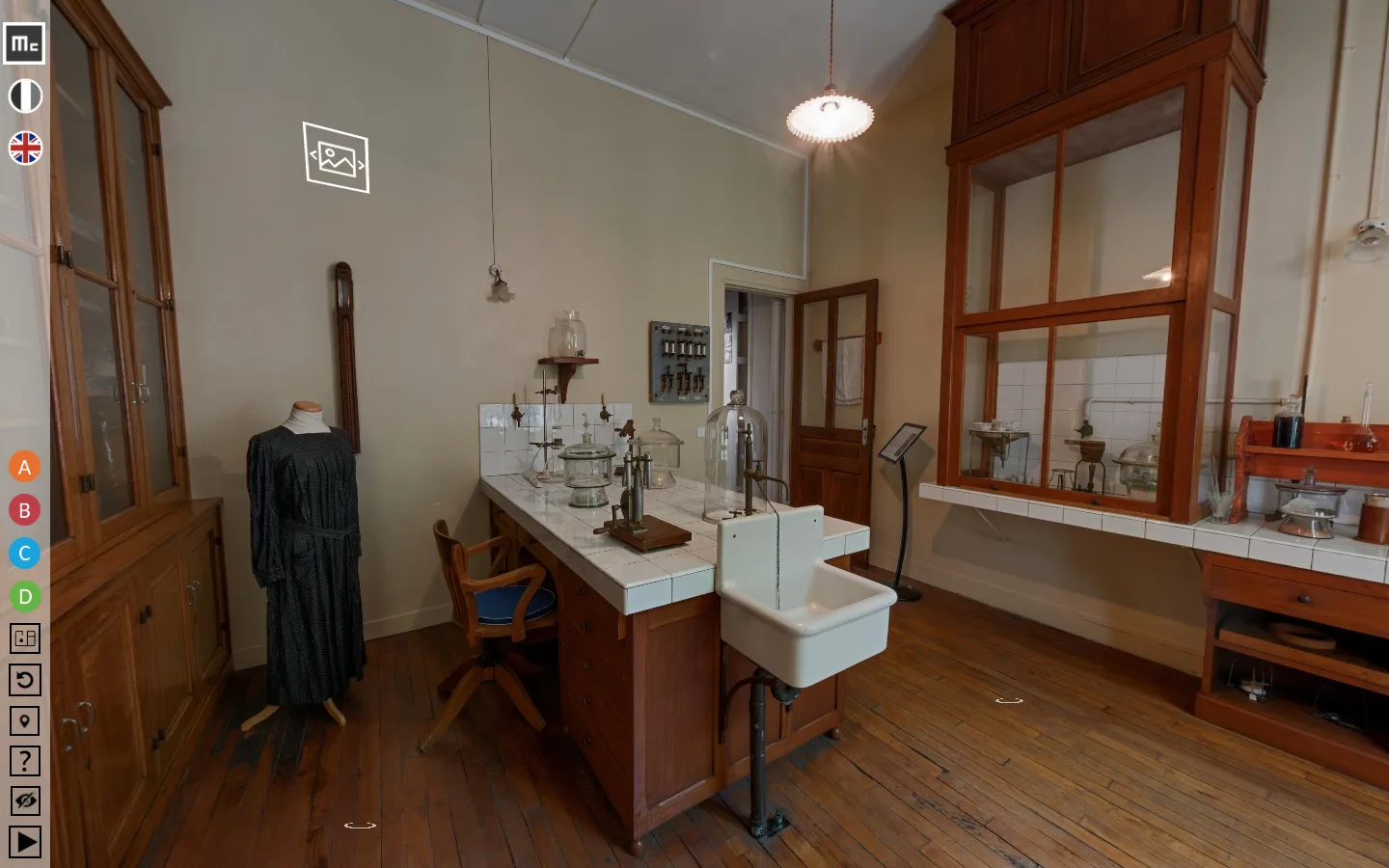
Eight of the 42 views of the immersive visit, as provided in its own thumbnails.
A rich content: more than three hours in all.
Time needed to take in all the content
Adults read non-fiction at about 238 words per minute on average (Brysbaert, 2019). At that pace, the texts alone take 49 minutes; the 111 audio tracks add 2 hours 24, measured file by file. For a curious adult exploring at home, that depth is a gift. For a class with one school hour, it has to be cut into short paths.
Texts written for adults, read by 14-year-olds.
I measured the French texts of the visit with the Kandel and Moles formula, the French adaptation of the Flesch reading ease score (1958). It combines sentence length and word length: the lower the score, the harder the text. 60 to 70 is standard, 50 to 60 fairly difficult, 30 to 50 difficult.
The 48 longest texts, by readability band
| Word | Occurrences | Known by a 9th grader? (my estimate) |
|---|---|---|
| radium | 149 | To explain at the start |
| radioactivity | 30 | Partly |
| radiation | 18 | Partly |
| radiotherapy, curietherapy | 15 | Rarely |
| ionisation, electrometer, piezoelectric | 10 | No: needs a glossary |
Syllables counted automatically, so the score is an estimate. A readability formula measures form, not meaning: it flags texts to rewrite, it does not replace a test with pupils.
Six checks, measured rather than guessed.
| Check | What I measured | Reference | Result |
|---|---|---|---|
| Subtitles | Subtitle entries for the 111 audio tracks | WCAG 1.2.1 | None declared |
| English audio | Audio files used by the English version | Language of content | The same 111 French files |
| Marker contrast | White text on blue (zone C) and green (zone D) markers | WCAG 1.4.3: 4.5:1 | 2.9:1 and 2.6:1 |
| Target size | Height of the plan markers | WCAG 2.5.8: 24 px | 23 px, tightly packed |
| Zoom | Viewport of the immersive visit | WCAG 1.4.4 | Pinch zoom disabled |
| Mobile width | Visit page on a 390 px phone | WCAG 1.4.10 | Laid out at 480 px |
Measured in a browser on the public pages. The immersive visit's text-to-speech option is turned off in its settings. Not a full audit: no test with assistive technologies or users.
| Page | Contrast | Images without alt | Links without name | Other | Total |
|---|---|---|---|---|---|
| Home | 71 | 12 | 7 | 4 (language, targets) | 94 |
| Virtual visit | 37 | 2 | 5 | 2 (language, frame) | 46 |
| Schools | 0 | 2 | 5 | 1 (language) | 8 |
| Teachers | 0 | 1 | 6 | 1 (language) | 8 |
Number of elements in error. On all four pages, the page language is not declared, so a screen reader may read French with the wrong voice. An automated test only finds part of the problems; it does not replace a manual audit.
Deaf pupils hear nothing
111 audio tracks and no subtitles: for deaf or hard-of-hearing pupils, and for a noisy classroom, a whole layer of the visit disappears.
English on screen, French in the ears
The English version translates 271 texts, but plays the French audio files. The report counts archive requests from Poland, the United States, Japan, China.
Small, pale markers
Two of the four colours fail the contrast ratio, and markers are below the minimum target size. On a classroom interactive board, from the back of the room, they are hard to read.
The eight criteria of Bastien and Scapin, applied to the 360° visit.
| Criterion | Verdict | Evidence |
|---|---|---|
| Guidance | Strong | Welcome plan, "you are here", direct access to the four spaces |
| Workload | Weak | 11,751 words and 2 h 24 of audio; fairly difficult texts |
| Explicit control | Medium | Autoplay, restart, hide controls; no shared pause for a group |
| Adaptability | Medium | French and English; but French audio only, zoom locked, one path for all |
| Error management | Not assessed | No input to make: few possible errors |
| Consistency | Strong | Same colours and codes A to D on the website, in the visit, on the panels and in the booklet |
| Significance of codes | Medium | Icons without visible labels: their name appears only on mouse hover, not on a tablet |
| Compatibility | Strong | Follows the real layout of the museum, so it prepares or extends a physical visit |
Evaluation by a single evaluator, on desktop. A complete evaluation would add other evaluators and the tablet.
Everything here comes from public sources. I did not interview the museum team or visitors: that is the next step, and the method above is ready for it.
The content exists and it is solid. The work to do is not to produce more, but to select and stage it for each audience.
20 of the 48 longest texts are difficult or very difficult. For the class mode, each stop needs a short version (two or three sentences) and a glossary of about ten words, keeping the full text for curious adults.
The visit is well built for finding your way. Its weak points are the quantity of content and adaptation to different audiences, not navigation.
Nothing in today's visit is made for a group, yet the materials for pupils already exist.
Built for one curious visitor, not for 30 pupils and a guide.
| Need from the brief | Today | Gap |
|---|---|---|
| Immersive | 42 views in 360°, 3D scans | Covered |
| Interactive | Clicking hotspots, opening pages | Partial: no activity, no quiz |
| Educational | 11,751 words, 111 audio tracks | Rich but not split by level |
| For pupils | One free path for everyone | No path by age or duration |
| With a guide | Each person navigates alone | Missing: no shared view, no pointing |
| For researchers | Links to the blog and archives | Partial: no access to source documents |
The museum already has the pedagogy. It is on paper.
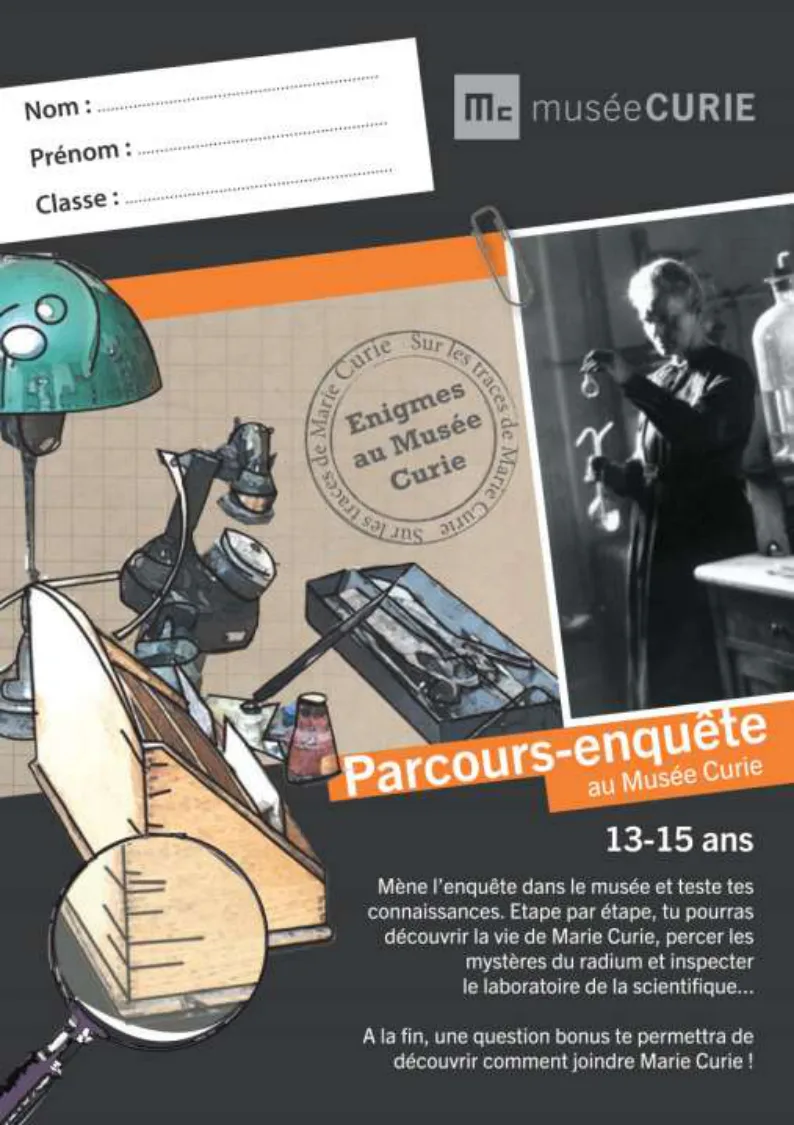
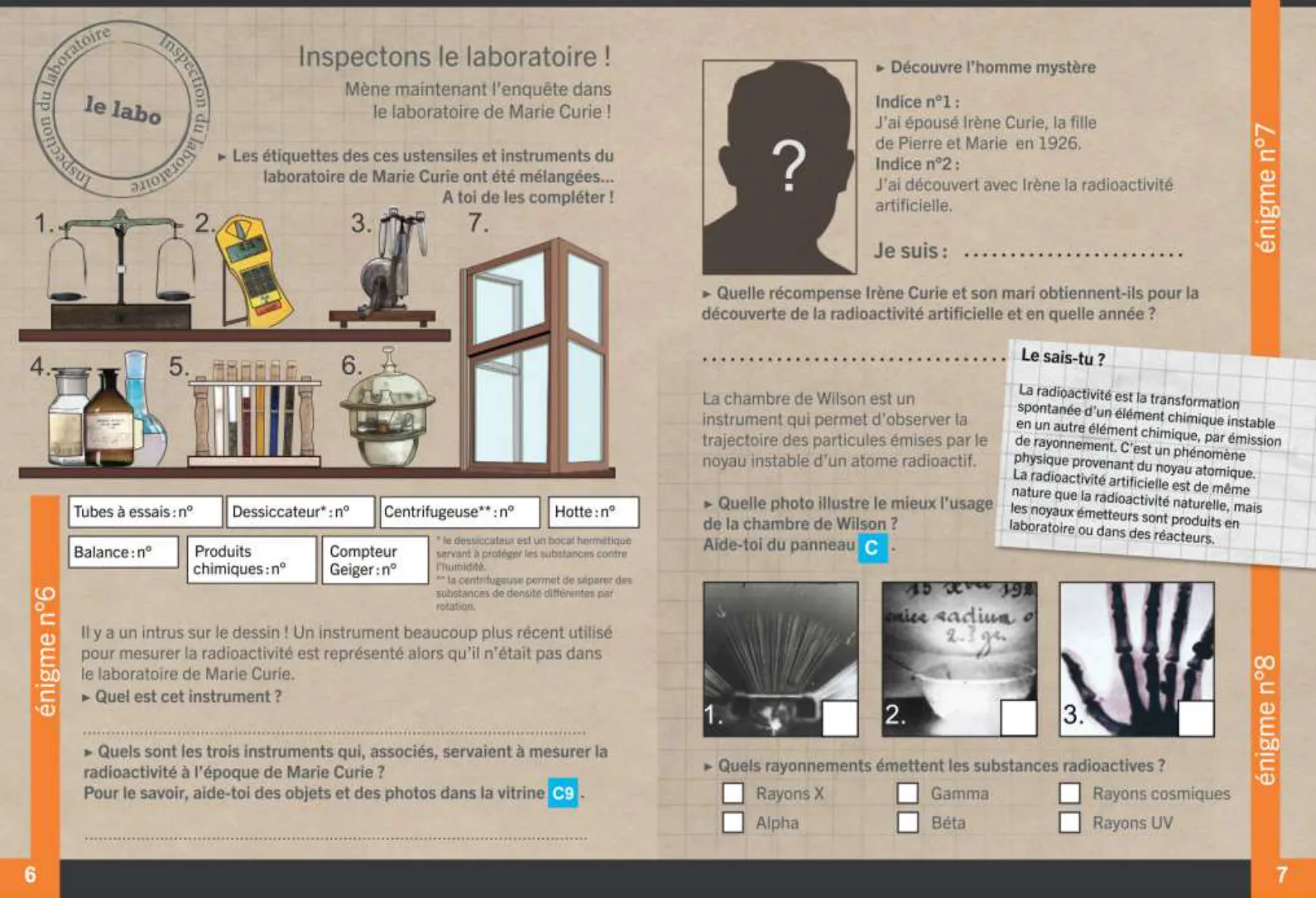
On its website, the museum offers two free investigation booklets (8-12 and 13-15 years) and a card and board game, "Les radio-activités du Musée Curie", with 5 activities on atoms and alpha and beta radioactivity. The 13-15 booklet holds 11 enigmas plus a bonus, and sends pupils to precise panels: B, C, C9, C15. These are the same codes as the plan of the online visit.
| Enigma | Theme | Point in the online plan |
|---|---|---|
| 1 | Marie Curie's identity card | A3 · multitouch table |
| 4 | Crossword on radium | B · radium panels |
| 6 | The lab instruments and how radioactivity was measured | C9 · the Curie method |
| 8 | The cloud chamber | C · lab panels |
| 10 | The day of a lab director | C15 · Marie Curie, the lab director |
Only the enigmas whose page names a code are listed. The other six can be linked the same way.
More immersion does not mean more learning.
In a controlled experiment with 52 students, learning from a science lab simulation in a virtual reality headset gave a stronger feeling of presence than on a computer screen, but less learning and a higher cognitive load measured by EEG (Makransky, Terkildsen & Mayer, 2019). The authors' explanation: the richness of the headset distracts from the content.
Headset compared with screen (effect size, d)
Cybersickness depends on movement
A meta-analysis of 55 studies and 3,016 participants measured sickness in headsets with the SSQ; it varies strongly with the content (Saredakis et al., 2020). A review of 49 publications finds that recent headsets cause less of it, and that movement and the mismatch between what is seen and what the body feels are the main causes (Caserman et al., 2021).
Good news for the existing visit
The 360° visit moves by jumps between fixed viewpoints, never by continuous travel. That is the least sickening way to move. A headset moment can reuse it as is, seated, for a few minutes.
My method in section 4.3 was about the collective activity of a visit. The existing tool has none: that is where the virtual environment should bring something new.
The class mode does not need new content: it can put the existing booklet into the 360° visit, enigma by enigma, at the right point, with answers shared on the board.
For a class, the headset should be a short, chosen moment (entering Marie Curie's laboratory), not the whole visit. The explanations work better on a shared screen, with a guide.
Three methods to design for a class, not for a single visitor.
Personas from interviews and observation, not from assumptions.
1. Semi-structured interviews
30 to 45 minutes with middle and high school teachers, museum guides, members of learned societies, volunteer pupils and historians of science.
2. In situ observation
Watch real guided visits (pupils and guide): interactions, emotional reactions, difficulties, attention span, use of space.
3. Synthesis
3 to 5 personas, each with motivations, expectations, frustrations, familiarity with VR, behaviour and learning needs.
| Theme | Question | What it reveals |
|---|---|---|
| Goals | What are your goals when you visit a museum, or bring a class? | Learning, curiosity, programme, outing |
| Memory | What makes a visit memorable? | The moments worth recreating virtually |
| Frustrations | What frustrates you in current visits? | Crowding, pace, too much text |
| Experience | Have you ever used virtual reality? | Familiarity, fears, cybersickness |
Learn from other museums' virtual visits before building one.
I proposed comparing three virtual museum experiences (the Louvre, the Anne Frank House, the Smithsonian) with 10 to 15 users: pupils, teachers and experts. Task: a free visit, then a subjective evaluation, observing navigation fluidity, comfort, understanding of the content and interactions with the guide.
| Scale | Measures | Why here |
|---|---|---|
| SUS | Overall usability, 10 items | Comparable score between systems |
| AttrakDiff | Pragmatic and hedonic quality | A museum visit must also be pleasant |
| NASA-TLX | Workload, 6 dimensions | Immersion can overload pupils |
| GEQ | Immersion, emotions, engagement | Is the visit engaging? |
| SSQ (added to the protocol) | Cybersickness: nausea, eye strain, disorientation | Essential as soon as a headset is used |
| Knowledge quiz (added to the protocol) | What pupils actually learned | Engagement is not learning (section 3.3) |
A class visit is a group activity, led by a guide.
To design a virtual visit that respects group dynamics, I proposed observing 3 to 5 real guided visits, filmed with consent, then coding the significant behaviours to find the critical points: disengagement, information overload, passivity.
| Dimension | What I code | Example of indicator |
|---|---|---|
| Speech | Who speaks, how long, questions asked | Share of guide speech vs pupils |
| Space | Positions around the showcases, movements | Pupils who cannot see the object |
| Non-verbal | Gestures, pointing, looks | Guide pointing at a detail |
| Key moments | Introduction, surprise, pauses | Reaction in front of Marie Curie's lab |
| Engagement | Individual and collective participation | Phones out, side conversations |
In the assignment I imagined five profiles: the curious pupil, the distracted pupil, the rigorous teacher, the passionate researcher, the experienced guide. These are hypotheses until the interviews are done; section 5.1 grounds them in the museum's real figures.
Rereading my work a year later, two measures were missing: cybersickness, which can ruin a headset visit, and learning itself. A visit can be loved and teach little.
The guide's main tools are pointing, timing and questions. A virtual visit for classes has to give these three tools back to the guide, otherwise each pupil is alone in front of a screen.
Eight points instead of 47: choosing rather than writing more.
Hypotheses grounded in figures, to check in interviews.
Without interviews, a persona is a hypothesis. So I call these proto-personas: each one starts from a real signal in the museum's data, and lists what the interviews in section 4.1 will have to confirm.
Before, during and after: where the virtual visit helps.
A design journey built from the observation grid (section 4.3) and the audit, to be checked with teachers. No emotion was measured, so the map has no emotional curve.
Eight of the 47 points, chosen for a 9th-grade class.
To show that the existing content is enough, I built a short path using only the real points of the 2D plan. The thread follows the story of radioactivity: discover, measure, see the invisible, the risks, the treatments.
Who are they, and why two Nobel prizes?
Guide mode: everyone looks at the same bench.
Investigation card: how do you measure what you cannot see?
Look at the tracks: what draws these lines?
Radium creams and fountains: what would you say to a buyer in 1925?
Why was a single gram worth a trip to the United States?
From danger to treatment: the same radiation, used to heal.
Quiz of 5 questions, then the teacher's summary.
Keep the existing visit, and add what a class needs.
1. Free mode (exists)
The current 360° visit, for curious adults and researchers, made accessible: subtitles, English audio, contrast, zoom.
2. Class mode (new)
The guide or the teacher leads: shared view, pointing, short paths by level, investigation cards and a quiz. Works on a classroom board or on tablets.
3. Headset moment (targeted)
A few minutes in a headset to step into Marie Curie's laboratory, then back to the shared screen to explain. Cybersickness checked.
Class mode, on three screens.
Low fidelity on purpose: these wireframes show functions and who controls what, before any visual design. They give back to the guide the three tools observed in section 4.3: pointing, pace and questions.
Eight points instead of 47, 20 minutes instead of 49 minutes of reading, and one activity per stop. Nothing new to write: only choices.
These screens are hypotheses to test with a guide and two classes (section 6.2), not a final design.
What to do first, and how to check it with real classes.
Start with what costs little and opens the visit to everyone.
Darker blue and green behind white text (4.5:1) and markers of at least 24 px.
AccessibilityRemove the zoom lock of the immersive visit and lay the page out at the phone's width.
AccessibilityTranscribe the 111 tracks; record or synthesise the English audio, or at least show the English text during the French audio: 59% of online reviews are not in French.
AccessibilitySelect 8 to 12 of the 47 points for each level, add short texts and a glossary, and put the 11 enigmas of the existing booklet in the quiz feature the player already has.
LearningA guide view that everyone follows, with pointing, pauses and group investigations.
Collective activityA few minutes in the laboratory, measured with the SSQ, never the whole visit.
ImmersionCompare the current visit with a class-mode prototype.
| Step | Current visit | Class-mode prototype | Measure |
|---|---|---|---|
| Participants | 2 classes of 9th graders and their teachers | Same classes, order reversed | Counterbalancing |
| Task | Find who discovered radium and how it was measured | Same question, with a guide and investigation cards | Success, time |
| Perception | SUS, AttrakDiff | SUS, AttrakDiff | Usability, appeal |
| Load | NASA-TLX | NASA-TLX | Workload |
| Learning | Quiz before and after | Quiz before and after | Knowledge gained |
| Collective | Observation grid (section 4.3) | Observation grid (section 4.3) | Speech, engagement |
If the headset moment is tested, add the SSQ before and after, and a quiet seated position. Parental consent for minors.
What this study can and cannot say.
No interview or observation was carried out: the personas and the journey are hypotheses grounded in public figures, not findings.
The figures come from the 2023 activity report, the most recent public one I found. They may have changed since.
The inventory reads the public files of the visit. A few elements may be counted twice or hidden in the interface.
The accessibility checks are partial: no screen reader, no keyboard-only test, no test with disabled users.
The reading time uses an adult average; pupils read more slowly, which strengthens the conclusion.
The 76 reviews come from people who chose to write, relayed by one site; they show themes, not their frequency among all visitors.
The readability score counts syllables automatically, and the heuristic evaluation was done by one evaluator: both are estimates to confirm with pupils.
This is independent work: the museum did not commission it and may have plans I do not know about.
Bastien, J. M. C. & Scapin, D. L. (1993). Ergonomic criteria for the evaluation of human-computer interfaces. Rapport technique n° 156, INRIA.
Brooke, J. (1996). SUS: A "quick and dirty" usability scale. In P. W. Jordan et al. (Eds.), Usability evaluation in industry (p. 189-194). Taylor & Francis.
Brysbaert, M. (2019). How many words do we read per minute? A review and meta-analysis of reading rate. Journal of Memory and Language, 109, 104047.
Caserman, P., Garcia-Agundez, A., Gámez Zerban, A. & Göbel, S. (2021). Cybersickness in current-generation virtual reality head-mounted displays: systematic review and outlook. Virtual Reality, 25, 1153-1170.
DEPP (2025). Repères et références statistiques 2025. Ministry of National Education.
Hart, S. G. & Staveland, L. E. (1988). Development of NASA-TLX (Task Load Index): Results of empirical and theoretical research. Advances in Psychology, 52, 139-183.
Hassenzahl, M., Burmester, M. & Koller, F. (2003). AttrakDiff: Ein Fragebogen zur Messung wahrgenommener hedonischer und pragmatischer Qualität. Mensch & Computer 2003, 187-196.
IJsselsteijn, W. A., de Kort, Y. A. W. & Poels, K. (2013). The Game Experience Questionnaire. Technische Universiteit Eindhoven.
Kandel, L. & Moles, A. (1958). Application de l'indice de Flesch à la langue française. Cahiers Études de Radio-Télévision, 19, 253-274.
Kennedy, R. S., Lane, N. E., Berbaum, K. S. & Lilienthal, M. G. (1993). Simulator Sickness Questionnaire: An enhanced method for quantifying simulator sickness. The International Journal of Aviation Psychology, 3(3), 203-220.
Makransky, G., Terkildsen, T. S. & Mayer, R. E. (2019). Adding immersive virtual reality to a science lab simulation causes more presence but less learning. Learning and Instruction, 60, 225-236.
Saredakis, D., Szpak, A., Birckhead, B., Keage, H. A. D., Rizzo, A. & Loetscher, T. (2020). Factors associated with virtual reality sickness in head-mounted displays: a systematic review and meta-analysis. Frontiers in Human Neuroscience, 14, 96.
W3C (2023). Web Content Accessibility Guidelines (WCAG) 2.2.
Musée Curie (2024). Activity report, year 2023. UAR 6425 CNRS - Institut Curie.
Musée Curie: virtual visit page, public 360° visit, pages for schools and teachers, investigation booklet for 13-15 year olds and game "Les radio-activités du Musée Curie", consulted online.
Petit Futé: 76 public reviews of the Musée Curie (75 from Google), consulted online.