SERVICE DESIGNUX RESEARCHIDE ADMISSION · CNAM-ENJMIN × GOBELINS2026
RÉVÉLATEUR
Révélateur is French for the darkroom developer: the bath that makes a photograph appear.Finding each other in the crowd, composing one image across three cities.
For the bicentenary of photography, a night-time experience that uses the phone only to bring strangers together, then puts it away. Groups formed in Paris, Lyon and Marseille each take a photo; together, the photos of the three cities draw one image projected at the same time on three facades.
Born from my design exam for the IDE specialised master's (Cnam-ENJMIN × Gobelins), 2026, then taken further.
PARIS
LYON
MARSEILLE
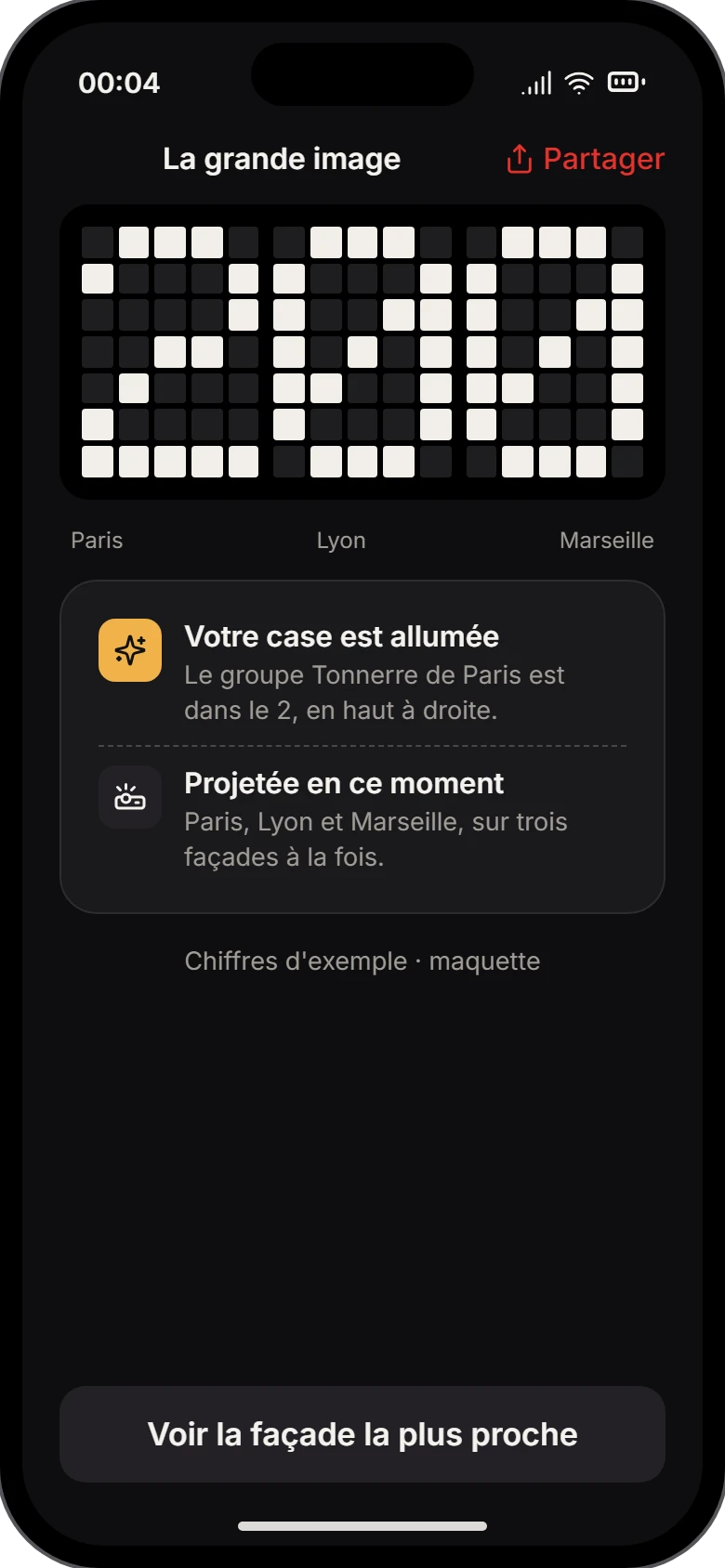
Each lit cell is the photo of a group that found each other. Lit together, the three cities write 200, for two hundred years of photography.
CONTACT SHEET · READ IT IN TWO MINUTES
3cities linked live: Paris, Lyon, Marseille
4strangers per group, brought together by shared tastes
< 10 mintarget screen time over the whole night
5people in the team, the constraint of the brief
THE BRIEFFor the bicentenary of photography, the Ministry of Culture wants an immersive experience linking Paris, Marseille and Lyon, inaugurated on Nuit Blanche night. The devices must interact; people must come together rather than stay alone on their phone; a team of five must be able to build it.
WHAT I DIDIn the 90-minute exam: a persona, the concept of finding strangers in the crowd thanks to a shared sign, a hand-drawn wireframe and a research approach. Then I took it further: the link between the three cities, the night's journey, clean screens, a safety charter, a realistic research plan, indicators and a schedule for five people.
THE IDEA IN ONE SENTENCEThe phone serves as a compass to find people, then becomes useless: what counts happens face to face, and the photo of the group feeds an image shared by three cities.
WHY IT MATTERS FOR A RECRUITERIt shows how I handle a brief under constraint: spot what the first answer missed, design for safety and real use, and measure success by what people live, not by time spent in the app.
VUE 01THE BRIEF, READ CLOSELY
Five requirements, and one paradox: an app that must keep people off their phones.
Before designing, I broke the brief down into requirements, because each one becomes a criterion to check the concept against. The trickiest is the paradox: the ministry does not want people isolated on a phone, yet the phone is the only device everyone carries.
PhotographyThe bicentenary must be at the heart, not a pretext.
Three citiesParis, Lyon and Marseille must interact.
Bring people togetherBetween cities, and between strangers in the same place.
Not on the phoneThe device must not isolate.
FeasibleFive people, a short deadline.
CONTEXT · NUIT BLANCHE 2026The 25th Nuit Blanche, on 6 June 2026, was placed under the theme of a great celebration of love, to bring people together and celebrate the joy of being together. A device built on meeting strangers fits that theme.
CONTEXT · TWO HUNDRED YEARSBetween 1826 and 1827, Nicéphore Niépce fixed the first lasting photographic image, the View from the Window at Le Gras. The Ministry of Culture runs a national Bicentenary of Photography programme.
VUE 02FROM THE EXAM TO THE PROJECT
Ninety minutes, a pen, and a first answer to take further.
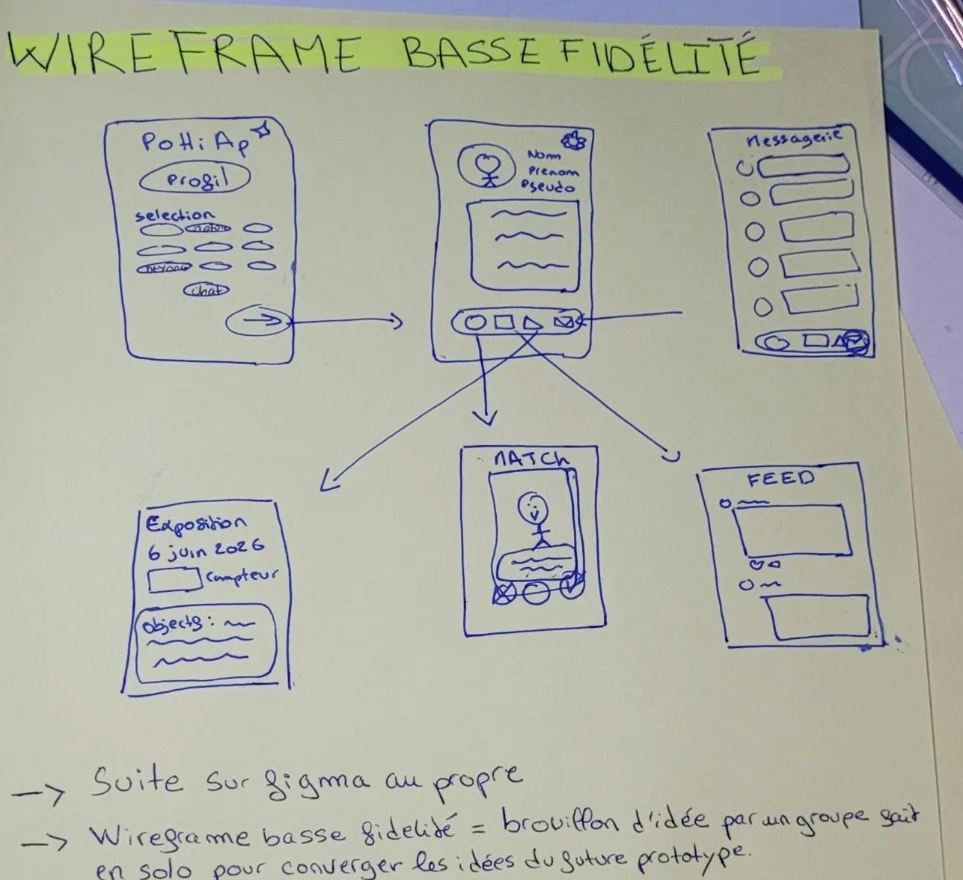
In the exam room, I named the app PoHiAp, drew six screens and laid out the core mechanic: the app connects you with three or four strangers who share your passions, and you have to find them in the crowd. A sign in common fills up when you meet. My references: the TurnUp app for meeting through music, Tinder for matching, and the K-drama Love Alarm, where a heart fills when someone who likes you is nearby.
MY PERSONA IN THE EXAMAlex, 22, copywriter in Paris, loves going out with friends, plays cosy games on Switch, draws, paints, reads crime novels; patient and attentive; wants to stay stimulated and find "the next gem".
MY WIREFRAME · DRAWN DURING THE EXAMOnboarding by tastes, profile, match, feed, messages and an "exhibition 6 June" screen with a counter and goals. My note at the bottom: a low-fidelity wireframe is an idea draft, made alone or as a group, to converge before the prototype.
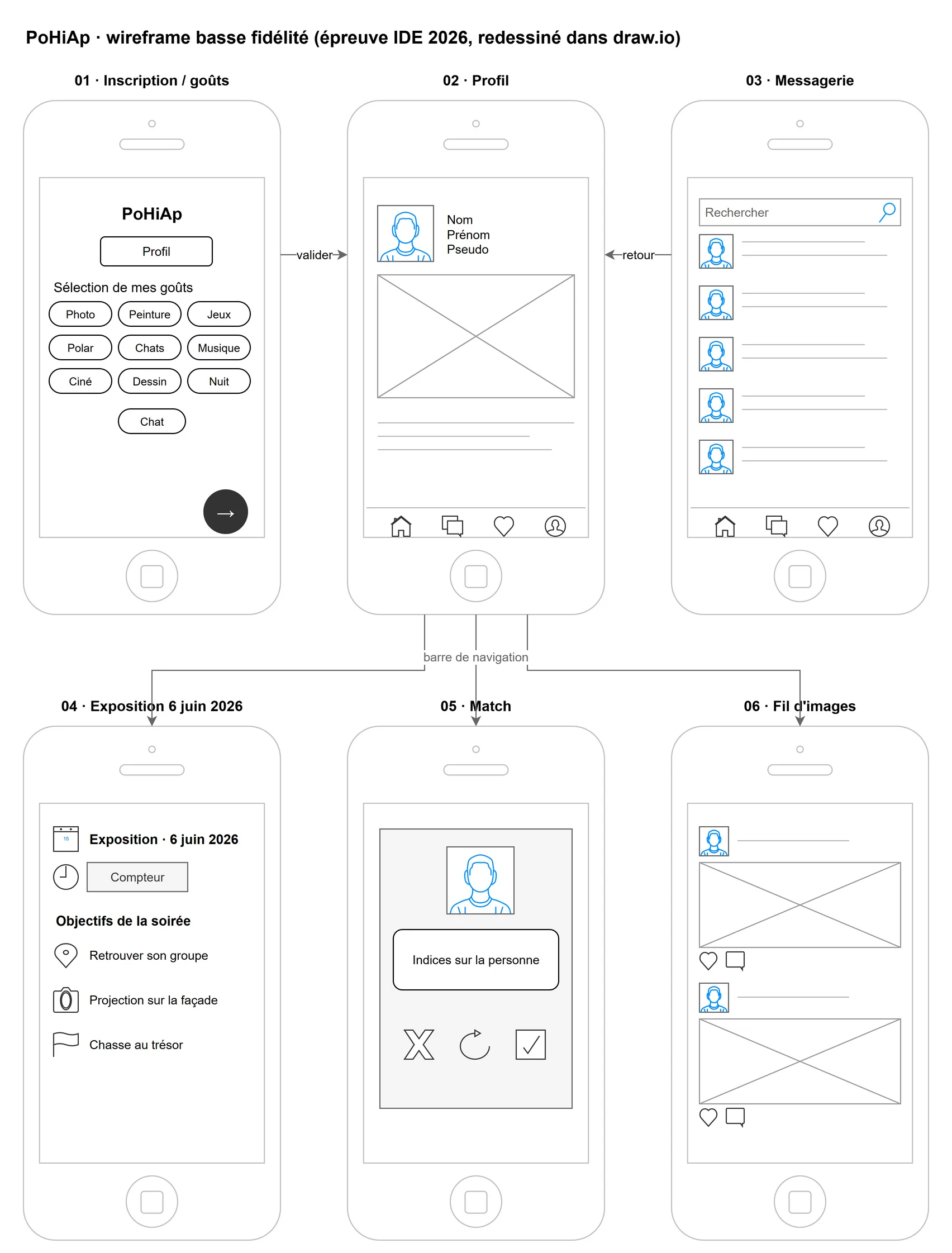
THE SAME WIREFRAME, REDRAWN IN DRAW.IOA faithful redraw of the paper sketch: same six screens, same navigation. It is the starting point; the screens in view 07 show where the project went.WHAT I CHANGED, AND WHY
POINTIN THE EXAMIN THE PROJECT
Three citiesEverything happens in one crowd.Each city's groups feed one shared image, projected in all three at once; the same sign links groups across cities.
PhotographyA feed of images, like Tumblr.The group photo is the act that completes the experience, and the composite image celebrates two hundred years of the medium.
The phoneAn app at the centre of the night.A compass for a few minutes, then back in the pocket; screen time becomes an indicator to minimise.
SafetyNot addressed.No exact position, meetings in staffed public zones, consent before any photo, a report button.
ScopeA lasting social network after the event.A one-night experience; data deleted after 48 hours.
ResearchPanel, questionnaire, interviews: too long for the deadline.A four-week plan, field tests on a rehearsal night, and observation on the night itself.
VUE 03NETNOGRAPHY
Before designing for the night, reading what people say about it.
Netnography is ethnography applied to online spaces: you observe what people write publicly, without intervening, and code it by theme. It is the only empirical material I could gather without a field. Corpus: 16 visitor testimonies published by the City of Paris, 7 contributions on a travellers' forum, and the official recap of the 2026 edition. Exploratory, not representative.
16visitor testimonies (City of Paris)
7contributions on a travellers' forum
1official recap, 2026 edition
THEMEWHAT THE CORPUS SAYSWHAT IT CHANGES IN THE DESIGN
Waiting and crowdsThe most frequent irritant on the forum (5 of 7 contributions): long lines, packed venues. The official recap mentions "several hours of waiting" for one show. Yet a group of students "did not regret" an hour and a half in line.Waiting is accepted when it leads somewhere. The search for one's group turns waiting time into an activity, and staggered meeting times avoid queues at the photo points.
Escape and wonder5 of 16 testimonies: feeling "transported to another reality", leaving France for the length of a show, relief after a week of work.The highlight must be a shared spectacle, not a screen: hence the big image on facades.
One work, many readingsThree visitors of different ages see a diamond, a beating heart and a shower head in the same artwork.A shared object to interpret is a natural icebreaker: the clues and the sign play this role between strangers.
Being together4 testimonies are about dancing, a friend, a group, the festive atmosphere. People come in pairs or groups; no one mentions meeting strangers.Meeting strangers is a hypothesis, not an observed need. Let people join as a pair, and test the appetite for strangers first.
Planning and language3 forum contributions advise mapping a few nearby venues in advance; one notes that many shows are in French only.The "before" step and the zone on the ticket meet this need; the screens and kiosks must be bilingual for tourists.
ExcessOne contributor found venues "packed and raucous" with heavy drinking, and would not go again.Confirms the staffed zones and volunteers of the safety charter.
WHAT IT SHOWSWaiting is the main irritant, wonder the main reward, and people come with those close to them. One finding matters as much as the others: the phone never appears in these testimonies.
WHY IT MATTERSThe corpus supports two design choices (a shared spectacle, staffed zones) and challenges one assumption: the desire to meet strangers. That is exactly what the Wizard of Oz test must verify first. Method: public content only, paraphrased, no usernames.
VUE 04WHO IT IS FOR
One priority profile, and the people around it.
In the exam I wrote that designing for everyone means designing for no one. I kept a priority profile, Alex, but added the other publics I had listed myself: people who love photography, revellers, passers-by and tourists. A good concept for Alex must not exclude them.
ALEX · PRIORITY22, copywriter, extrovert, plays cosy games, draws.Wants: to be stimulated, to meet people who share their tastes.Risk: gets bored if it is too slow.
THE PHOTO LOVERComes for the bicentenary, often alone, camera around the neck.Wants: to talk photography, to see a beautiful image.Risk: finds the app gimmicky.
THE PASSER-BYTourist or curious, discovers the device on the spot, no account.Wants: to understand in ten seconds and join.Risk: language, no app installed.
WHAT IT SHOWSThree profiles with different needs: Alex wants stimulation, the photo lover wants substance, the passer-by wants to join in ten seconds without an account.
WHY IT MATTERSHence three design decisions: a web page that opens by QR code, no install; a quick and playful mechanic for Alex; and a real photographic act, the group pose, for those who come for photography. These are proto-personas: to be validated by research.
VUE 05EMPATHY MAP
Alex, on the night: what they say, think, do and feel.
Built from my exam persona and the netnography, to share a single image of the user with the team before designing. It describes hypotheses, to be confirmed in interviews.
SAYS· « On se retrouve où ? »· « Il y a combien d'attente ? »· « Je l'ai prise en photo pour ma story. »
THINKS· I'd like to meet people who like the same things.· I don't want to look weird approaching someone.· I hope it's worth the queue.
DOES· Comes with two friends, plans 2 or 3 venues.· Checks the programme on the phone in the line.· Photographs installations, rarely the people.
FEELS· Excited at the start, tired by the waiting.· Shy with strangers despite being outgoing with friends.· Moved when a work surprises them.
PAINSWaiting; fear of the awkward first contact; being stuck on the phone; not finding anyone.
GAINSA reason to talk to someone; a shared memory; seeing their photo become part of something bigger.
WHAT THE DESIGN ANSWERSThe sign and the clues give a reason to approach; the search fills the waiting time; joining with friends lowers the shyness.
VUE 06THE NIGHT, STEP BY STEP
Experience map: seven moments, and the phone out for only a few minutes.
The journey is designed so that the screen fades out as the night goes on. Each bar shows the target time on the phone at each step, in minutes: the total stays under ten for the whole night.
BEFOREChoose your tastes
21:00Get your sign
21:05Find each other
21:30Complete the sign
22:00Common pose
00:00The big image
AFTERKeep the trace
ACTIONSPhoto genres, artists, ways of going out. Two minutes, at home.A sign (thunder, wave, spiral…) shared with 3 or 4 strangers nearby.Warmer / colder, then the phone goes back in the pocket: you look at faces, not the screen.Phones touch: the sign fills by vibration. The group exists.One photo of the group, taken at the photo point of the square, with consent.The photos of the three cities form one image projected on three facades at the same time.The group's photo and the big image, then everything is deleted after 48 hours.THOUGHTS"Will I find people like me?""Thunder, that's me.""Warmer… it's them, in yellow!""We're four now.""Silhouette, it's fine.""There's our cell!""I'm keeping this one."TOUCHPOINTSWeb page, QR codePhonePhone, then the crowdTwo phones, vibrationPhoto point, volunteerThree facadesPhone, 48 hOPPORTUNITIESJoin as a pairBilingual cluesVolunteer button always visiblePhones-away promptSilhouette by defaultSame time in 3 citiesDownload, then deleteEMOTIONSCREEN
2 min
1 min
3 min
1 min
1 min
0 min
1 min
Experience map of a participant in Paris. Thoughts and the emotion curve are hypotheses drawn from the empathy map, to be measured on the night.
WHAT IT SHOWSThe phone only matters at the start, to find the group, and for the pose. The highlight of the night, the big image, happens on a facade, with everyone looking up together. Two risky moments are flagged: getting lost in the crowd, and not wanting to be photographed.
WHY IT MATTERSIt answers the paradox of the brief: the phone is used as a tool to leave the phone. Each risky moment has its answer: volunteers in red vests at each square for those who are lost, and the choice of a silhouette instead of a face in the photo.
VUE 07THE SCREENS
Six screens, from my paper wireframe to a high-fidelity prototype.
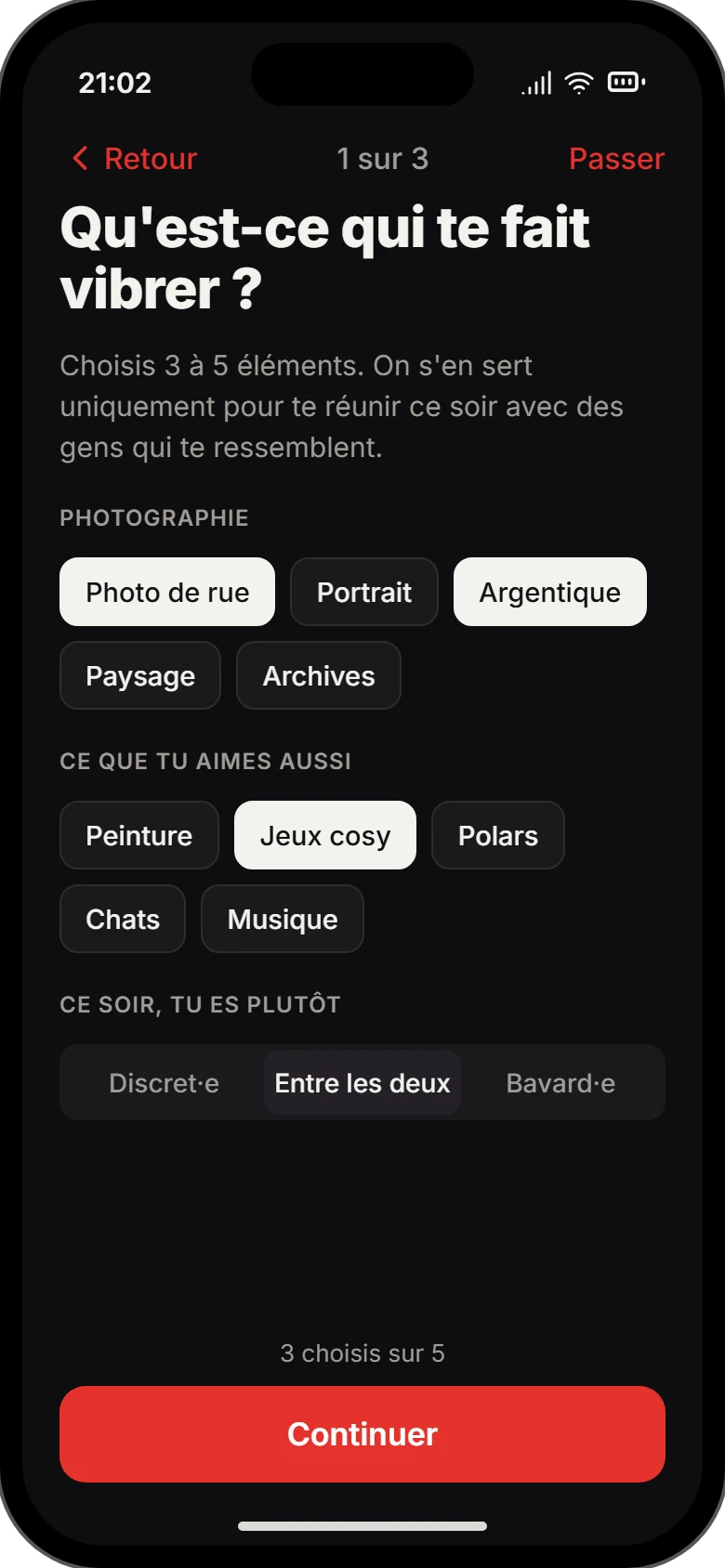
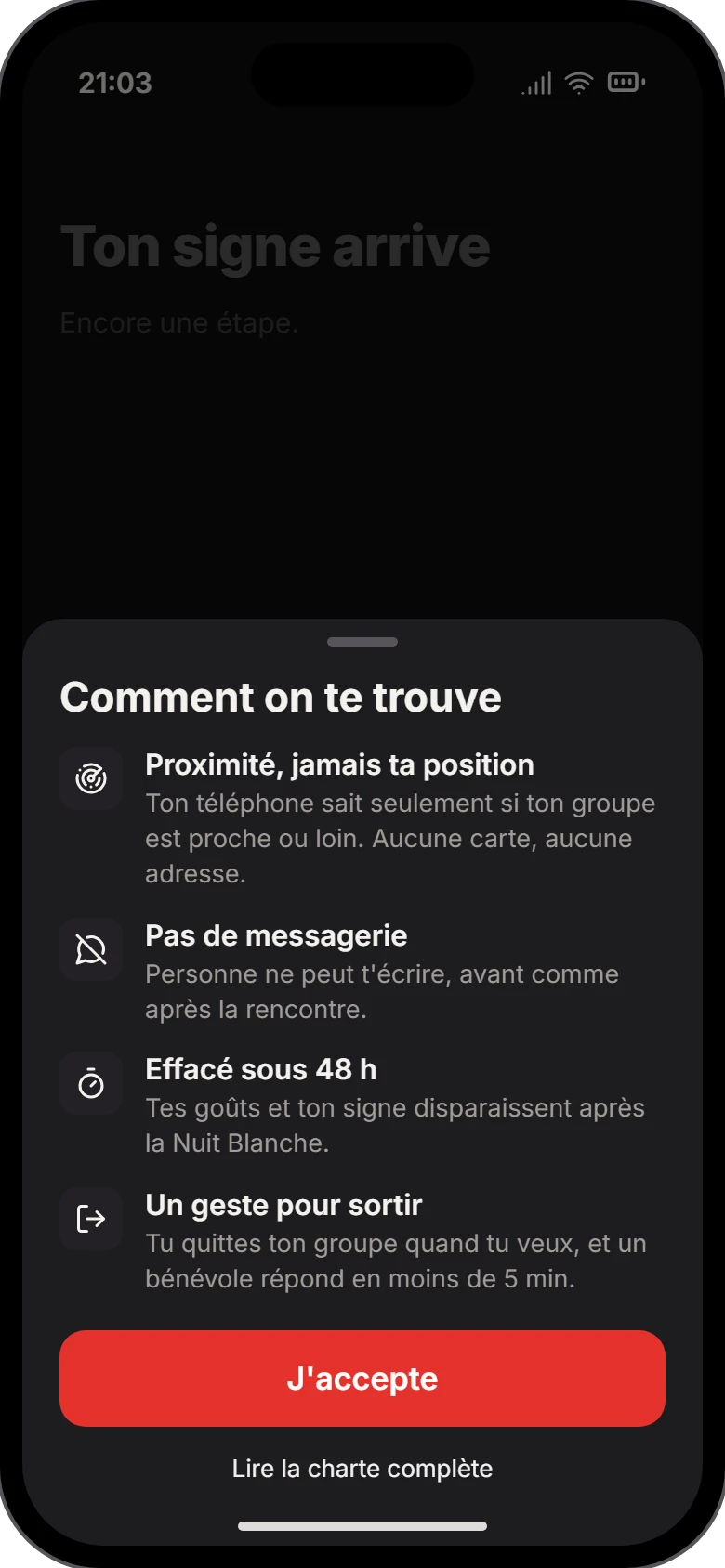
Six high-fidelity screens, in dark mode because the app is used at night. I drew on the conventions of real apps: Apple's Precision Finding for the search, which guides with sound, vibration and a visual signal rather than a map; event apps, which explain a permission before asking for it and let you skip a step.
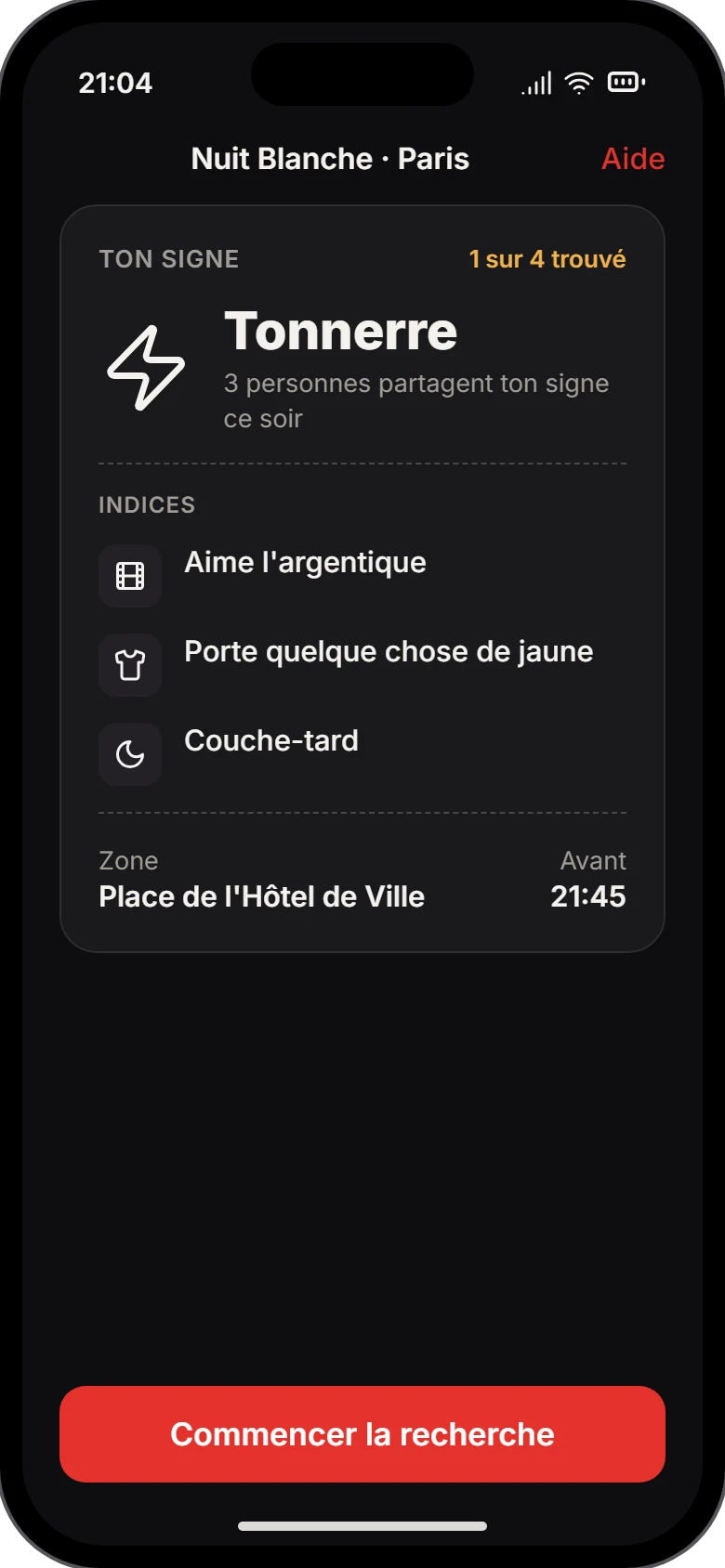
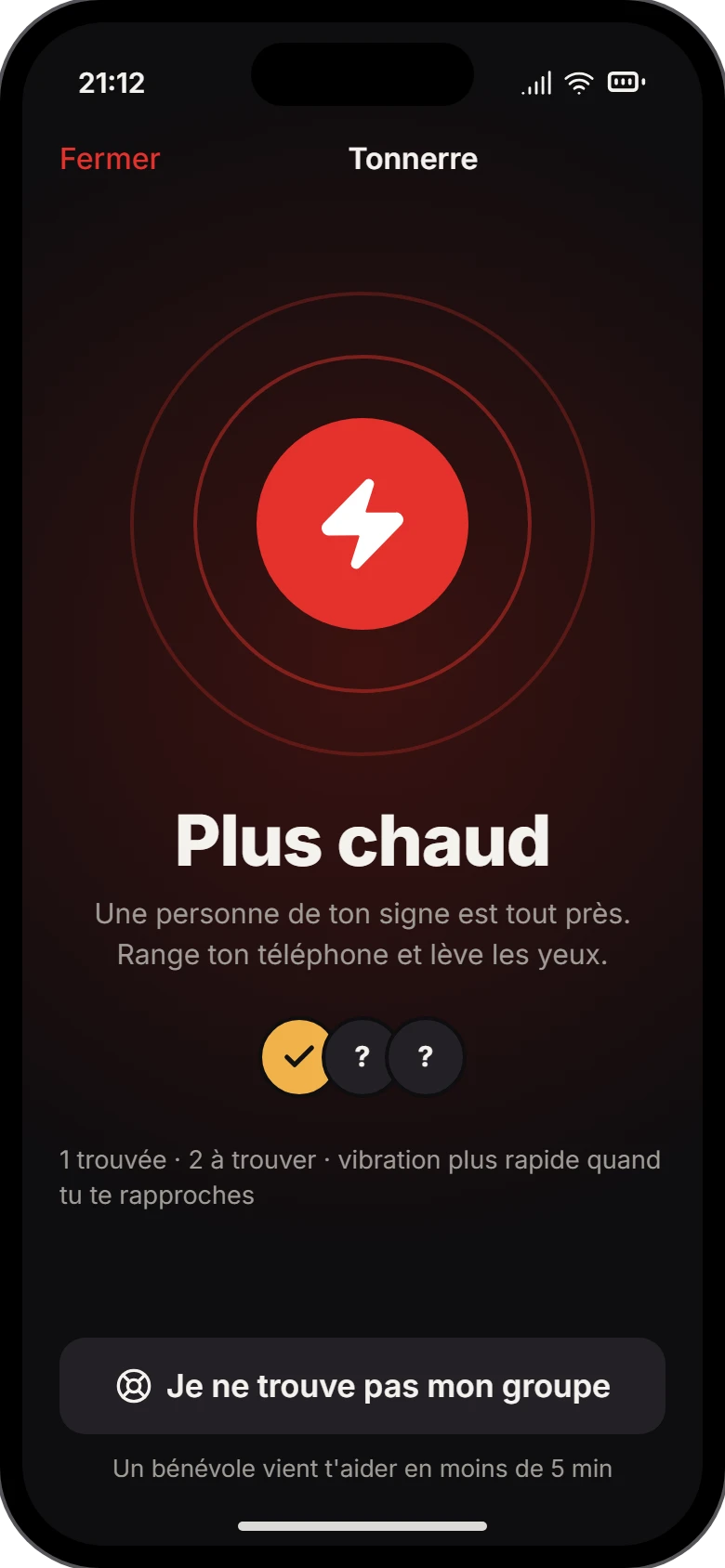
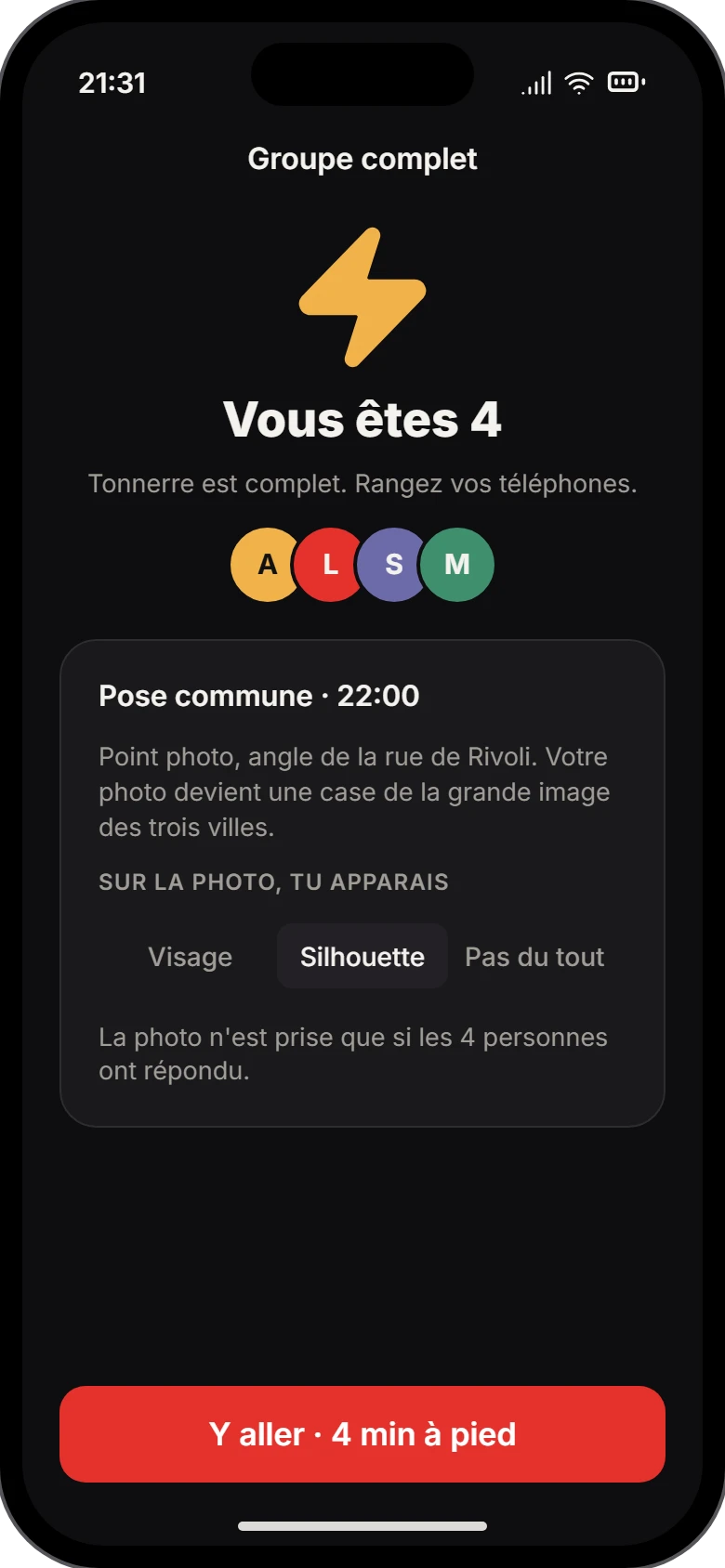
01 · TASTES3 to 5 choices, a "skip" option, the reason given before the request: tastes only serve tonight's matching.02 · CONSENTA sheet that explains the four safety rules in plain words before anything starts. One clear button, the full charter one tap away.03 · YOUR SIGNDesigned like a ticket: the sign, three clues, the zone and the deadline. Never a photo or a name.04 · SEARCHInspired by Precision Finding: warmer or colder, faster vibration as you get closer, and a visible way out: "I can't find my group" calls a volunteer.05 · COMPLETEThe sign fills, the app tells you to put phones away. Each person chooses how they appear in the photo; it is only taken when all four have answered.06 · THE BIG IMAGEYour group's cell lit in the 200 of the three cities. Figures shown are placeholders.
Icons: Lucide, an open-source icon set (ISC licence). Screens designed for the project; figures shown are examples.
VUE 08THREE CITIES, ONE SYSTEM
How the devices talk to each other.
WHAT TRAVELSOnly three things: the sign of each group, its state (searching, complete) and, with consent, its photo. Never a position, never a name.
THE LINK BETWEEN CITIESEach sign exists in all three cities. When the Thunder groups of Paris, Lyon and Marseille are all complete, the sign lights up on the three facades at once, and each city sees the others' photos arrive.
WITHOUT A SMARTPHONEA kiosk at each square hands out a sign on a card; volunteers do the matching by hand. Nobody is left out because of their phone.
VUE 09SAFETY AND PRIVACY
Meeting strangers at night: six rules, decided before the first screen.
This is the point the exam answer did not cover, and the one a client would ask about first. Love Alarm, my reference, shows the risk: knowing who is nearby can be used against someone. The rules below are design constraints, not an afterthought.
1NO EXACT POSITIONOnly warmer or colder, computed on the server in wide distance bands.
2STAFFED ZONESMeetings only happen in lit public squares, with volunteers in red vests.
3NO PRIVATE MESSAGESNo chat before or after the meeting: no way to insist or harass.
4CONSENT TO THE PHOTOEach person chooses: face, silhouette, or not in the photo. The group photo needs everyone's yes.
5ONE-TAP EXITLeave the group at any time; a report button alerts the volunteers.
6DELETED IN 48 HTastes, signs and photos are deleted after 48 hours; only the big image remains, without faces.
VUE 10THE SOCIOLOGICAL BET
Turning a crowd of strangers into small groups, with the help of a photo.
GOFFMAN · CIVIL INATTENTIONIn public, we politely ignore strangers: a quick glance, then eyes elsewhere. The device gives a legitimate reason to break this rule for one night: you have a sign in common, so you may approach.
BOURDIEU · UN ART MOYENBourdieu's team showed that photography is above all a social rite: the group photo celebrates and strengthens the group. Here, the pose is the moment that seals a group born an hour earlier.
GRANOVETTER · WEAK TIESWeak ties, people we know a little, open us to new circles. The night creates weak ties around shared tastes, without forcing friendship.
TURKLE · ALONE TOGETHERSherry Turkle describes being together while each person is absorbed in their screen. The device is designed against this: the success of the night is measured by phones put away.
VUE 11PRIORITISING
Five people, a few weeks: what we build first.
BUILT FIRSTThe core loop: sign, warmer/colder, group pose, volunteer button, plus the kiosk and bilingual screens so no one is left out. Without it, there is no experience; the big image comes right after, because it is the promise of the night.
IF TIME ALLOWSThe treasure hunt from my exam answer: a good idea, but a whole second experience to design and test.
DROPPED, AND WHYMessaging and the image feed from the exam: costly, and contrary to the brief and to safety. Dropping my own ideas is part of the method.
VUE 12RESEARCH PLAN
Four weeks before, one night during, one week after.
My exam plan was sound in its logic, but too long for the deadline. Here is a version that fits the time and the team, mixing UX research and social sciences methods.
WEEK 1UnderstandDesk research on Nuit Blanche audiences; short online questionnaire (Likert scales and open questions, lexical analysis with Iramuteq); 6 to 8 street interviews in places where people go out at night.
WEEK 2Co-designWorkshop with the team of five, using de Bono's six thinking hats to debate ideas without "I don't like it"; paper prototype of the 5 screens.
WEEK 3TestWizard of Oz test: the team plays the server and sends "warmer / colder" by hand to 12 participants on a real square, at night.
WEEK 4RehearseDress rehearsal in the three cities with volunteers; check the projection, the kiosk without smartphone and the safety rules.
THE NIGHTObserveEthnographic observation with a grid: heads up or down, groups formed, waiting time; 2-minute intercept interviews.
AFTERAssessPost-event questionnaire, 8 interviews at one week, cross-analysis with the anonymous logs.
WHY A WIZARD OF OZBuilding the real proximity system takes weeks. Simulating it by hand tests the essential question first: do people actually look up and approach strangers?
RECRUITINGThrough cultural venues, photo clubs and student associations in the three cities, with parity and a share of people over 40, and a consent form for each test.
ONE TEAM OF FIVEA product designer leading the project, two UX/UI designers, two UX researchers, as in my exam answer; the projection and the server are handled with the venues' technical teams.
VUE 13INDICATORS
Measuring success by what people live, not by time spent in the app.
A classic app measures engagement: the more time spent, the better. Here, the logic is reversed. These are targets set before the event, to be measured on the night; they are not results.
< 10 minmedian screen time per participant over the nightSOURCE · anonymous logs
70 %of signs completed within 20 minutesSOURCE · logs
60 %of people observed heads up rather than down, at the photo pointsSOURCE · observation grid
4 / 5average on "I met someone I wouldn't have met otherwise"SOURCE · post-event questionnaire
0serious safety incidents; every report handled within 5 minutesSOURCE · volunteers' log
30 %of participants coming through the kiosk without a smartphone, or moreSOURCE · kiosk count
WHAT IT SHOWSSix indicators: two on the phone (time, completion), two on human contact (heads up, feeling of meeting), one on safety, one on inclusion.
WHY IT MATTERSThe usual indicator, time spent in the app, would reward exactly what the brief forbids. Choosing what to measure is a design decision: it decides what the team will optimise.
VUE 14LIMITS AND WHAT I LEARNED
A speculative project, honest about what it does not know.
NOT BUILT, NOT TESTEDEverything here is a proposal: personas, targets and screens remain to be validated by the research plan.
THE CROWD IS UNPREDICTABLENetworks saturate in dense crowds; the warmer / colder must work with very little connection, or fall back on the volunteers.
NOT EVERYONE WANTS TO MEETSome come to watch, not to talk. The big image must be beautiful even for those who never take part.
WHAT I LEARNEDTo reread a brief as a list of requirements and check my own answer against it; to treat safety as a starting constraint; and to choose indicators that serve people rather than screen time. The exam gave the idea; the work afterwards made it a project.
REFERENCESGoffman, E. (1963). Behavior in Public Places. Free Press. · Bourdieu, P. (dir.) (1965). Un art moyen. Essai sur les usages sociaux de la photographie. Minuit. · Granovetter, M. (1973). The Strength of Weak Ties. American Journal of Sociology, 78(6). · Turkle, S. (2011). Alone Together. Basic Books. · Ministry of Culture, Bicentenary of Photography 2026-2027.
NEXT_CASE_STUDY
ERGONOMIC BENCHMARK
FITNESS APPS
An ergonomic benchmark of six apps: what the interface does to the body.