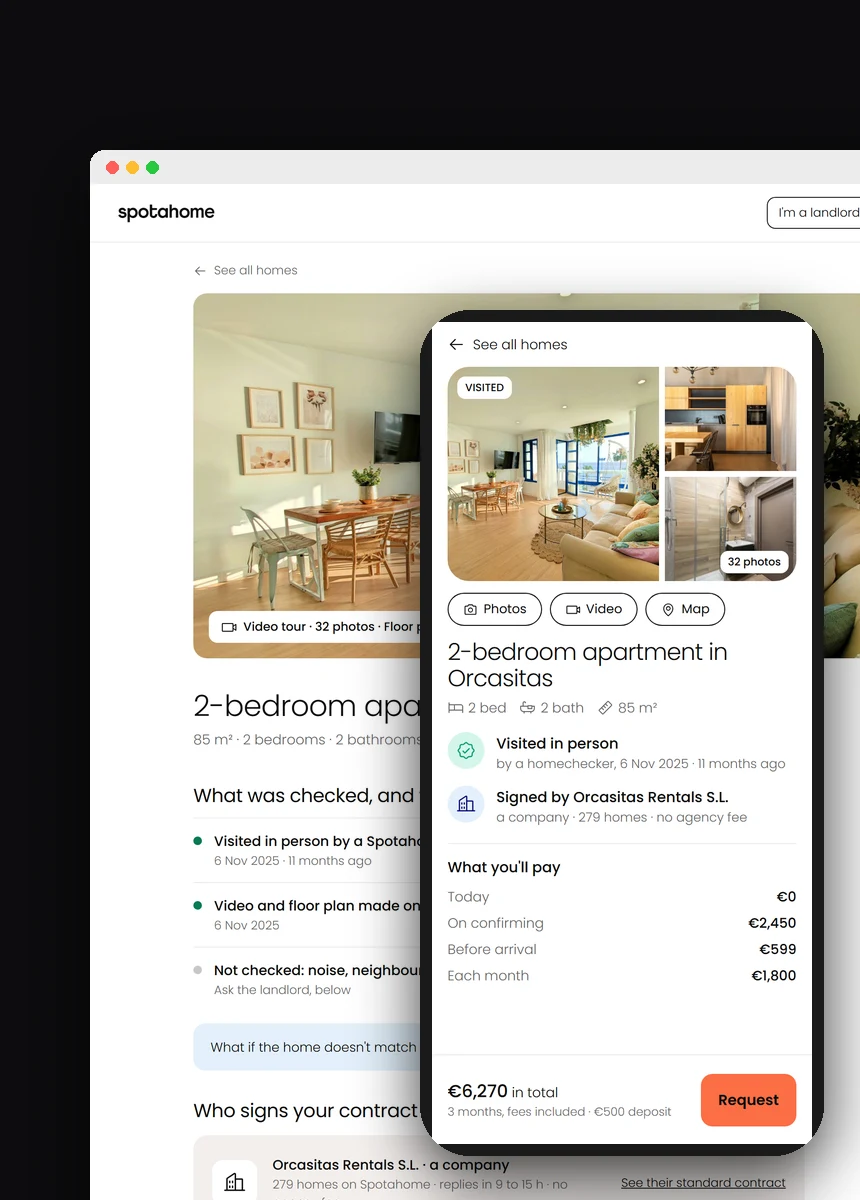
NOTHING HIDDEN
Booking a home without seeing it
Spotahome lets students and expats rent a furnished home for months without visiting it. I studied how people trust a place they have never seen, using social-science methods on 716 reviews, a real booking journey and 60 listings, then redesigned the journey inside Spotahome's own brand.
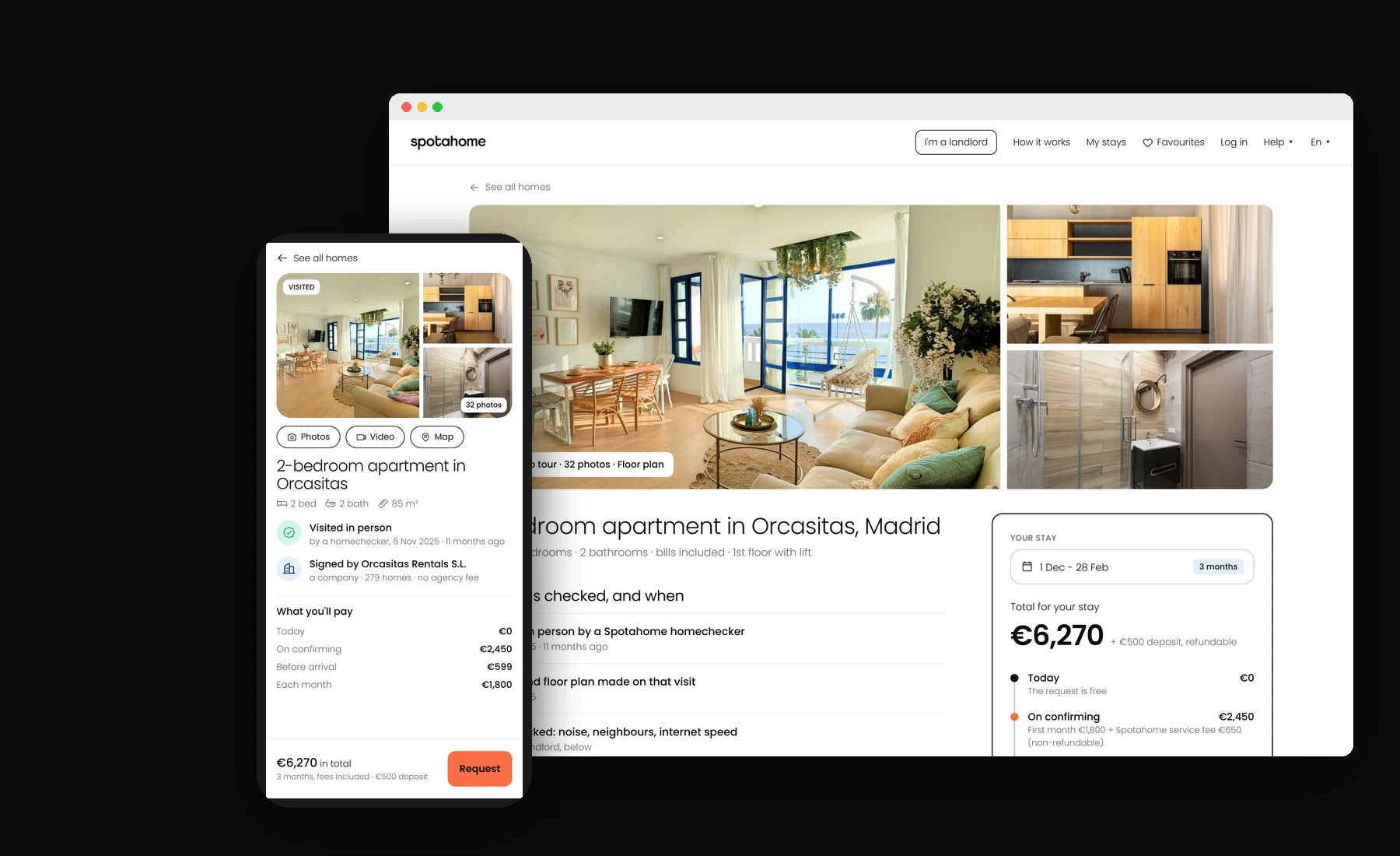
Spotahome sells peace of mind, yet its one-star reviews doubled in a year (18.6% to 36.4%). Tenants can only check the price, the verification and the rules after paying.
Twenty-one social-science and ergonomic-psychology methods, without any participant: 716 reviews coded by hand, five ideal types, 203 brand replies, the real journey, the terms, 60 listings and their photos, three competitors, 34 audit findings.
Six insights, five design principles and a redesign called "Nothing hidden": 5 desktop pages, 6 mobile screens, a clickable prototype, and the interview guide, test guide, survey and note-taking grid ready to run.
In one year, one-star reviews have doubled
Trustpilot's public counters tell what the overall 3.5 hides: the share of one-star reviews went from 18.6% for reviews over a year old to 36.4% over the last 12 months, and the average rating from 4.38 to 3.16 over the last 30 days.
Share of one-star reviews by period (Trustpilot, 16,529 reviews, 7 October 2026)The total for the stay doesn't exist before paying: 52 s, 8 clicks and 5 sums to rebuild it.
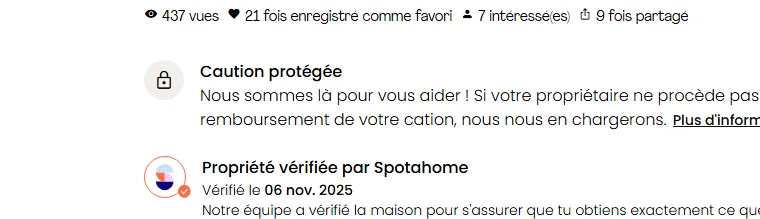
"Verified" says neither how nor when: 17 months in median, by a freelance photographer.
The guarantee promises with certainty; the terms add conditions and judge alone.
And after paying, no one: 49% of negative reviews mention silence and 92% of one-star stories have no resolution. Hence "Nothing hidden": make the promise checkable before paying, keep a named person after.
Same sector, another question
My SpareRoom case study is about people and a brand. Spotahome asks something else: money, rules and what happens after paying. To avoid writing the same study twice, I changed the tools too. No invented personas, no rebrand: methods from sociology and ethnography, with ideal types built from the reviews, then a product redesign that keeps Spotahome's logo, colours and type.
A platform that sells trust at a distance
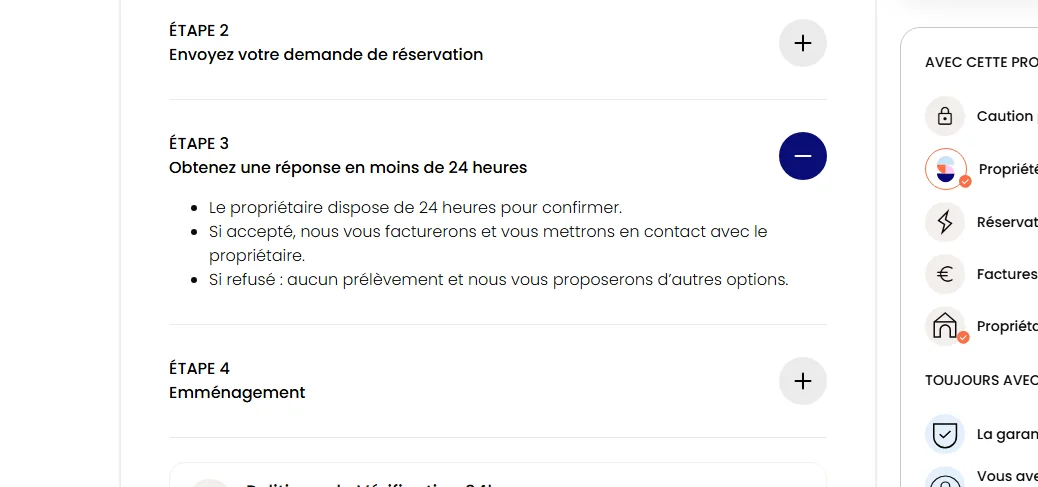
Spotahome rents furnished homes for 1 to 11 months in over 800 cities. Nobody visits: homecheckers film the home, the platform holds the first payment for 48 hours and promises a 24-hour guarantee on arrival.
How do people trust a home they have never seen? What devices does the platform put in place, and what happens to them when the experience spills over the frame?
Twenty-one tools, no participant
I had no access to users, so I chose methods that work on traces people leave behind, and I say so on every deliverable. Interviews and tests are written, ready to run, not run.
Netnography Kozinets, 716 reviews · Ideal types Weber, 5 profiles · Lexical analysis Log-likelihood, negative vs positive · Temporalities 2017 to 2026, review lag · Trust model Mayer, Davis, Schoorman, 716 reviews · Narrative analysis Labov, Waletzky, 60 stories
Interaction order Goffman, 203 replies · Discourse analysis Flesch-Kandel, Guarantees vs terms · Qualification Boltanski, Thévenot, 31,644 words
Walkthrough method Light, Burgess, Duguay, real journey · Script Akrich, expected user · Ergonomic audit Bastien & Scapin, 34 findings · Task analysis and KLM Card, Moran, Newell, 52.3 s · Cognitive walkthrough Wharton, Polson, 10 steps · Accessibility WCAG 2.1, axe-core, 5 pages
Content analysis Karpik, 60 listings · Visual semiology Barthes, photos · Dark patterns Gray, Mathur, Morwitz, 60 listings · Benchmark DiMaggio, Powell, 3 competitors · Actor mapping Latour, Venturini, draw.io map
Prepared, not run: interview guide, test guide, 22-question survey and note grid (Kaufmann).
The problem isn't the home, it's after paying
I read all 716 texts, built a 26-code grid from what they said, then coded each one by hand. A first keyword pass only found 53% of the manual codes, so it was used to test the grid, not to count.
Share of 1-2 star reviews that mention the theme (n = 200)"Spotahome will be so attentive and responsive only if you are trying to book"
"this is now the only way I can communicate with Spotahome"
Over ten years: the same complaints on Que Choisir in 2016 to 2019 (agency fee on arrival, the 24-hour rule, deposits not returned) as on Trustpilot in 2026.
Five ways of being let down, each at a different moment
Instead of inventing personas, I described each of the 347 negative reviews by its codes and grouped close reviews with a k-medoids clustering (Jaccard distance, 5 clusters, silhouette 0.24). Each cluster is named as an ideal type in Weber's sense: an accentuated portrait, not a real person.
Guarantees 57%, listing gap 46%, silence 38%
Silence 64%, cost revealed after paying 56%
Interface defects, mostly App Store
Cancelling, double charge, multiple requests
Fake availability, chains of refusals
Specific words by log-likelihood, 1-2 stars against 4-5 stars
The brand answers almost every complaint, never as a person
Spotahome publicly replies to 88% of 1-2 star reviews, within 46 hours in median. Read with Goffman, the reply is a front stage: it speaks to future customers reading, and sends the problem backstage, to a private channel. Positive reviews thank Andrea, Lucas or Lucía; the replies are never signed.
Share of the 203 public replies showing each moveListed at €1,800 a month, about €6,270 for three months
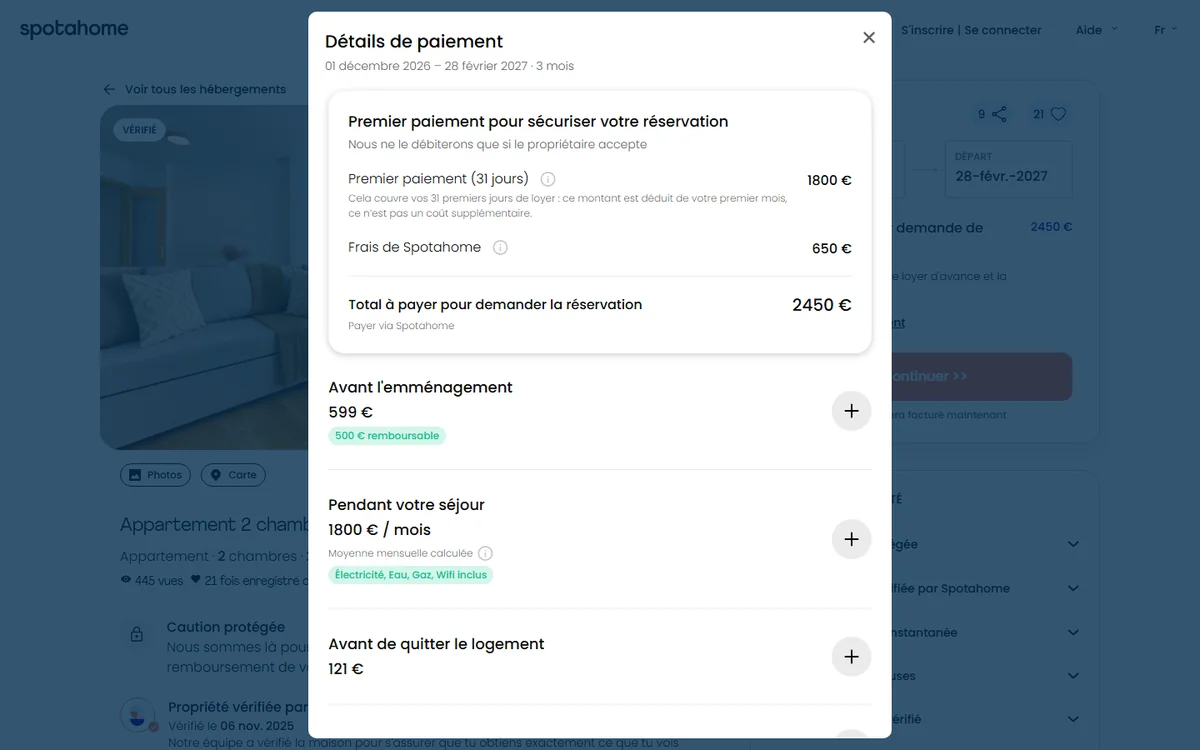
I walked through a real Madrid listing as a visitor, dates included, until the sign-up wall. The price shown is the rent alone. The first payment, €2,450, includes €650 of fees presented as "the Spotahome guarantee". The total for the stay is never added up: it is a help-centre article.
"€1,800/month" on the card
"Select dates to see prices"
"Total to pay per request: €2,450, includes one month in advance and the Spotahome guarantee"
In the breakdown: €650 fee, €599 before move-in, €121 at move-out
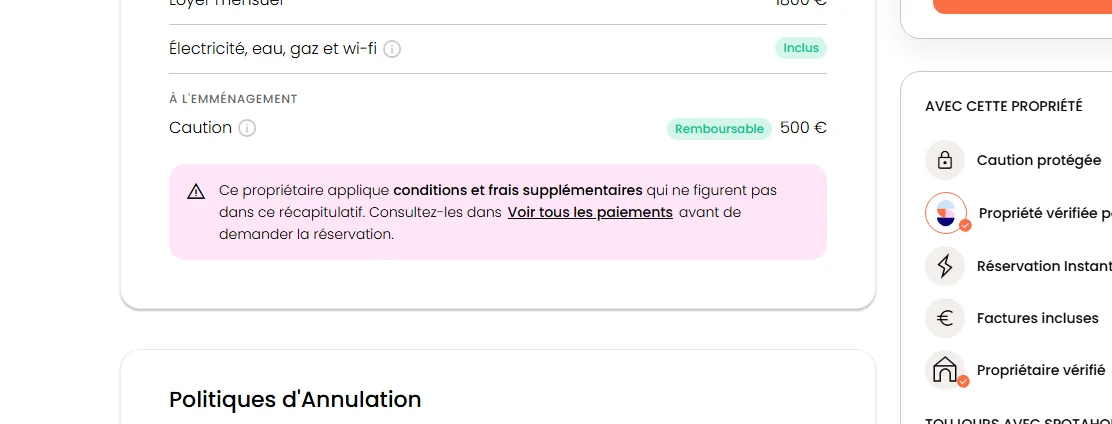
The terms class as "minor", with no right to cancel, the very situations reviews describe most. Only one party qualifies the situation, after the fact.
Guarantees page: 50 certainty markers and 4.4 conditions per 1,000 words, readability 61. Terms, section 7: 2.2 certainty markers, 13.4 conditions, 40-word sentences, readability about 28 (very hard). "Discretion" appears 42 times, "reserves the right" 54 times.
The label doesn't say what it proves
One listing uses photos marked "Example"; two show a room still occupied by the current tenant. The photo answers "what does the room look like?", never "who will I live with?".
Everyone shares the same device; legibility makes the difference
HousingAnywhere, Uniplaces and Wunderflats also hold the first payment until after arrival and charge a non-refundable fee. Read with DiMaggio and Powell, this is isomorphism: under uncertainty, a field ends up alike. Spotahome can stand out through what no one does: state the total, date the verification, write the rule before payment.
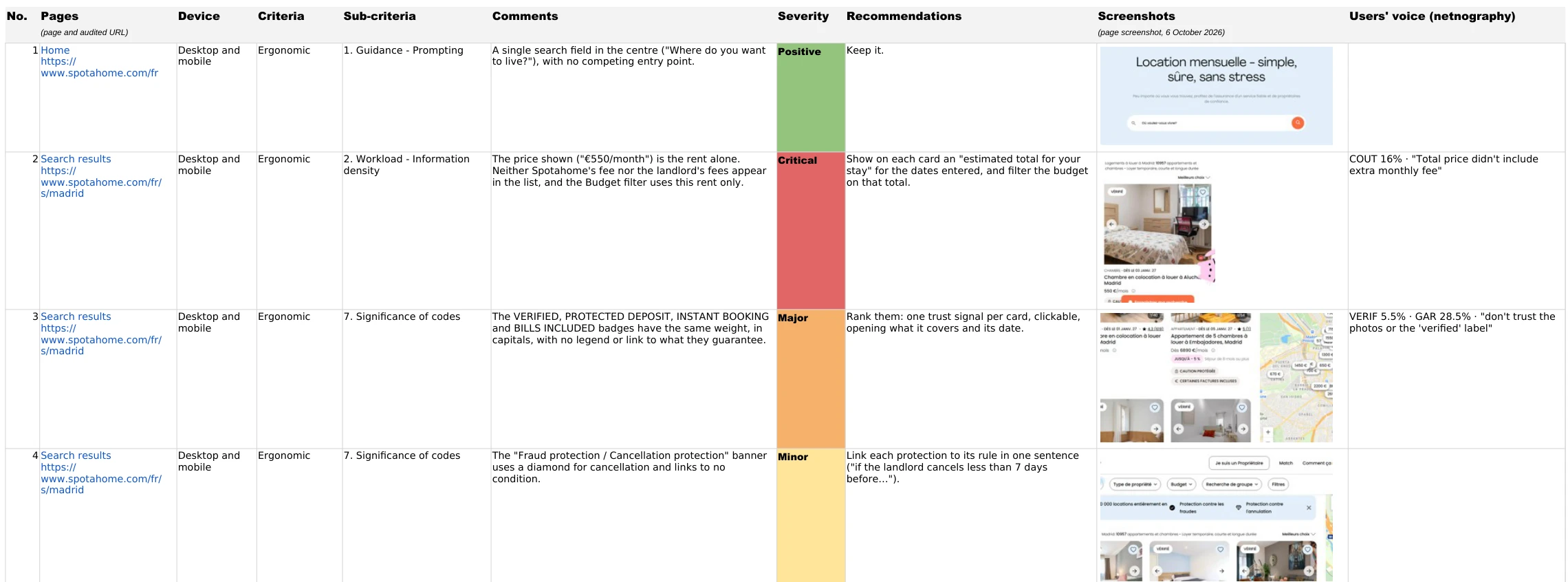
9 critical findings, all about money or control
34 findings in an Excel grid, each with its Bastien & Scapin criterion, severity, screenshot, recommendation and a "users' voice" column: the share of reviews that describe the same problem.
Measured, not guessed
Ten more methods carried through to results, still without participants: task analysis and the KLM model, cognitive load, a cognitive walkthrough, a dark-pattern audit, an accessibility test, Mayer's trust model, a service blueprint, Labov's narrative analysis, homechecker job ads and the terms read against the Consumer Code.
Time to find the real cost of a 3-month stay (KLM model)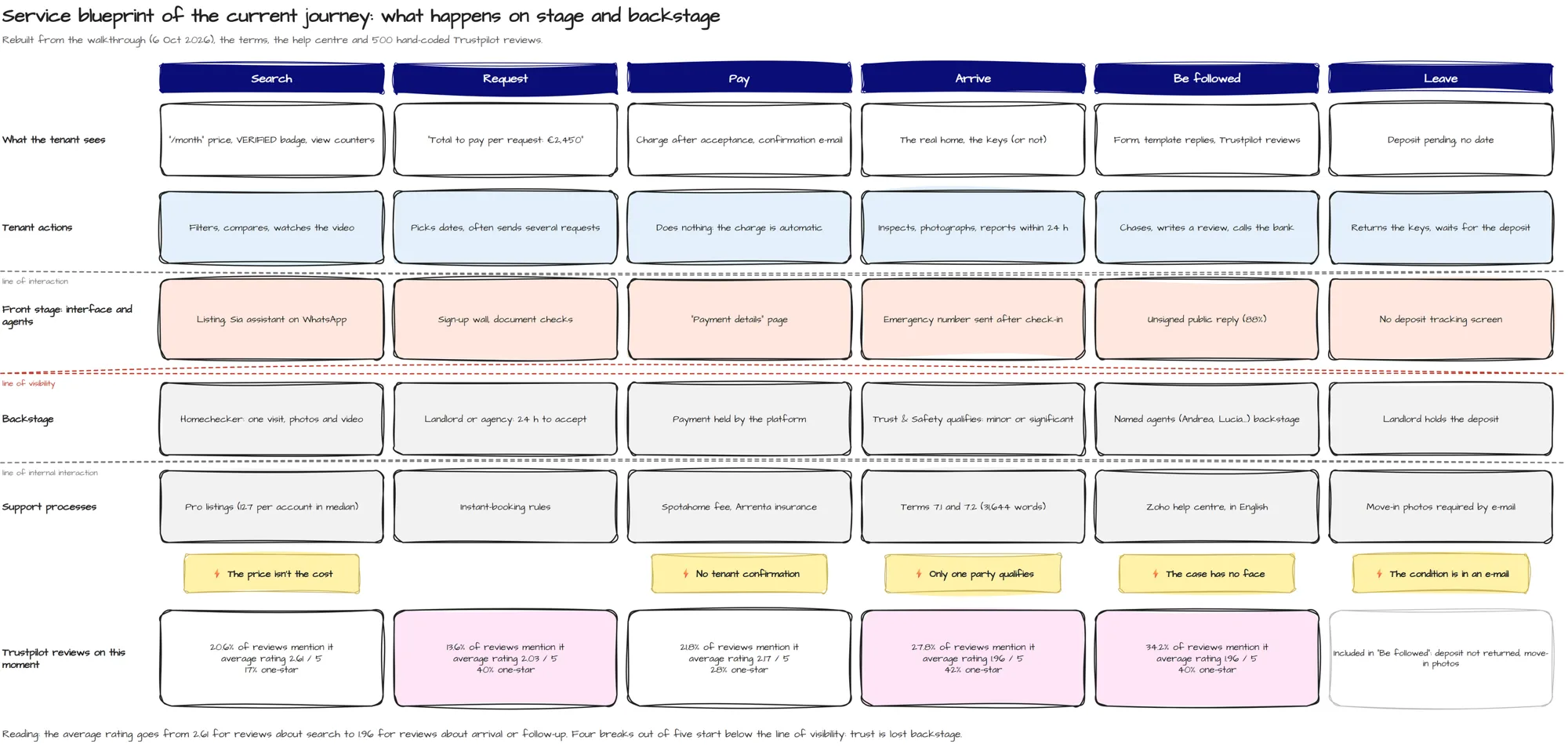
Homechecker job ads describe a freelance photographer, and 6 clauses of the terms match the French Consumer Code's black list (a reading grid, not legal advice).
Six insights, five principles
Relief at booking, silence after paying.
The total is never added up; the fee becomes a "guarantee".
Verified covers in person or remote, 17 months old in median.
Paying more or living with the landlord counts as "minor".
Reviews, chargebacks, screenshots of every listing.
Positive reviews thank Andrea or Lucas, not "Spotahome".
Eleven wireframes in draw.io
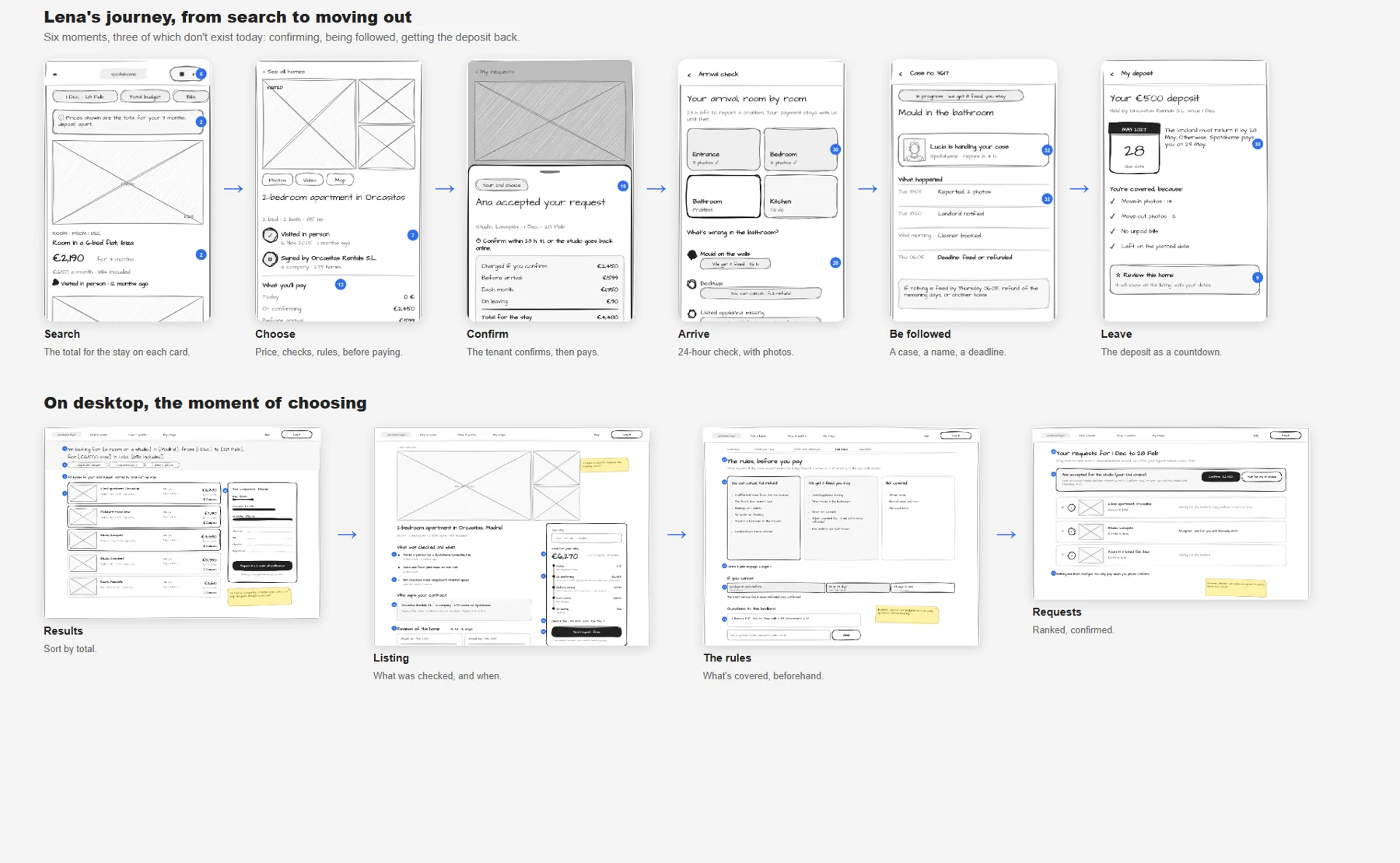
Five desktop screens and six mobile screens, drawn in draw.io in sketch style. Each blue number points to an audit finding; yellow notes hold the open questions to settle in testing, including two business tensions for Spotahome.
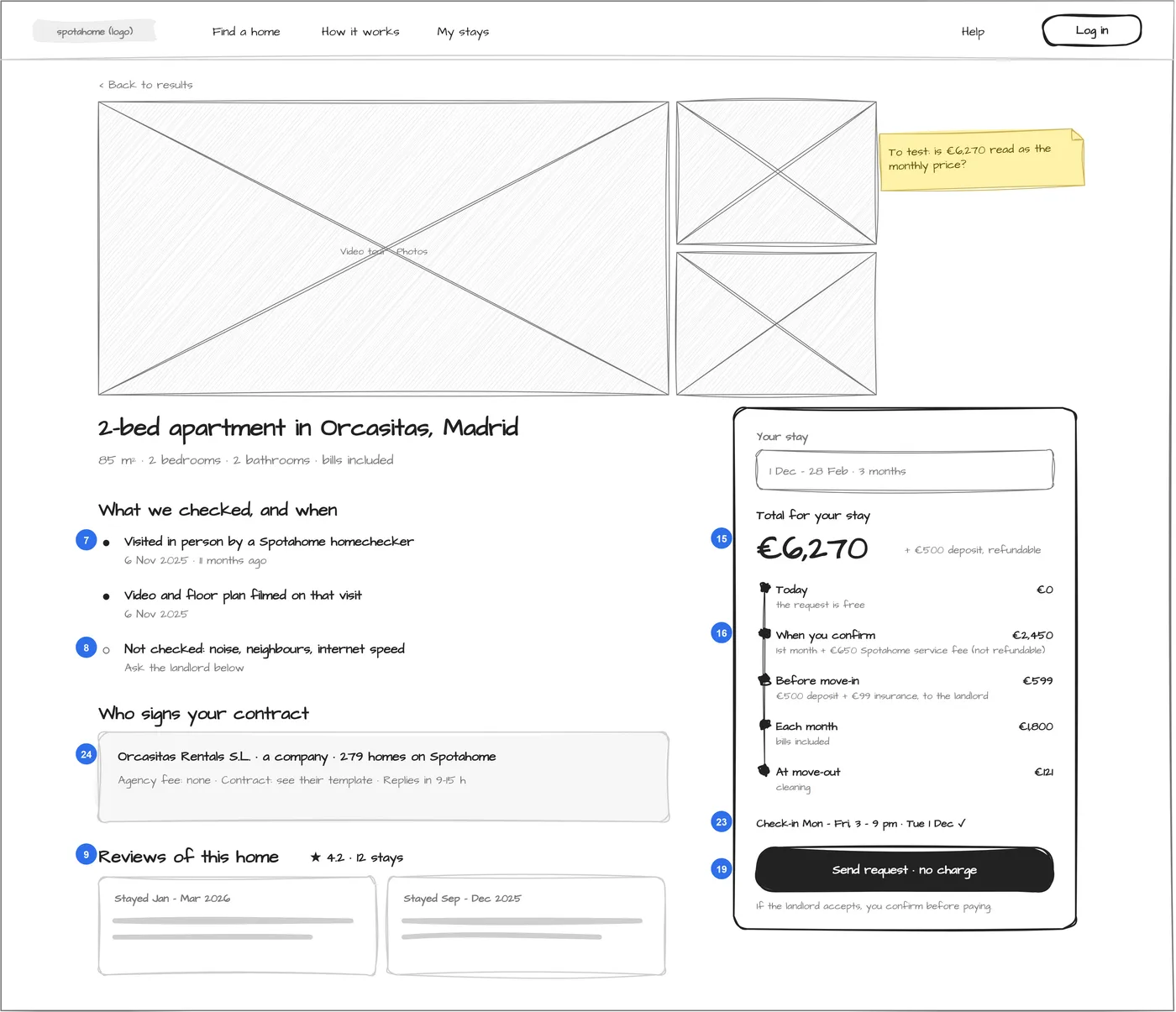
A "Total for your stay" split by moment, the fee named, what was checked and when, who signs the contract, reviews of the home.
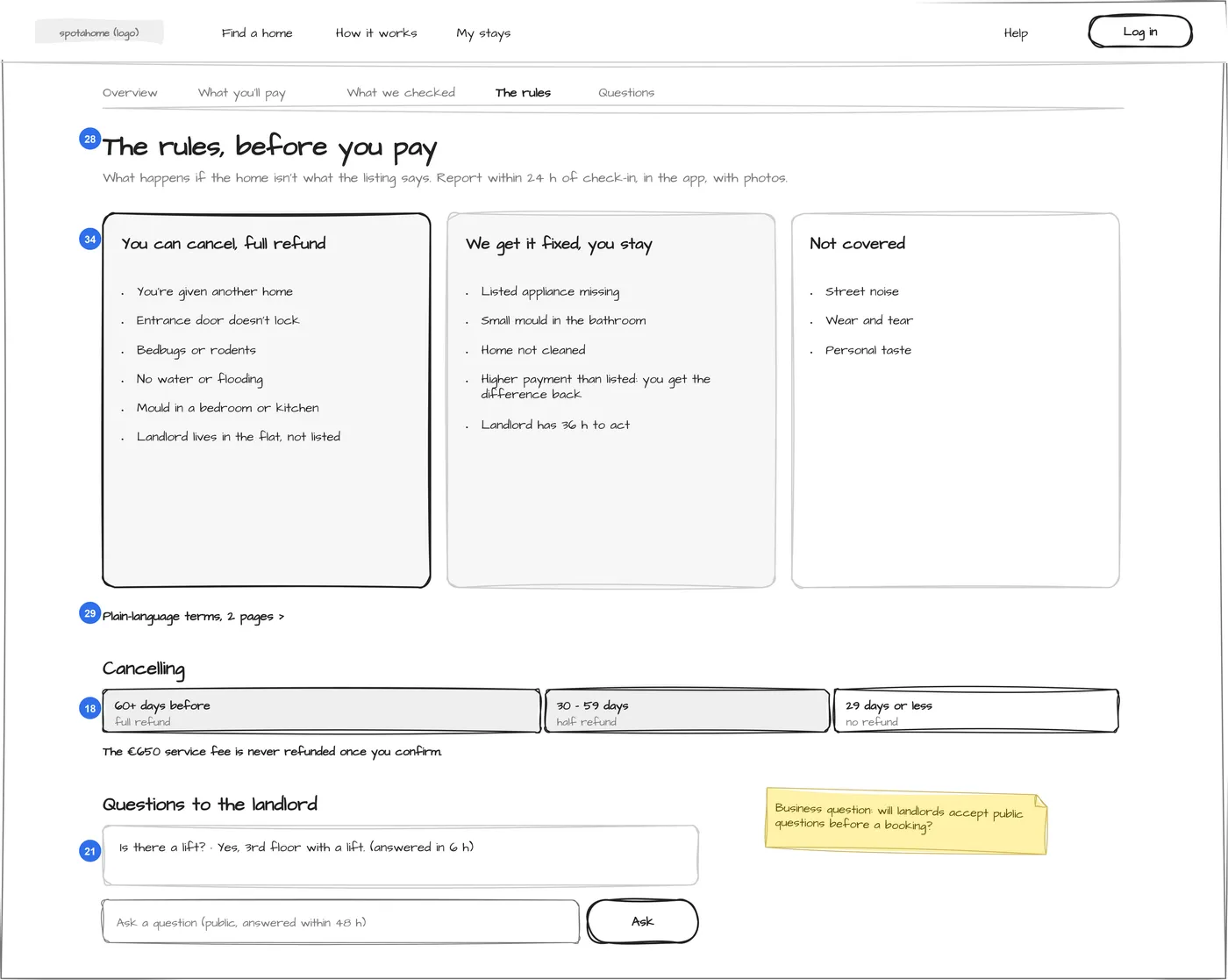
Three columns aligned with the terms: you can cancel, we get it fixed, not covered. An unlisted resident landlord moves to "you can cancel".
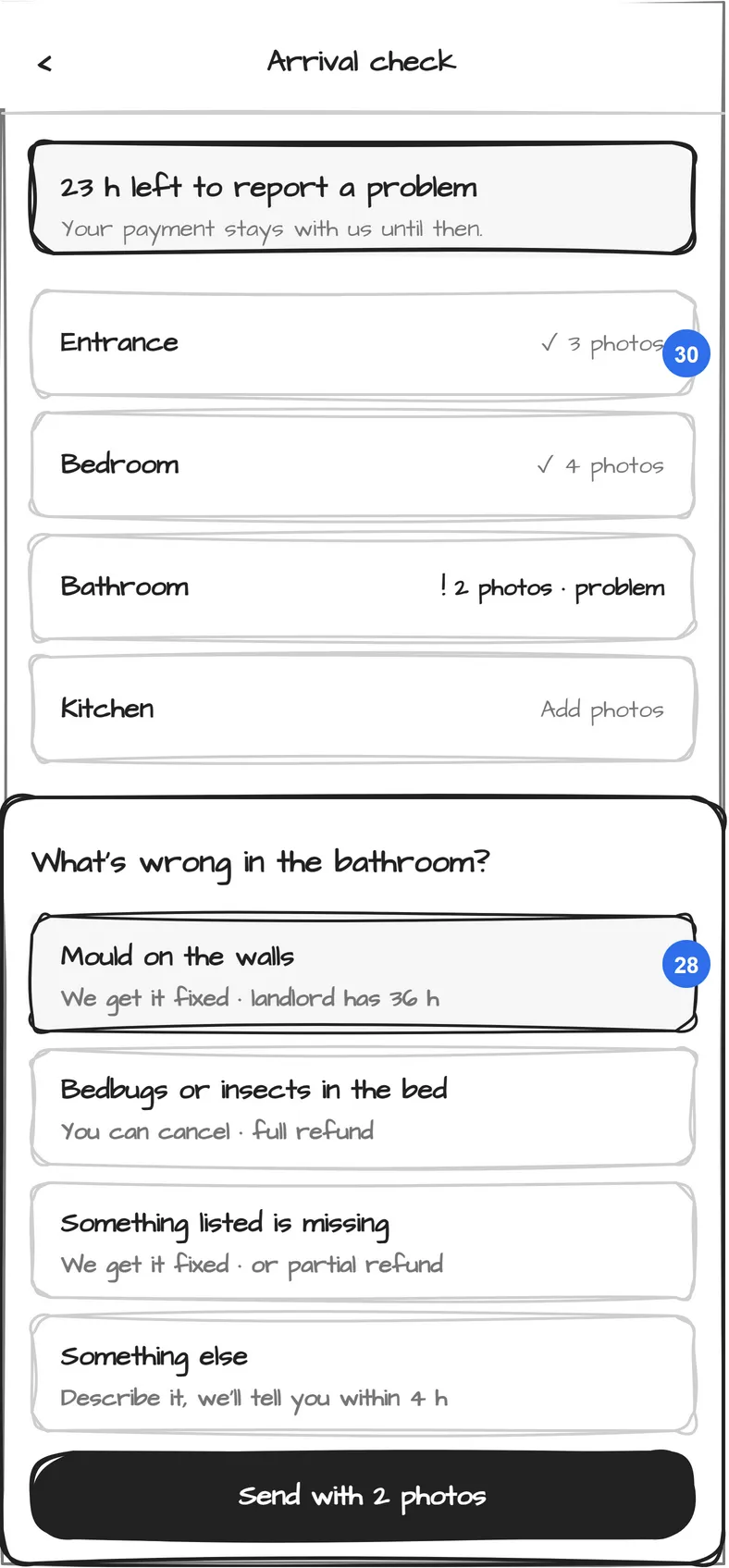
Photos room by room, and each problem says what it entitles you to before you send it.
Inside Spotahome's own brand
A product redesign, not a new identity: Poppins, Spotahome's orange #FB6E44, sand, mint and light-blue backgrounds, 12 px corners. Agrandir, the licensed heading font, is replaced by Poppins.
Click through the website and the mobile app: choose a home, read the rules, send a request, get verified once, confirm, report a problem on arrival, follow your case and your deposit. Clickable areas flash if you click elsewhere.
Pick a page, then switch between today's site and the redesign. On the left, the audit findings each change fixes.
The total for the stay comes first, split by moment, next to what was checked and when.
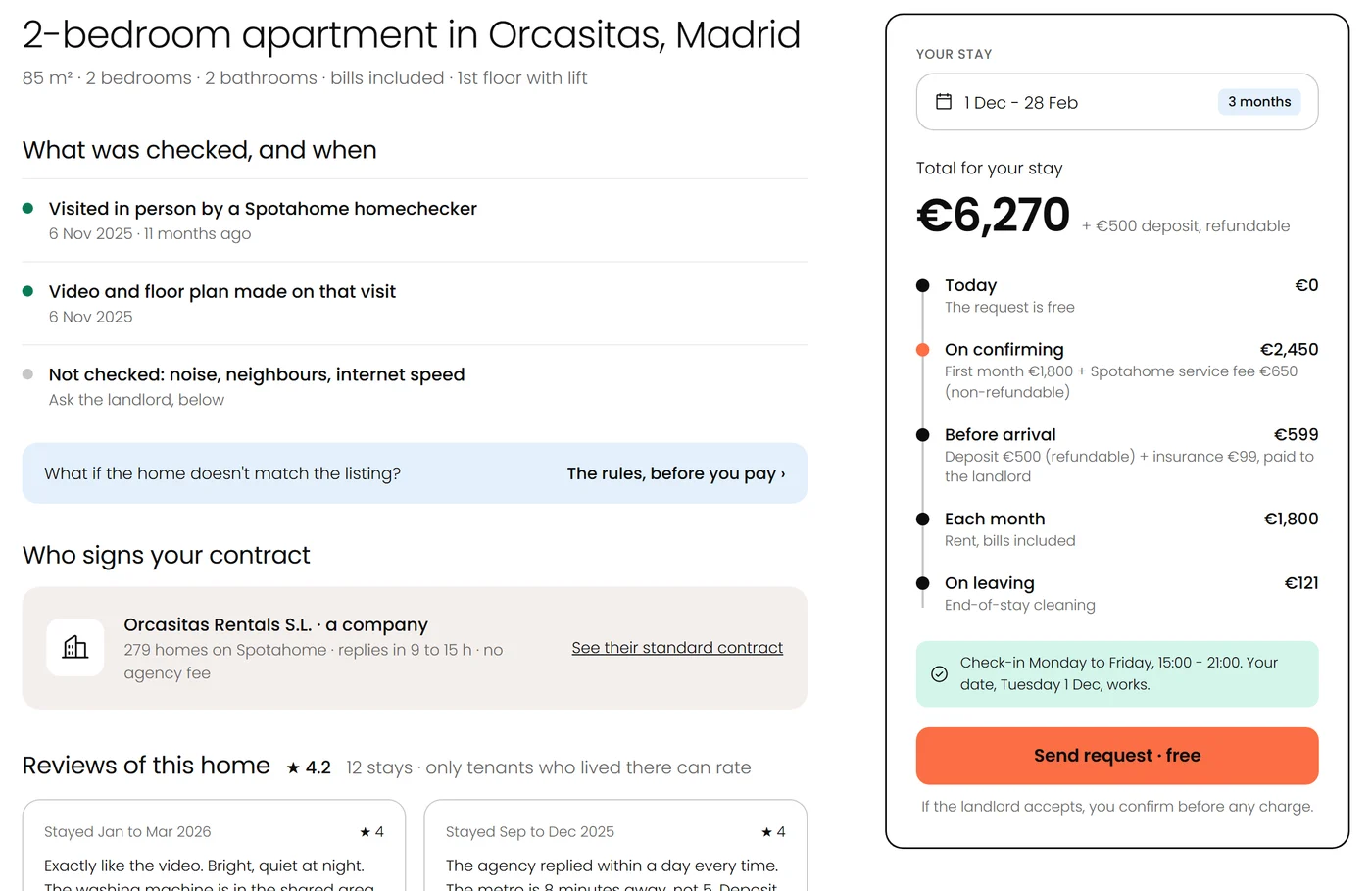
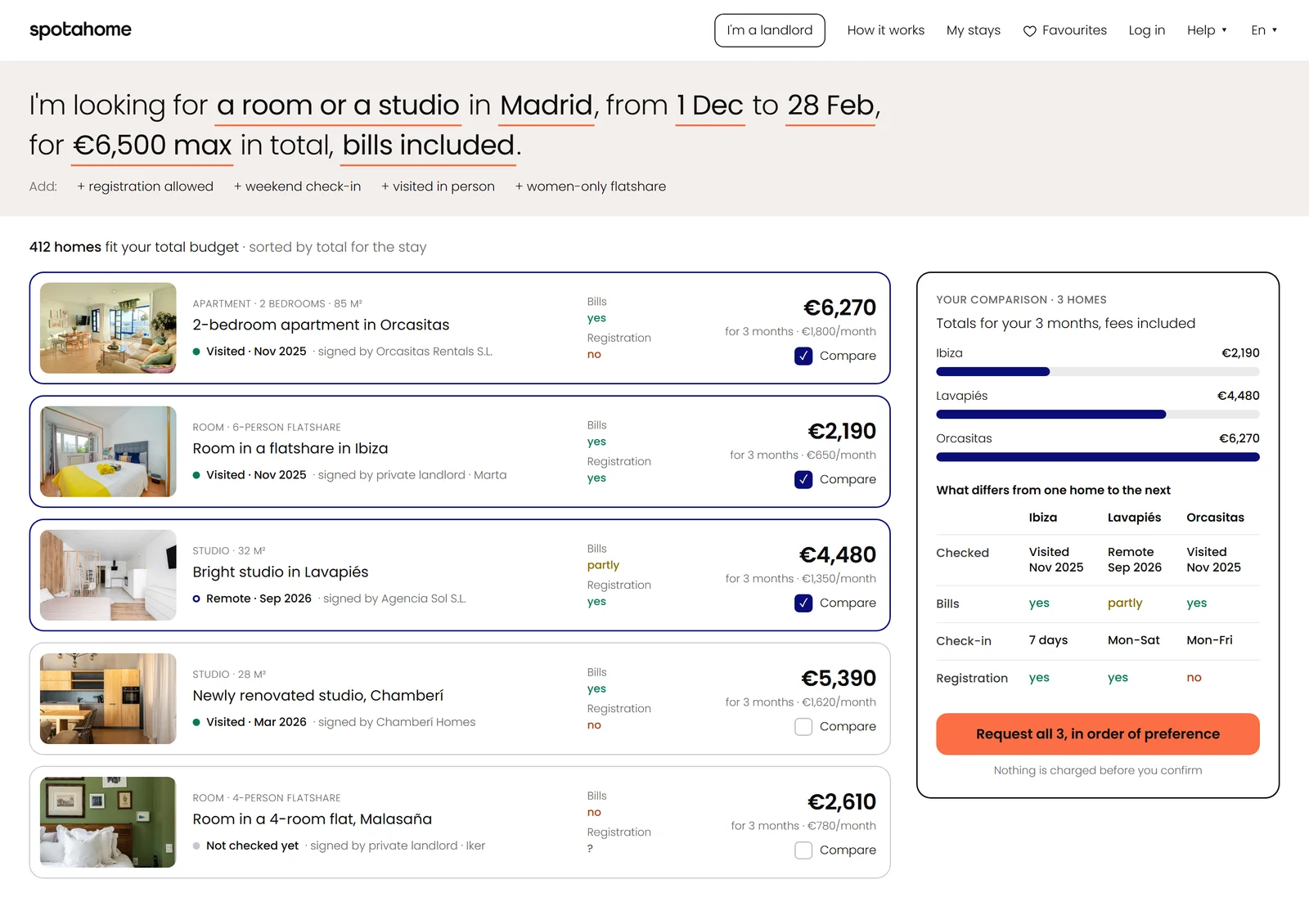
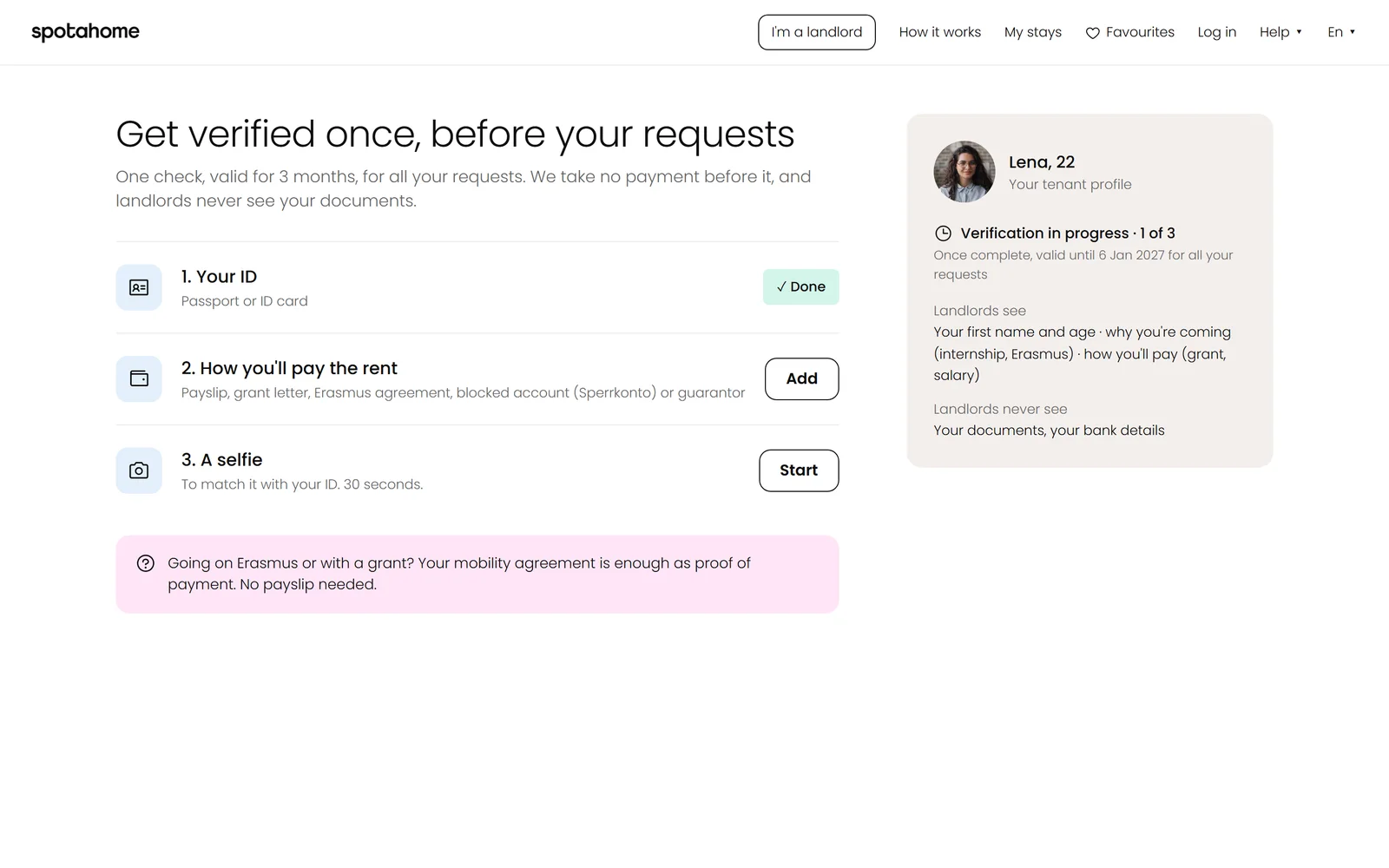
Six screens, one per moment of the stay. Three of them don't exist today: confirming, the arrival check and following a case.
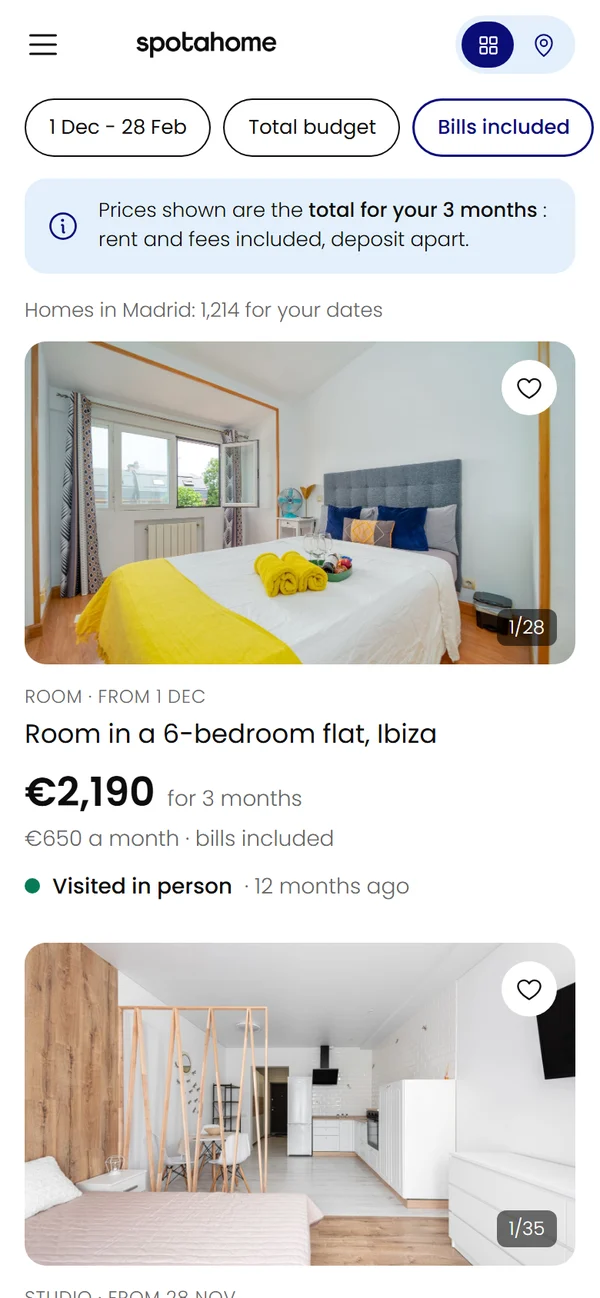
The total for 3 months is the main figure; the trust line says how and when the home was checked.
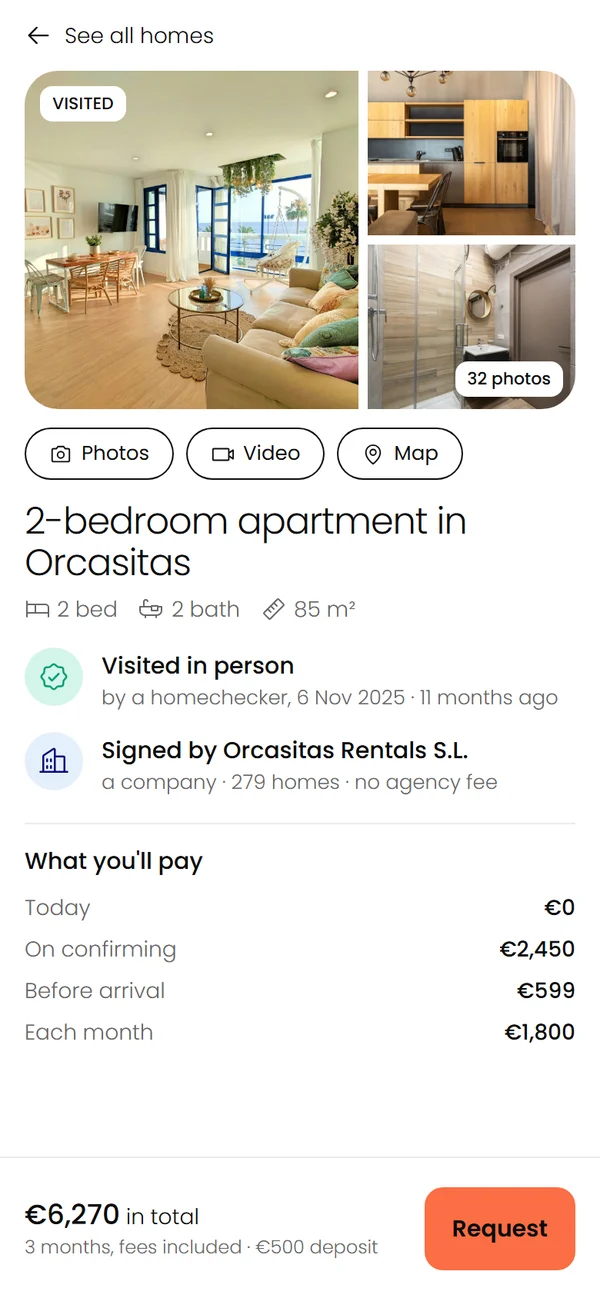
What you'll pay, open by default: €0 today, €2,450 on confirming, €1,800 a month.
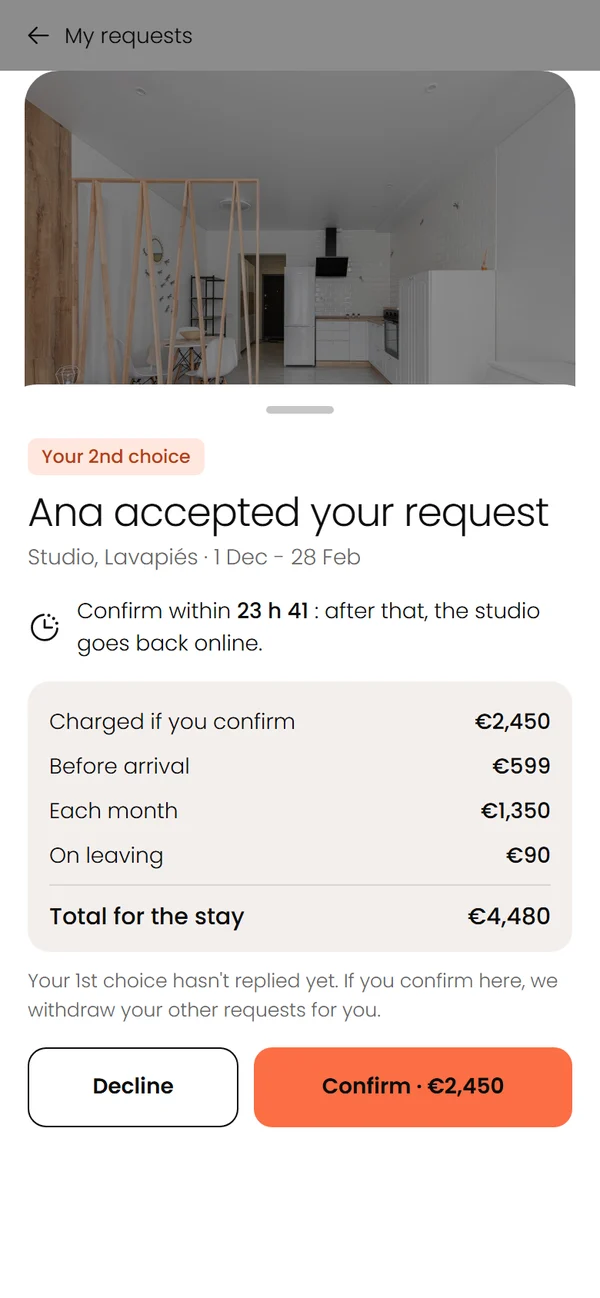
A sheet over the request: deadline, amount charged, and what happens to the other requests.
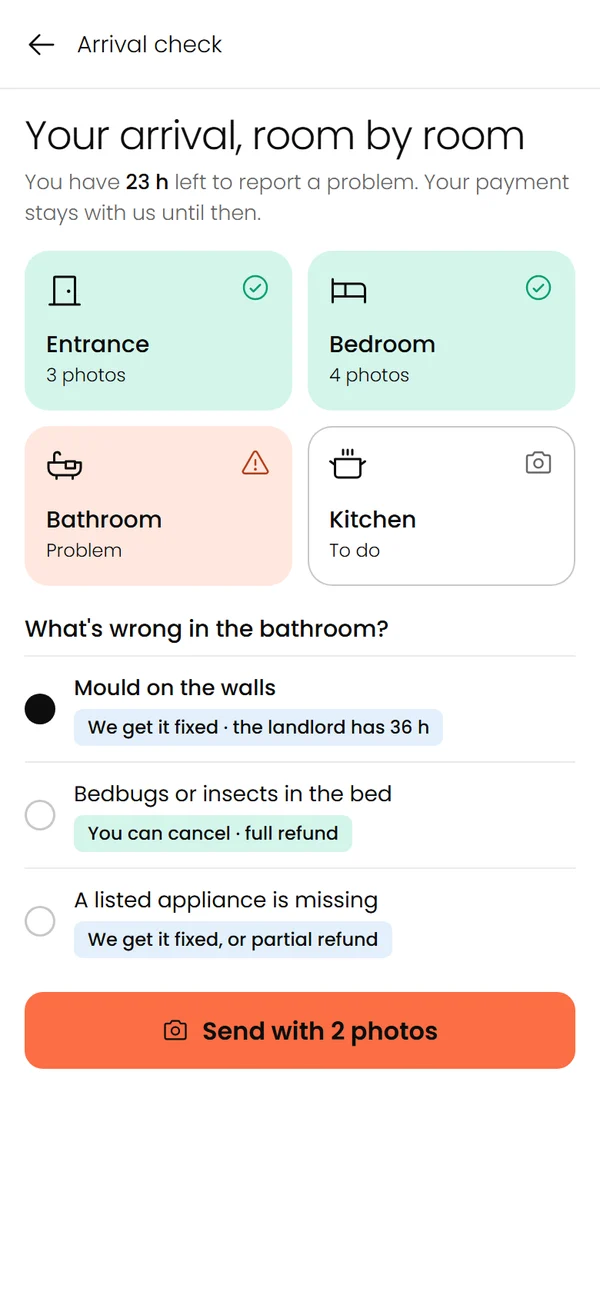
The 24-hour check as a grid of rooms. Each problem shows its rule before sending.
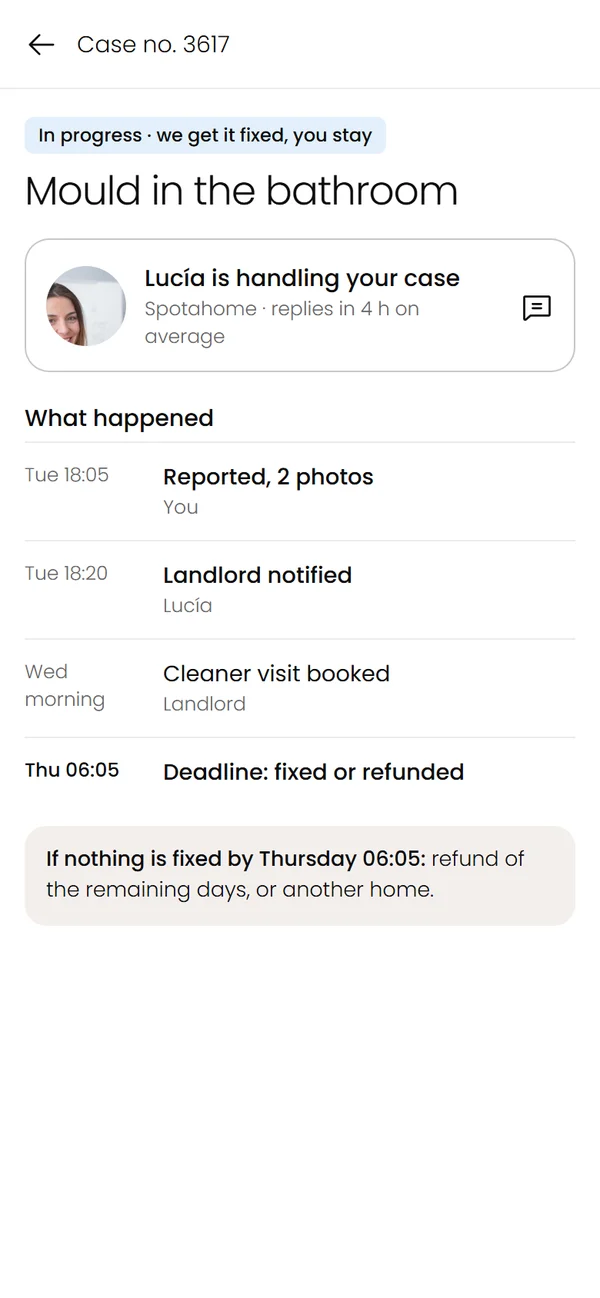
A dated feed of events, a named contact and the next deadline.
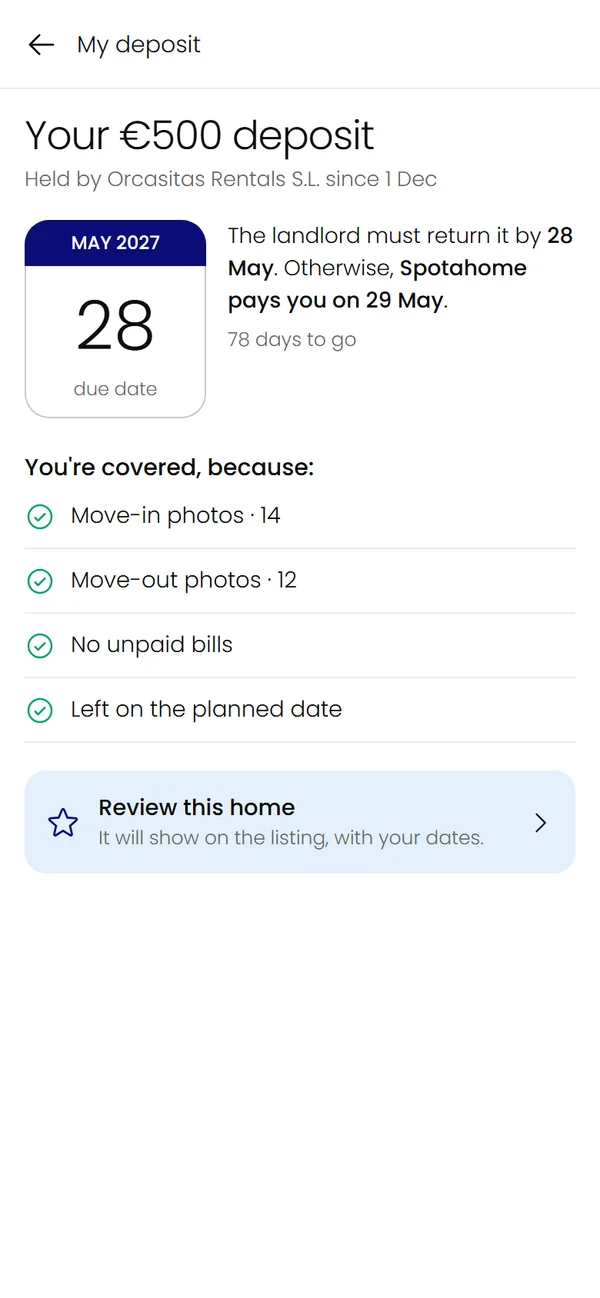
The deposit's due date, and the day Spotahome pays if the landlord doesn't.
I ran the redesign through the tools used on the current site. The evaluator is also the designer, so these measures show the defects are addressed, not that people understand the redesign: that needs testing.
One accessibility choice changed the brand use: white on Spotahome's orange has a contrast of 2.83 (WCAG asks 4.5). I kept the exact orange and switched button text to black (6.86) rather than darkening the brand.
Six hypotheses to check with real people
Everything above comes from traces, not from people. The next step is written and ready.
Comprehensive interview, photo-elicitation on real listings, and a card sort: ten situations sorted into "I can cancel", "they owe me a fix", "too bad for me", then compared with the terms.
Five tasks, current site against prototype. Targets: total estimated within €50, 80% success without help, +2 points of confidence.
Seven minutes to measure H1 to H6 at scale, with at least 100 Spotahome tenants, so the interviews can explain what the numbers show.
Download the deliverables
The real files, in English, in the formats used with clients. Switch the portfolio to French (FR, top right) to download the French versions.
34 findings, screenshots, users' voice; netnography, typology, listings and brand-replies tabs
↓ DOWNLOADTrustpilot trend, before-after, KLM, walkthrough, dark patterns, accessibility, trust, narratives, clauses
↓ DOWNLOAD46 slides in agency format: what's at stake, central insight, evidence, redesign, before-after
↓ DOWNLOADThree days of descriptive, analytical and reflexive notes
↓ DOWNLOADHypotheses, recruitment, timed running order, card sort
↓ DOWNLOADFive tasks, current site against prototype, metrics
↓ DOWNLOAD22 questions mapped to H1 to H6
↓ DOWNLOADOne column per participant, for interviews and tests
↓ DOWNLOAD11 annotated screens, the journey and one iteration
↓ DOWNLOADThe editable draw.io file, 11 pages
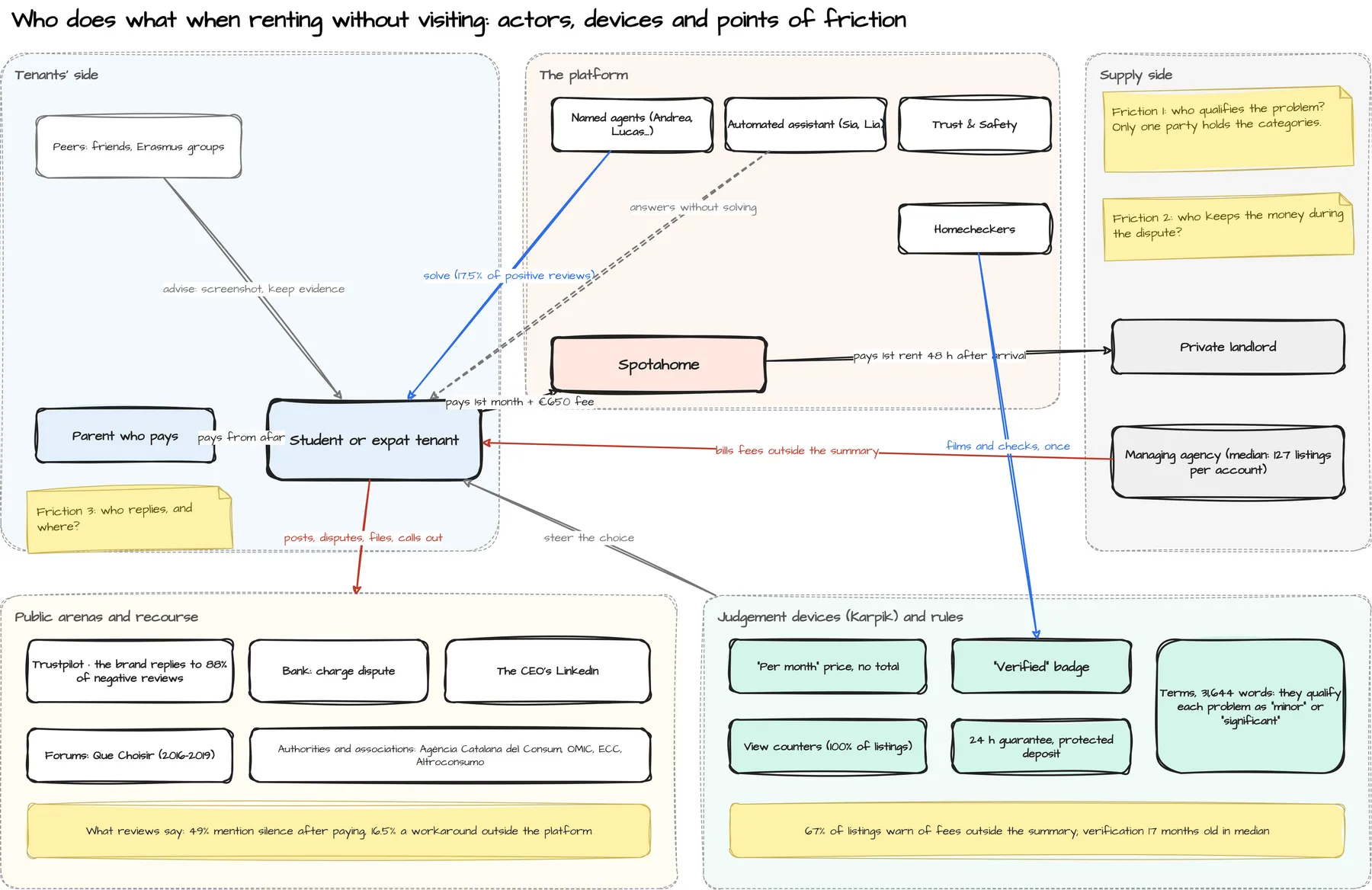
↓ DOWNLOADActors, devices and friction points
↓ DOWNLOADFront stage, backstage and reviews by moment
↓ DOWNLOADWhat I'd keep from this project
Without participants, reviews, terms and listings still say a lot, as long as each text is read and coded by hand rather than counted by keyword.
Karpik, Akrich or Boltanski are only useful here because each one explains a number: why 88% of complaints end up on Trustpilot, why "minor" hurts.
No interview, no test: the guide and the protocol are there to show what would come next, not to pretend it happened.
What I'd measure
Four numbers before and after shipping the total for the stay and the dated badge, which cost little and touch the most reviews.
Part of 1-star reviews among new Trustpilot reviews, month by month.
Bank disputes per 1,000 bookings, a direct sign of lost trust.
Median time to a human answer once the booking is paid.
Difference between the total first shown and the total actually paid.
SPAREROOM
Research-led rebrand of the UK's biggest flatshare platform