
My Role & Context
Mayare Ouassou
Alexis Fernandes Antunes
Co-UX Researcher - protocol design, participant recruitment, interview facilitation, Think Aloud observations, thematic analysis, recommendation writing, co-design of Figma prototype.
Research report (30p.)
Final presentation
Interactive Figma prototype
Mission & Problem Statement
How do you retain the 65% of users who abandon their cart on Vinted?
Vinted's revenue depends directly on buyer protection fees collected at each transaction. A 65% abandonment rate represents massive revenue loss and a competitive risk against Depop, Vestiaire Collective, and fast-fashion alternatives.
1. Item search phase - difficulty finding a trustworthy item through filters and photos. 2. Seller negotiation phase - uncertainty about seller reliability and responsiveness.
The quality of negotiation and seller responsiveness directly determine whether a purchase is completed or abandoned.
Payment complexity and late fee disclosure trigger abandonment at the final step of the funnel.
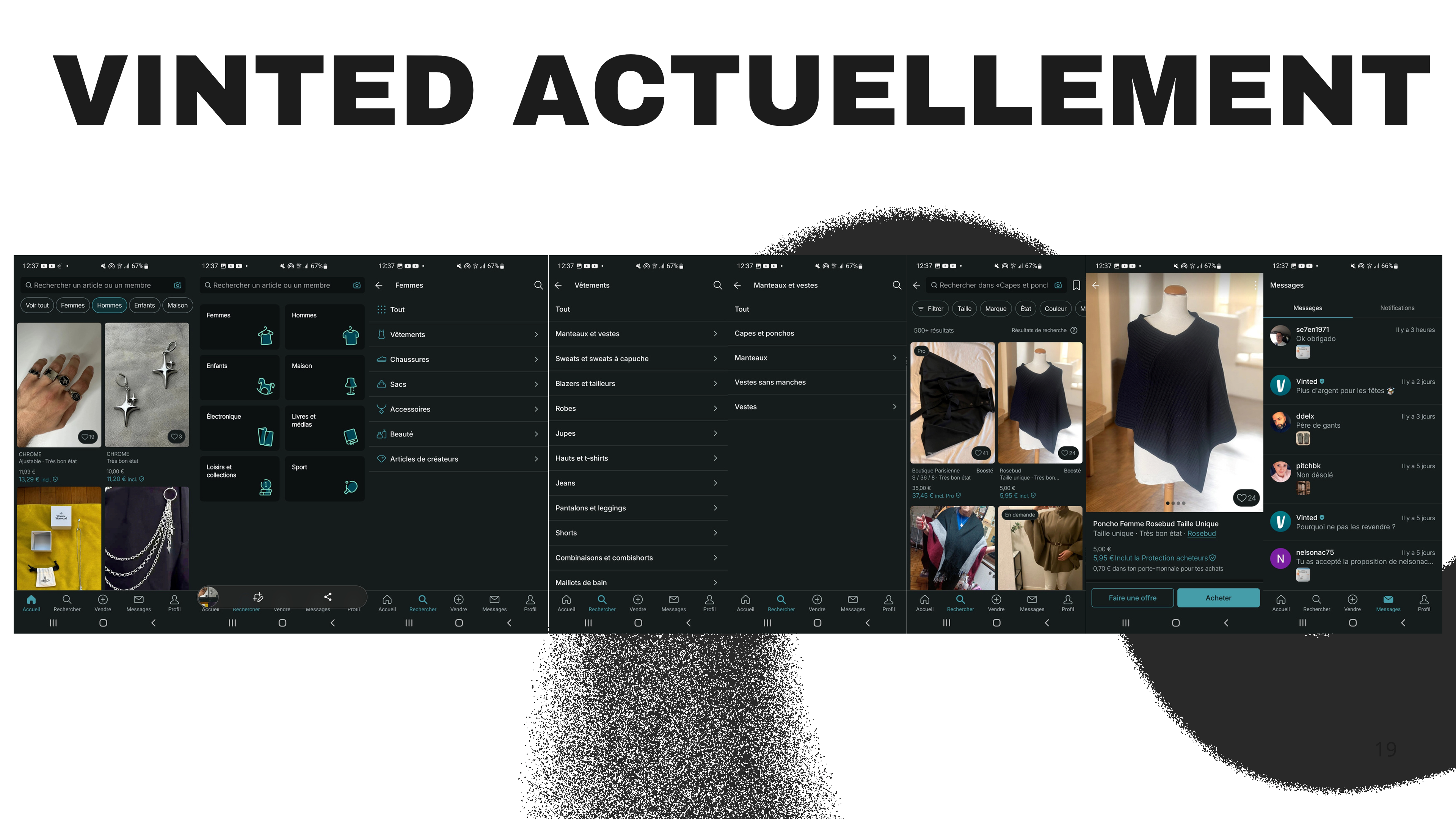
Screenshot from observation sessions - highlighted areas correspond to identified friction points: insufficiently granular search bar, overly broad top-level filters, and payment summary revealing fees too late in the journey.
Why a Qualitative Approach?
Cart abandonment on Vinted is not a technical problem measurable by analytics. It is a behavioral and emotional phenomenon. Quantitative data (click rates, heatmaps, conversion funnels) indicate WHERE abandonment happens - they do not explain WHY. To access deeper motivations, latent fears, and frustrations users don't spontaneously articulate, a qualitative approach was the only relevant option.
Without access to Vinted's internal analytics, numbers cannot capture the emotional experience of a user facing a silent seller or a blurry photo. Abandonment is not a click - it is a decision loaded with doubt and anxiety.
The Think Aloud method allows observing micro-hesitations in real time - backward navigation, obsessive label zooming, screenshots instead of favoriting. These behaviors are invisible in logs but reveal everything about cognitive friction.
By combining interviews (declarative), observations (behavioral), and lexical analysis (textual), we attack the same phenomenon from three angles. What participants say, what they do, and what their words unconsciously reveal - three complementary levels of truth.
Methodology
Technique: experience storytelling. Target: users who abandoned a purchase within the last 2 months. Duration: 30-40 min. Goal: access the "why" and emotional weight behind each abandonment.
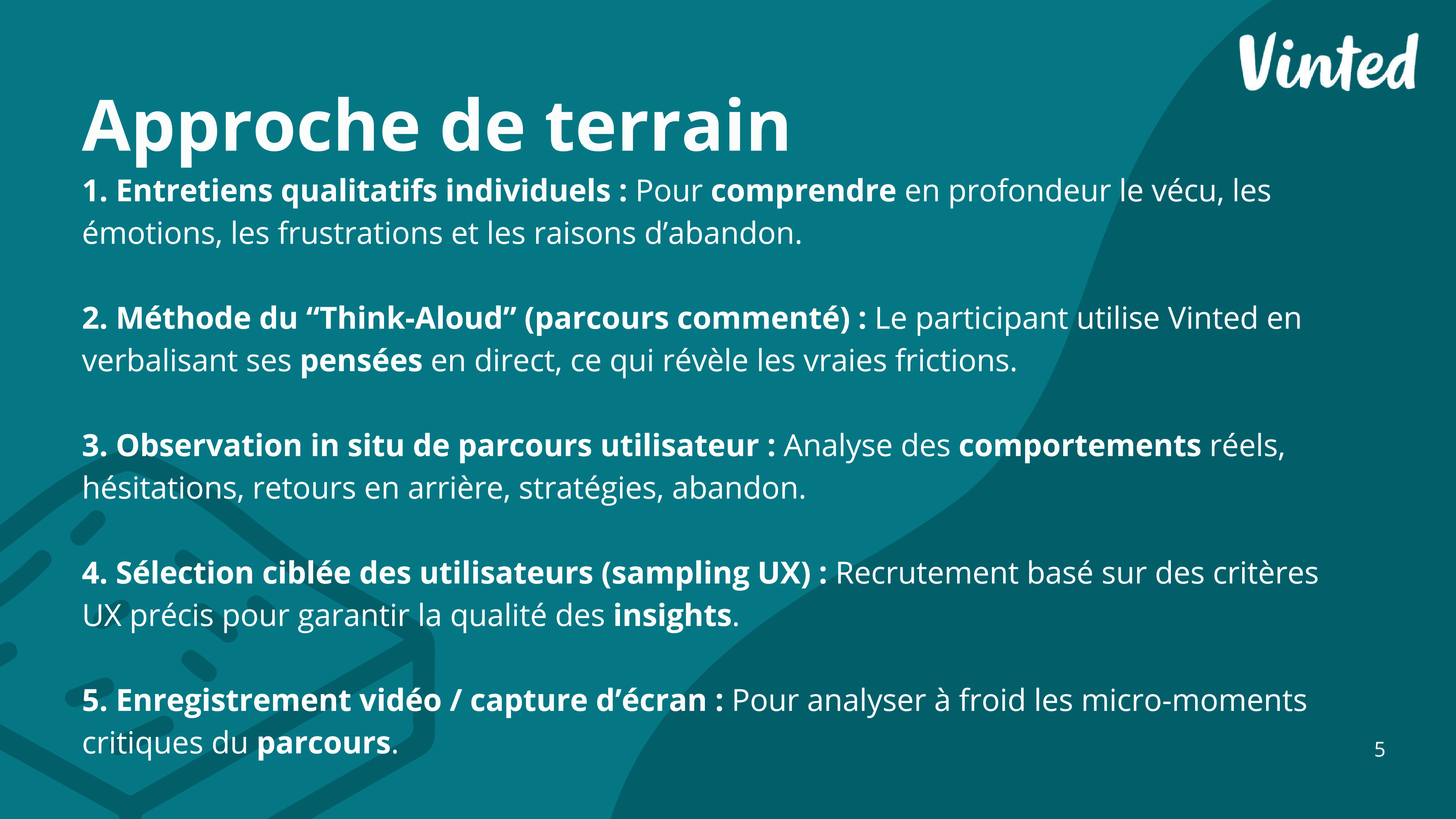
Task: search for a real item with genuine purchase intent on Vinted. Video recorded with consent. Post-session analysis of behaviors, hesitations, and abandonment moments in real time.
Hierarchical Descending Classification (Reinert method) applied to all 11 transcripts via IRaMuTeQ. The corpus is segmented into Elementary Context Units (ECU), then classified by lexical co-occurrence. Result: 5 thematic classes with discriminant chi2. 78% of ECUs classified. 1,247 active forms analysed. The dendrogram reveals the deep cognitive structure of discourse: an architecture dominated by sensory doubt, relational waiting, and economic trade-off.
Synthetic overview of the research protocol and participant distribution by method, profile, and purchase frequency. Triangulation of the three data sources (interview, video, lexical) is visible in the "SESSION" column.
Sampling Strategy
The primary selection criterion was having abandoned a purchase on Vinted within the last two months - a time window chosen to ensure the memory was still fresh and the account emotionally loaded. Recruitment was conducted via personal networks, student groups, and social media, prioritizing diversity of usage profiles.
Written consent form signed before each session. Data anonymized (participant_01, etc.). Recordings used for analysis purposes only. Right to withdraw at any time without explanation.
| ID | GENDER | AGE | PROFILE | SESSION | LAST ABANDON |
|---|---|---|---|---|---|
| P01 | F | 23 | Active buyer | Interview + Obs. | < 2 wks |
| P02 | F | 27 | Occasional buyer | Interview | < 1 mo. |
| P03 | M | 25 | Buyer/Seller | Interview | < 3 wks |
| P04 | F | 31 | Frequent buyer | Interview + Obs. | < 1 wk |
| P05 | M | 22 | Occasional buyer | Interview | < 2 mo. |
| P06 | F | 35 | Seller/Buyer | Interview + Obs. | < 2 wks |
| P07 | M | 28 | Luxury resale buyer | Interview | < 1 mo. |
| P08 | F | 19 | Novice buyer | Observation | < 2 wks |
| P09 | F | 33 | Fashion buyer | Observation | < 3 wks |
| P10 | M | 26 | Active buyer/seller | Interview + Obs. | < 1 wk |
| P11 | F | 29 | Deco/vintage buyer | Observation | < 2 mo. |
From Raw Data to Insight
The analysis followed a five-phase protocol to ensure rigor and cross-method consistency. The goal was to move from a mass of raw verbatims and videos to a structured friction map, prioritized by impact and frequency.
Full transcription of all 11 interviews. Real names replaced by identifiers (participant_01... participant_11). Coding of 6 Think Aloud videos with timestamping of critical moments (hesitation, backward navigation, abandonment).
Import of all 11 transcripts into IRaMuTeQ. Hierarchical Descending Classification (Reinert method): corpus split into ECUs (Elementary Context Units) and classified by co-occurrence. 78% of ECUs classified across 1,247 active forms. Result: 5 thematic classes with discriminant lemmas (chi2). Class 2 "Seller Relation" records the highest chi2 in the corpus (repondre = 92.1) - confirming seller responsiveness is the most emotionally charged variable. Corpus URL: voyant-tools.org/?corpus=ab66d05600a3e58146febd4dd96f91f6 (raw frequency verification).
Reading and re-reading of verbatims. Assignment of thematic codes to each excerpt (quality uncertainty, search fatigue, ghosting, hidden fees, etc.). Grouping via affinity diagram - verbatims naturally cluster into 4 major themes, confirming initial hypotheses while surfacing new ones.
Frame-by-frame decoding of all 6 Think Aloud sessions. For each video: identification of the observable behavior, the triggering friction point, and the underlying insight. Behaviors revealed (pogo-sticking, screenshots outside the app, bypass of the "Buy" button) are invisible in any other data source.
Cross-referencing of interview results x video observations x lexical analysis. An irritant confirmed by all three methods = high priority. Impact x frequency matrix to rank recommendations. Insights converging across all three methods are retained as robust findings.
Friction Map
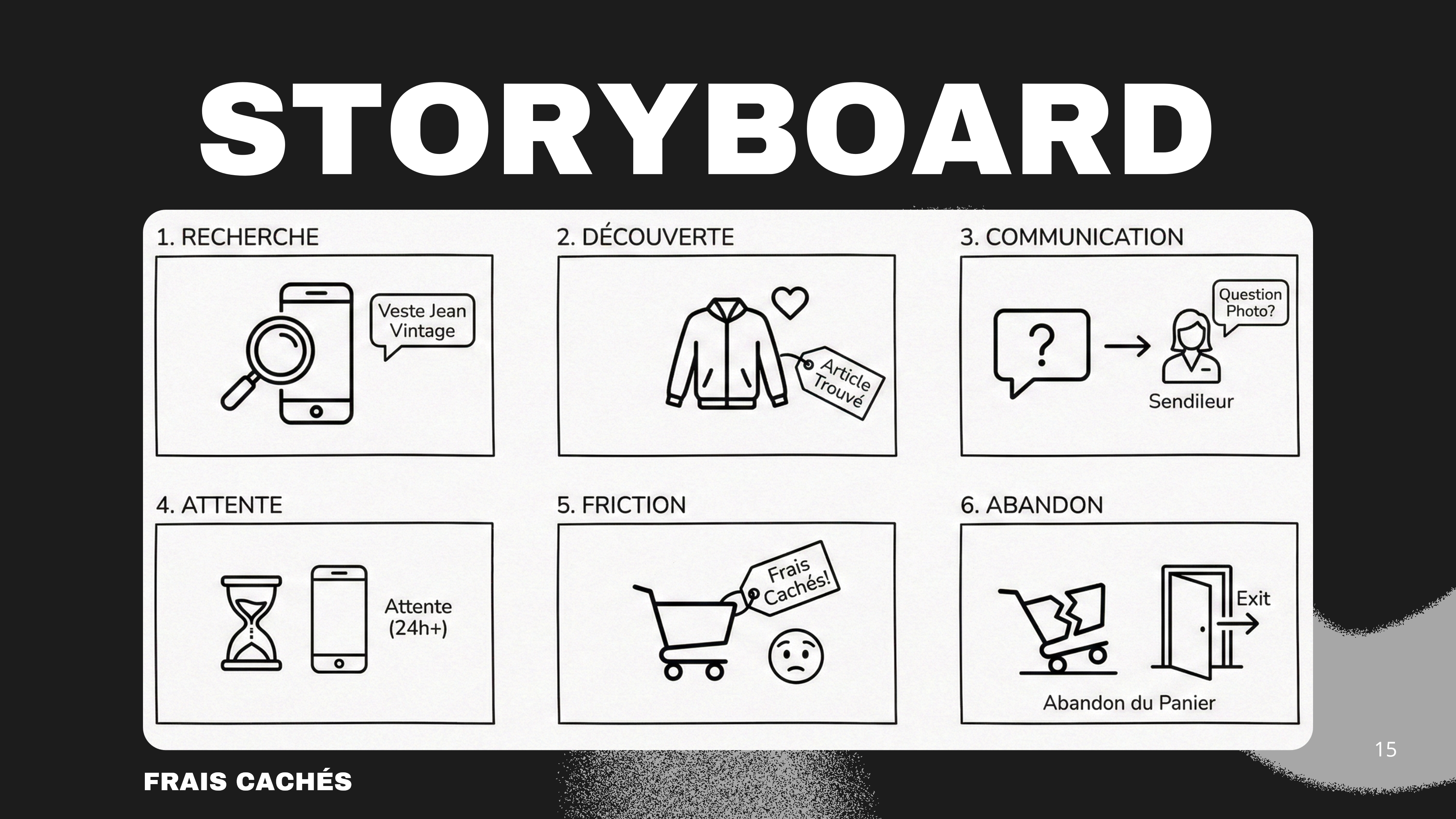
Six critical moments mapped across the purchase journey where trust breaks down and abandonment occurs.
User identifies item but lacks immediate trust cues.
Manual profile checking consumes excessive cognitive resources.
Communication lag leads to progressive loss of purchase intent.
User reassesses risk vs. value during the wait time.
Checkout fee discovery creates final point of abandonment.
User leaves to avoid perceived financial or cognitive risk.
Hierarchical Descending Classification
All 11 interview transcripts were submitted to IRaMuTeQ (Interface de R pour les Analyses Multidimensionnelles de Textes et de Questionnaires) for a Hierarchical Descending Classification (CHD) - Reinert method. The corpus is segmented into Elementary Context Units (ECU), each ECU assigned to a class based on its lexical co-occurrences. The result is a dendrogram structuring discourse into mutually exclusive classes, each defined by its most discriminant lemmas (highest chi2 value).
Class 1 (Sensory Trust, 28%) and Class 2 (Seller Relation, 22%) together account for 50% of the corpus - half of participants' discourse organized around two fundamental absences: visual proof and human reassurance. Classes 3-5 document the consequences: search exhaustion, price calculation, and memory wound.
Most represented class. "Photo" dominates at chi2=84.3 - the camera is the primary trust tool in second-hand buying. Absent standardized photos are perceived not as negligence, but as deliberate concealment. Participants mentally construct the object from incomplete images, increasing disappointment risk.
"Repondre" (to respond) records the highest chi2 in the entire corpus (92.1) - seller responsiveness surpasses even photos as an emotional variable. Silence is not neutral: it is interpreted as active rejection. Vinted is a conversational marketplace where the quality of the human relationship determines conversion as much as item quality.
"Scroller" (chi2=63.2) reveals a passive stance imposed by the interface - participants undergo the flow rather than controlling it. Searching on Vinted is not an act of discovery: it is an exhausting manual sorting task caused by insufficiently granular filters and a semantically poor search engine.
"Prix" (chi2=89.2) structures a field of permanent negotiation. An item's value is never absolute on Vinted - it is systematically compared against the new item price augmented by the security it provides. Fees revealed at checkout act as a terminal "price shock" that erases the purchase intent built during browsing.
Most concentrated class (mean chi2 = 72.3, highest). Although representing 13% of the corpus, its impact is structural: past bad experiences condition all future interactions. "Decu" (disappointed, chi2=94.1) reveals an active cognitive wound. Participants do not reason in terms of mathematical purchase expectancy - they filter every opportunity through the painful lens of a return, a non-conforming item, a disappeared seller. This class explains why even an objectively perfect item can be abandoned.
4 Key Insights
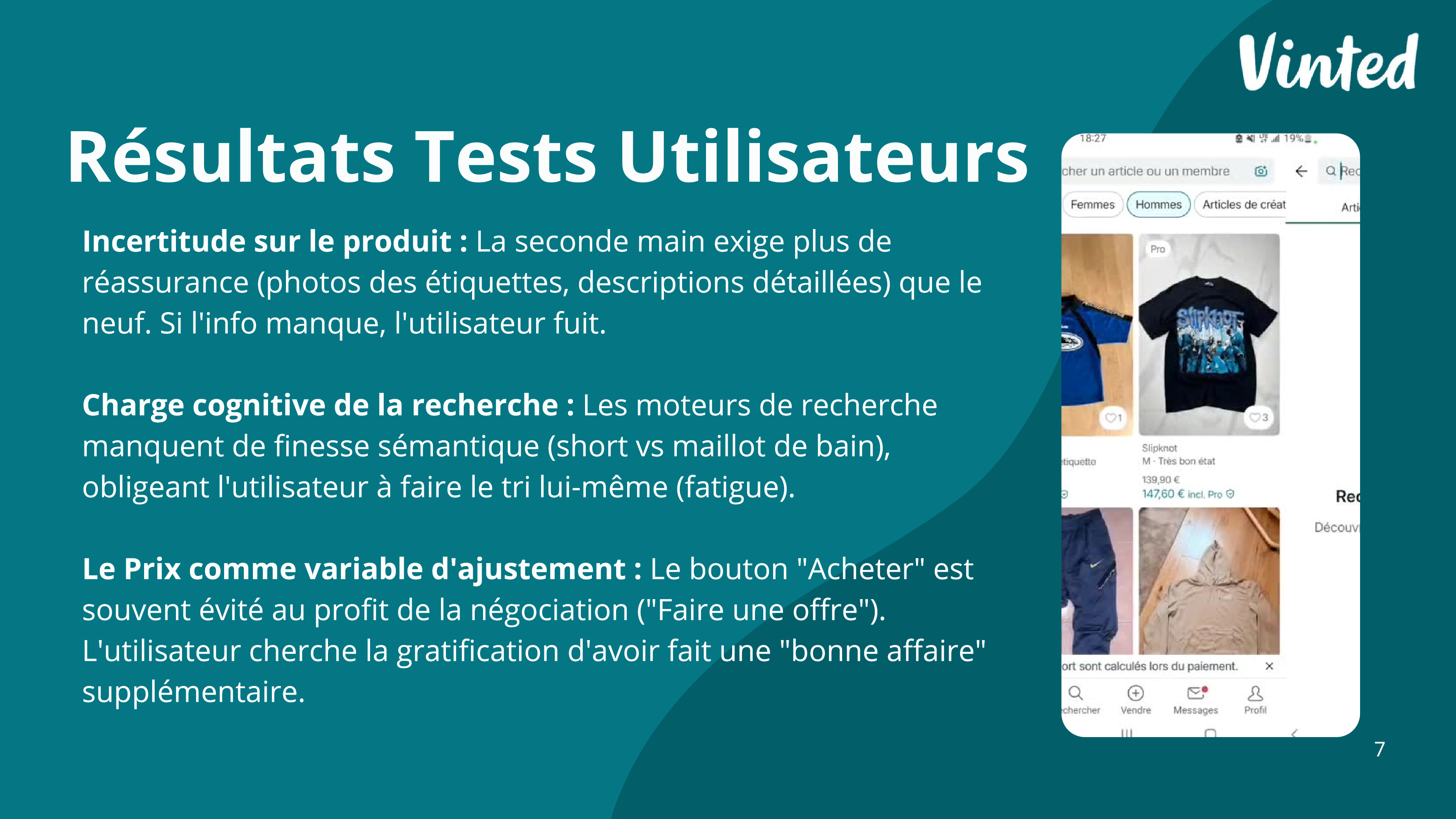
Second-hand buying is perceived as a structural risk. Photos - often too few, poorly lit, lacking complementary angles - fail to establish the required trust. The absence of photo standards leaves too much room for interpretation and disappointment. Past bad experiences create lasting trauma that conditions all future purchases.
"The trousers I received were basically cropped - you couldn't tell from the photo because it was just laid flat on the floor."
Infinite scroll on a non-personalized platform generates rapid decision fatigue. Search filters (brand, size, price, condition) are too coarse to match users' actual criteria - style, use case, cut, pattern. The absence of granular filters forces exhausting manual sorting. Categorization errors (shorts vs swimwear, posters vs clothing) multiply fruitless clicks and abandonment through fatigue.
"Out of 30 items, maybe one will appeal to you. Scrolling through all the ones that don't is exhausting."
Vinted is a conversational marketplace: unlike traditional e-commerce, the transaction depends on human interaction. This interaction is a major source of anxiety. Ghosting (reading without responding) is experienced as a personal offense - not mere silence. Slow response times trigger a re-evaluation process that kills the purchase impulse. Conversely, a responsive, courteous, transparent seller is a direct conversion accelerator.
"If she had replied "no", I would have said 'fine, I'll buy it'. But she ghosted me after 3 follow-ups, so I didn't want to buy from her anymore."
Price is never evaluated in absolute terms on Vinted - it is always compared against the new item price, augmented by the security it provides. As soon as the total price (item + shipping + buyer protection) approaches the store price, the appeal of second-hand collapses. Fees revealed at checkout create a psychological price shock that triggers final abandonment, even in users who were ready to buy 10 seconds earlier.
"I didn't find a fur coat cheaper than in store. So I think: at that price, ok it's less ethical, but I might as well buy new."
Summary table from the final presentation - the 4 major insights are ranked by frequency of occurrence and emotional impact level. Verbatims associated with each finding are extracted from the full transcription of all 11 interviews.
6 Think Aloud Sessions Decoded
Each session was filmed and decoded to identify friction behaviors invisible in interviews. What follows is a synthesis of observed behaviors and actionable insights extracted from each session.
Final comparison and negotiation attempt via favorites list.
User scrolls favorites, selects item, views photos - but deliberately bypasses the "Buy" button to click "Make an offer" at 200 euros. The favorites list acts as external memory to reduce cognitive load. The primary CTA is intentionally bypassed.
The "Buy" button is perceived as too direct a commitment. Users never see the displayed price as the final price - negotiation is a systematic step, not an exception.
Find a natural-material bomber (wool or leather) using filters.
Intensive filter use. Multiple product pages opened only to zoom on composition labels. Immediate exit if label photo is unreadable or reveals synthetic material. Behavior repeated on 10+ items. Progressive decision fatigue visible in accelerating scroll speed.
Users develop personal verification rituals to compensate for absent information standards. These rituals extend the journey and exhaust the user long before finding the right item.
Build a bundle with two items from the same seller to reduce shipping.
User arrives at bundle summary (top + boots). Total price displays with fees. He does not click "Pay". Instead, uses "Make an offer" to attempt reducing from 30 euros to 25 euros. This is not a full abandonment - it is a conditional purchase delay. But the double validation wait (bundle + offer) cools the initial impulse.
Checkout is a moment of real-cost awareness. When the total price exceeds the buyer's psychological threshold, it systematically triggers negotiation or abandonment - and the wait for seller response is enough to kill the desire.
Find a Scream poster in A3 format in the home decor category.
Precise search "poster scream A3" - empty page, no results. Return to broader search - results polluted by DVDs and clothing. 'Home' filter insufficient. Displayed items often damaged or poorly photographed. User clicks, sees defects (visible creases, yellowing), and exits immediately.
An empty results page is catastrophic - it creates a UX dead-end that forces immediate abandonment. The search engine must handle synonyms, formats, and categorical granularity to prevent these dead ends.
Search for a men's red short, sorted by ascending price.
First result at 1 euro - it's a chino. Back. Second result - it's swimwear. Back. Third - sport short in wrong color. Thumbnails are indistinguishable. Price sorting exposes the worst-categorized items. Pogo-sticking behavior (rapid entry/exit from product pages) repeated on 8+ items before abandonment.
Ascending price sorting is a UX trap: it prioritizes the most poorly categorized and lowest-quality items. The absence of a 'Use case' filter (sport/casual/swim) imposes an unsustainable visual workload.
Find a faux fur coat, specific style, max price 30 euros.
Precise filters applied. User scrolls at length, clicks on a well-rated Zara item, examines all photos, checks 5-star seller profile - then does not buy. She screenshots the product and exits the app. External save instead of 'Add to favorites'.
A screenshot instead of a favorite marks a critical conversion break: the user extracts information from the app to think about it later, dramatically increasing the risk of forgetting and permanent abandonment. The empty description ('size XS very good condition') without measurements or details creates a final blocking doubt.
Friction Scenarios
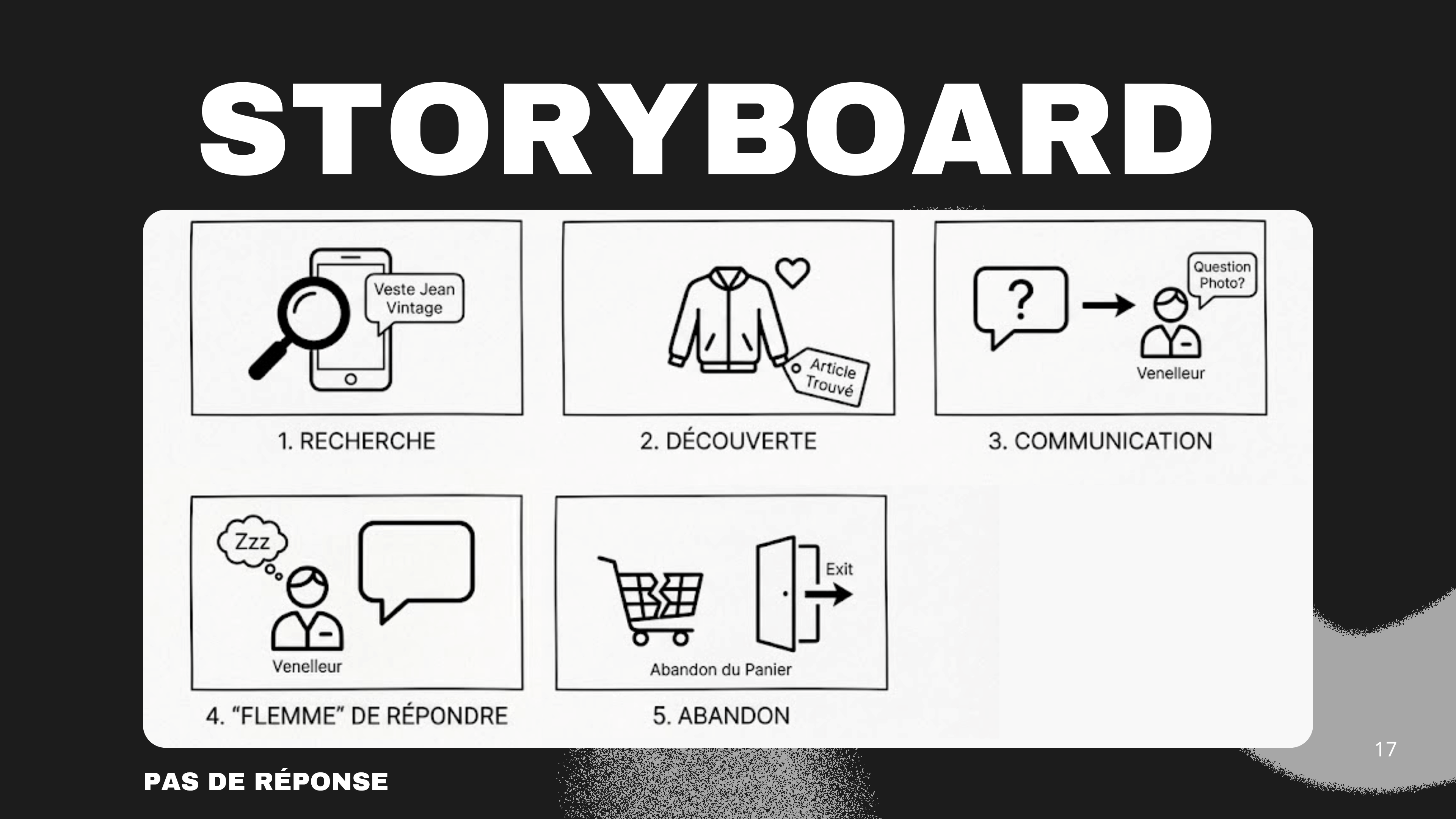
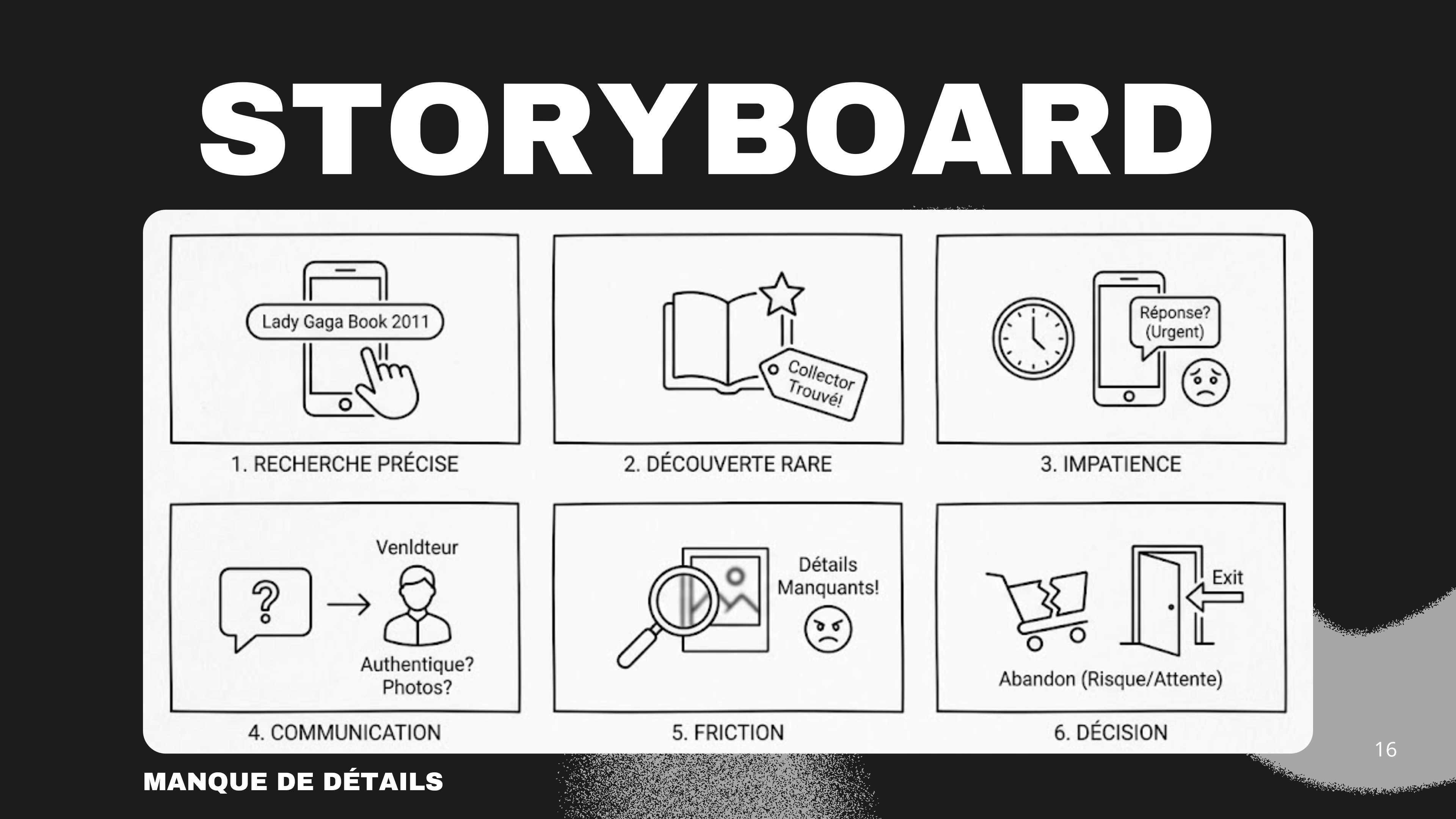
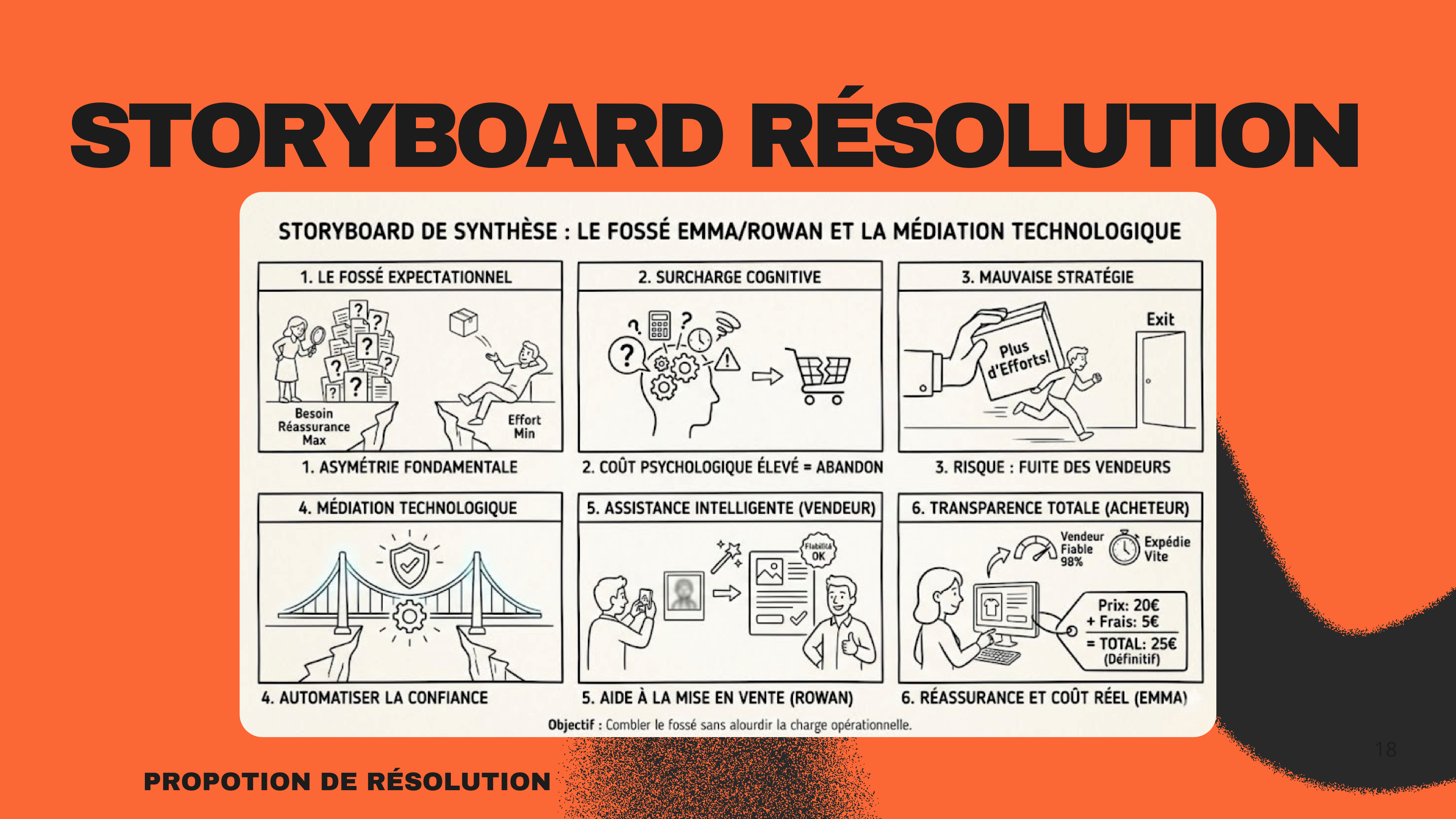
Behavioral Profiles
"I only buy if the profile looks perfect."
"I want to click and forget."
Detailed User Profiles
These three personas are not theoretical archetypes - they are built from recurring behavioral patterns observed across interviews and video sessions. Each profile corresponds to a specific abandonment mode and implies distinct retention levers.
Occasional buyer marked by past disappointments (defective items, misleading descriptions). Always filters by "new condition", scrutinizes every photo, checks seller profile before any contact. Never negotiates - too afraid of dealing with bad-faith sellers. Abandons during search, through fatigue of not finding sufficiently reassuring items. A low price is not enough: she needs exhaustive visual proof.
Regular C2C platform user. Never considers the displayed price final - negotiation is a systematic step in her journey. Uses the favorites list as external memory to compare before committing. Demands reactive and honest sellers. Abandons if the seller takes more than a day to respond, adopts a curt tone, or refuses a reasonable offer without explanation. Relationship quality is her primary trust criterion.
Seeker of specific and rare items. Low tolerance for friction and infinite scroll. Exits immediately if search results are irrelevant or return zero results. Frustrated by categorization errors and slow seller exchanges. Would prefer instant reliability indicators requiring no interaction. His abandonment is fast, emotionally neutral - he simply moves to the competition.
Irritants by Impact Level
Prioritization was performed by crossing two variables: frequency of appearance across interviews and videos, and estimated conversion impact. An irritant mentioned by more than 7 out of 11 participants AND observable in video = high priority. This matrix directly guides the order of recommendations.
| IRRITANT | FREQUENCY | INTERVIEWS | VIDEOS | IMPACT | PRIORITY |
|---|---|---|---|---|---|
| Photo quality uncertainty | 9/11 | 9/11 | 6/6 | ★★★★★ | HIGH |
| Ghosting / seller silence | 8/11 | 8/11 | 3/6 | ★★★★★ | HIGH |
| Fees revealed at checkout | 8/11 | 8/11 | 4/6 | ★★★★☆ | HIGH |
| Difficulty finding the item | 7/11 | 6/11 | 5/6 | ★★★☆☆ | MEDIUM |
| Rigid negotiation interface | 6/11 | 6/11 | 3/6 | ★★★☆☆ | MEDIUM |
| Categorization errors (pogo-sticking) | 5/11 | 4/11 | 4/6 | ★★★☆☆ | MEDIUM |
| Size / style disappointments | 4/11 | 4/11 | 1/6 | ★★☆☆☆ | LOW |
| Missing detailed measurements | 3/11 | 3/11 | 2/6 | ★★☆☆☆ | LOW |
Figma Prototype
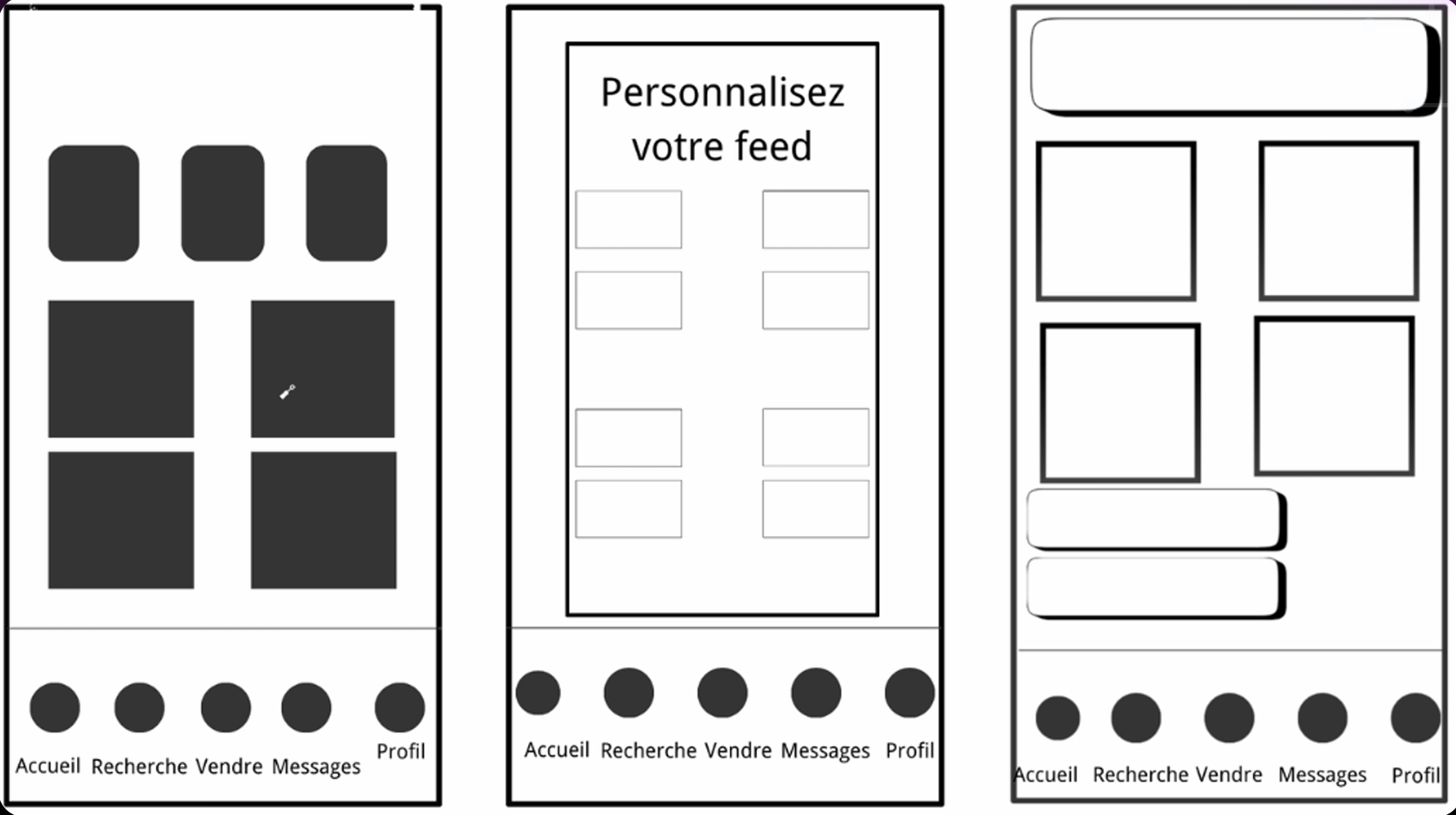
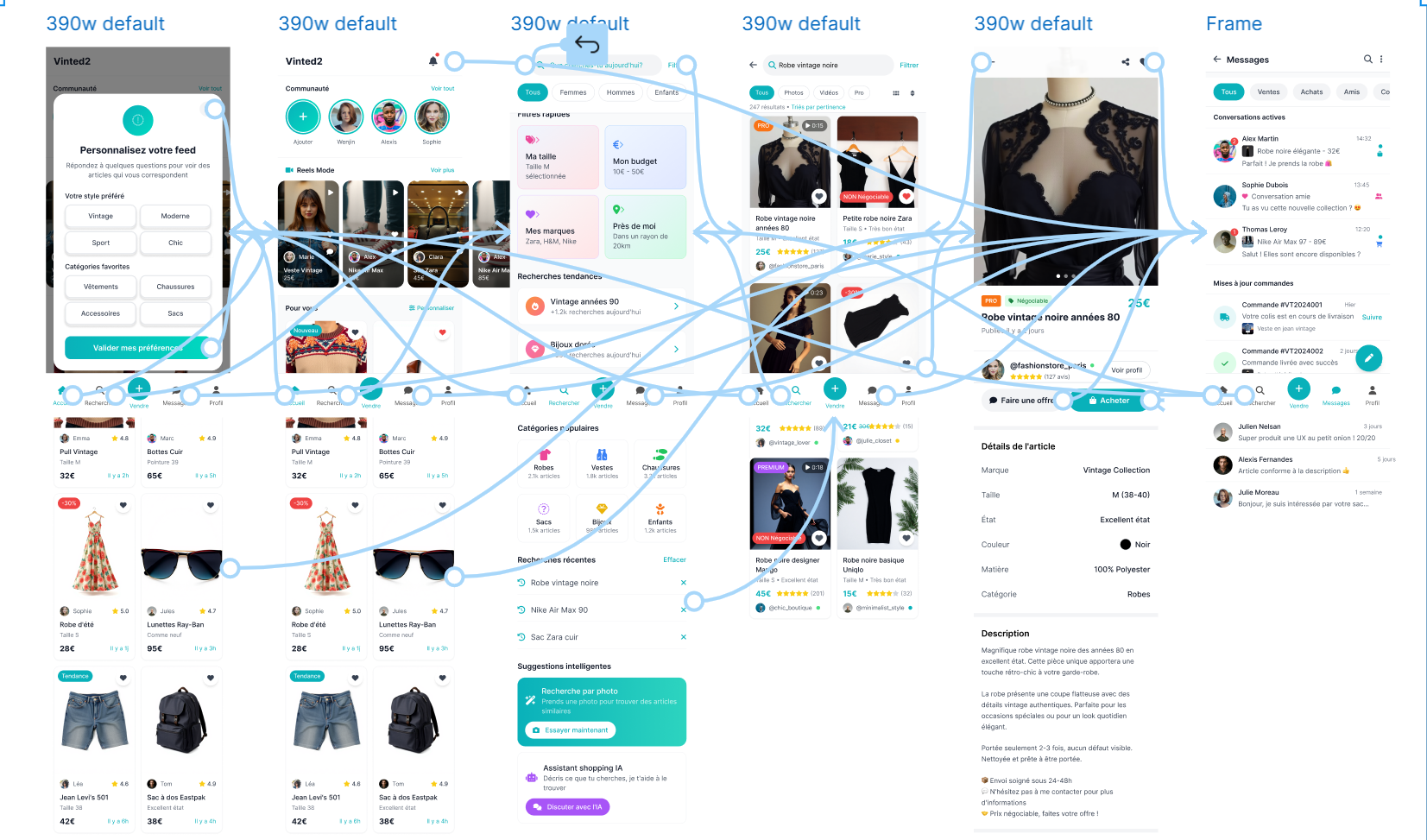
Research insights were directly translated into design solutions. Lo-fi wireframes first to test navigation logic, then an interactive Figma prototype integrating: seller photo standardization, upfront display of real fees, seller responsiveness badges, pre-formatted messages to ease exchanges, and enriched search filters.
UX Recommendations
Critical Study Reflection
Key Takeaways
This research confirms that cart abandonment on Vinted is not a single-cause issue, but the result of an accumulation of doubts and negative social signals that create an anxiety-laden experience. Second-hand buying is inherently a risky purchase: users accept this risk only when three conditions are met - significantly lower price than new, sufficient quality confirmation, and a trustworthy seller. When one condition is missing, the user abandons.
The mixed-methods approach - semi-structured interviews, Think Aloud observations, and IRaMuTeQ lexical analysis - enabled comprehensive mapping of both conscious pain points and latent concerns that quantitative metrics alone would never have revealed.
Trust is not a feature. It is an emergent property of a coherent, transparent, and responsive system.
Method triangulation (declarative, behavioral, textual) is the only way to access the three truth levels of user behavior.
Figma prototype user testing, A/B testing of upfront fee display, and complementary quantitative study (500+ users) to validate findings at scale.
Lessons Learned
With more resources and time, three choices would have been made differently. This retrospective documents the trade-off decisions inherent to a 10-week academic project with two researchers and zero budget.
11 interviews were deemed sufficient by calendar constraint. With 3 extra weeks, we would have recruited 6 underrepresented 40-65 year-olds and 4 non-Parisian users to correct the geographic bias. Thematic saturation had not been reached on the 'seller mediation' variable.
Zero budget = Figma prototype never tested in real conditions. With 150-200 euros, we would have run 4 paid user testing sessions on the hi-fi prototype to measure the real impact of recommendations 01 (standardized photos), 03 (responsiveness badges), and 05 (upfront fees) before the final presentation.
The study documents only the buyer perspective. The missing symmetry: understanding why sellers ghost (message overload, lack of tools, no training). Without this perspective, recommendations 03 and 04 (badges, pre-formatted messages) remain one-sided and risk creating new friction on the seller side.